
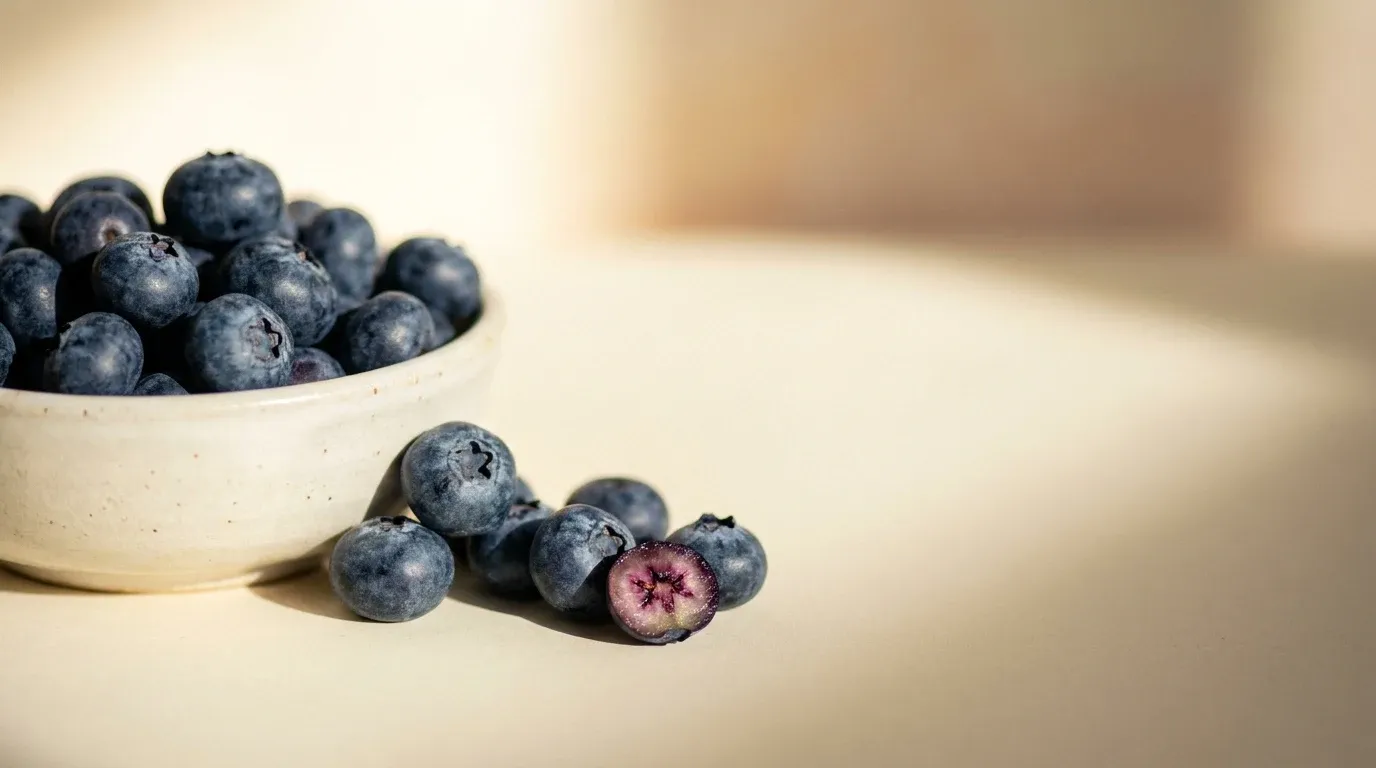
A September 2026 study out of Japan added a small but genuinely interesting piece to the body composition puzzle. Researchers identified pterostilbene, a natural polyphenol compound found in blueberries, grapes, and a handful of other berries, as a potential driver of a metabolic shift in muscle cells. Specifically, the compound appears to push muscle cell metabolism toward burning fat rather than storing it. That's worth unpacking, especially if you're currently in a cut or recomp phase.
This isn't a magic berry story. But it's not nothing either. Here's what the research actually found, what it means for your training nutrition, and where it fits into everything else you already know about building lean muscle.
What Is Pterostilbene and Where Does It Come From?
Pterostilbene (pronounced tero-STILL-bean) is a stilbenoid compound, structurally similar to resveratrol, the polyphenol that made red wine briefly famous in nutrition circles. It occurs naturally in blueberries, muscadine grapes, bilberries, and cranberries. Blueberries are the most accessible and consistently concentrated source for most people.
What makes pterostilbene biochemically interesting is its bioavailability. Compared to resveratrol, it crosses cell membranes more efficiently and has a longer half-life in the body, meaning a higher proportion of what you consume actually reaches the tissues where it can act. Earlier research had flagged it for antioxidant and anti-inflammatory properties, but the September 2026 Japanese study took a more targeted look at skeletal muscle specifically.
That specificity matters. Skeletal muscle is the body's largest metabolic tissue. How it handles lipids, whether it oxidizes fatty acids for fuel or packages them for storage, has direct consequences for body composition over time.
What the Japanese Study Actually Found
The research team exposed skeletal muscle cell lines to pterostilbene and tracked changes in metabolic activity. The compound appeared to upregulate pathways associated with fatty acid oxidation, essentially signaling muscle cells to pull in and burn fat rather than store it as intramuscular lipid. The mechanism involved activation of AMPK (adenosine monophosphate-activated protein kinase), a cellular energy sensor that's already a well-established target in metabolic research.
AMPK activation is significant because it's the same pathway engaged during aerobic exercise and caloric restriction. When AMPK is switched on, the cell interprets the signal as low energy availability and ramps up fat burning in response. Pterostilbene appears to partially mimic that signal at the cellular level.
It's worth noting that this was a cell study, not a randomized controlled trial in humans. Cell findings don't always translate directly into meaningful real-world outcomes. The compound behaved in a compelling way in a controlled lab environment. What happens in a training human eating a mixed diet is more complicated.
Why This Matters for Lifters on a Cut or Recomp
If you're cutting, your primary challenge is maintaining muscle tissue while creating enough of a calorie deficit to drop body fat. If you're recomping, you're trying to do both simultaneously, which requires precise nutrition and generally works best in people with some training history and room for metabolic optimization.
In both contexts, any compound that nudges muscle cells toward fat oxidation rather than lipid storage is theoretically useful. It doesn't replace the deficit, the protein targets, or the training stimulus. But it could function as a supporting variable, something that makes the metabolic environment in your muscle tissue slightly more favorable for fat loss.
The practical version of this is simple: eat blueberries. A cup of fresh blueberries (roughly 150g) delivers somewhere between 4mg and 6mg of pterostilbene depending on the variety and growing conditions. That's a modest dose, and the study didn't establish a definitive human threshold. But it's a real food with legitimate micronutrient density, solid fiber content, and a low glycemic impact, all of which already make it a reasonable addition to a body composition-focused diet.
Whole food delivery is worth prioritizing over supplements here, for now. The supplement industry moves fast, and pterostilbene capsules already exist. But as ingredient testing doesn't always predict how a supplement performs in your body, the gap between a promising lab finding and a reliable encapsulated product is significant. Eating the actual berry keeps you closer to the compound in its natural matrix, alongside the other polyphenols and fiber that may influence its absorption and activity.
Realistic Expectations: What Berries Can and Cannot Do
Let's be direct. Blueberries are not going to strip body fat on their own. No single food does. The foundations of body recomposition don't change because of this study.
- Calorie balance remains the primary driver. You can eat a pound of blueberries daily and still gain fat if you're in a sustained surplus. The metabolic nudge from pterostilbene doesn't override energy balance.
- Protein synthesis is still the anchor of muscle retention. During a cut, adequate protein intake (most evidence clusters around 0.7 to 1g per pound of bodyweight) is what keeps your muscle tissue from being catabolized. No berry compound substitutes for that.
- Training stimulus drives adaptation. The reason muscle cells respond to metabolic signals at all is because resistance training has conditioned them to. An untrained muscle in a sedentary person is a different biological environment than a trained muscle that's been stress-adapted over months or years.
- Sleep and recovery modulate every metabolic outcome. AMPK activity, protein synthesis rates, fat oxidation efficiency. all of these are influenced heavily by sleep quality and stress load. If you're sleeping poorly, the metabolic environment in your muscle tissue is already compromised before you eat a single berry.
What blueberries can realistically do is contribute to a nutritional environment that supports your goals. They're low in calories, high in antioxidants that may reduce exercise-induced oxidative stress, and now there's reasonable mechanistic evidence that their pterostilbene content could support fat metabolism at the cellular level. That's a genuinely good food, not a supplement that replaces work.
Where This Fits in Broader Muscle Nutrition Science
The pterostilbene finding is part of a broader and accelerating body of research on how secondary plant compounds influence skeletal muscle metabolism. Quercetin, curcumin, EGCG from green tea, and now pterostilbene are all being examined for their capacity to modulate pathways like AMPK, mTOR, and PGC-1 alpha, which sit at the intersection of fat metabolism, muscle protein synthesis, and mitochondrial biogenesis.
None of these compounds, individually, produce the magnitude of effect that training and diet do. But the scientific conversation is shifting away from treating nutrition as purely macronutrient math toward a more nuanced understanding of how phytochemicals interact with muscle physiology. That's a useful evolution in how coaches and athletes think about food quality, not just food quantity.
For context, it's a similar conversation happening around recovery modalities. Research on topics like cold plunge protocols after training illustrates how interventions that seem minor can either support or undermine adaptation depending on timing, dosage, and context. The principle applies to nutrition too. The supporting variables matter, but they don't override the primary variables.
There's also a broader pattern worth recognizing. The more science examines whole foods with their full chemical complexity, the more it finds that the matrix matters. A berry contains hundreds of compounds working in concert. Isolating one and capsulizing it almost always produces a weaker, less predictable effect than the whole food. That's not an argument against all supplementation, but it is an argument for keeping whole food intake as your foundation.
How to Actually Use This Information
If you're already eating a reasonably structured diet around your training, adding a serving of blueberries daily is a low-cost, low-effort optimization with a reasonable evidence base behind it. It fits naturally into a pre-workout meal, a Greek yogurt bowl, or a post-training smoothie with protein powder.
If you're building out a more complete approach to your training nutrition, understanding how gut health compounds like postbiotics and probiotics interact with your diet is another layer worth examining. The gut microbiome influences how efficiently you absorb and metabolize polyphenols, including pterostilbene, so building a robust dietary foundation supports the effectiveness of every individual food you're eating.
And if you're thinking more broadly about what optimizes your body composition progress, the training variables beyond pure lifting deserve attention too. Many serious lifters are integrating Pilates in 2026 specifically for the structural and movement quality benefits that improve training longevity. More productive training sessions mean a more responsive metabolic environment. Pterostilbene works better in a muscle that's being trained hard and recovered well.
The bottom line: this is a legitimate finding that adds a useful layer to how you think about food quality during a cut or recomp. Eat your blueberries. Keep your protein high, your training consistent, and your deficit controlled. The berry helps the machine. It doesn't replace it.