
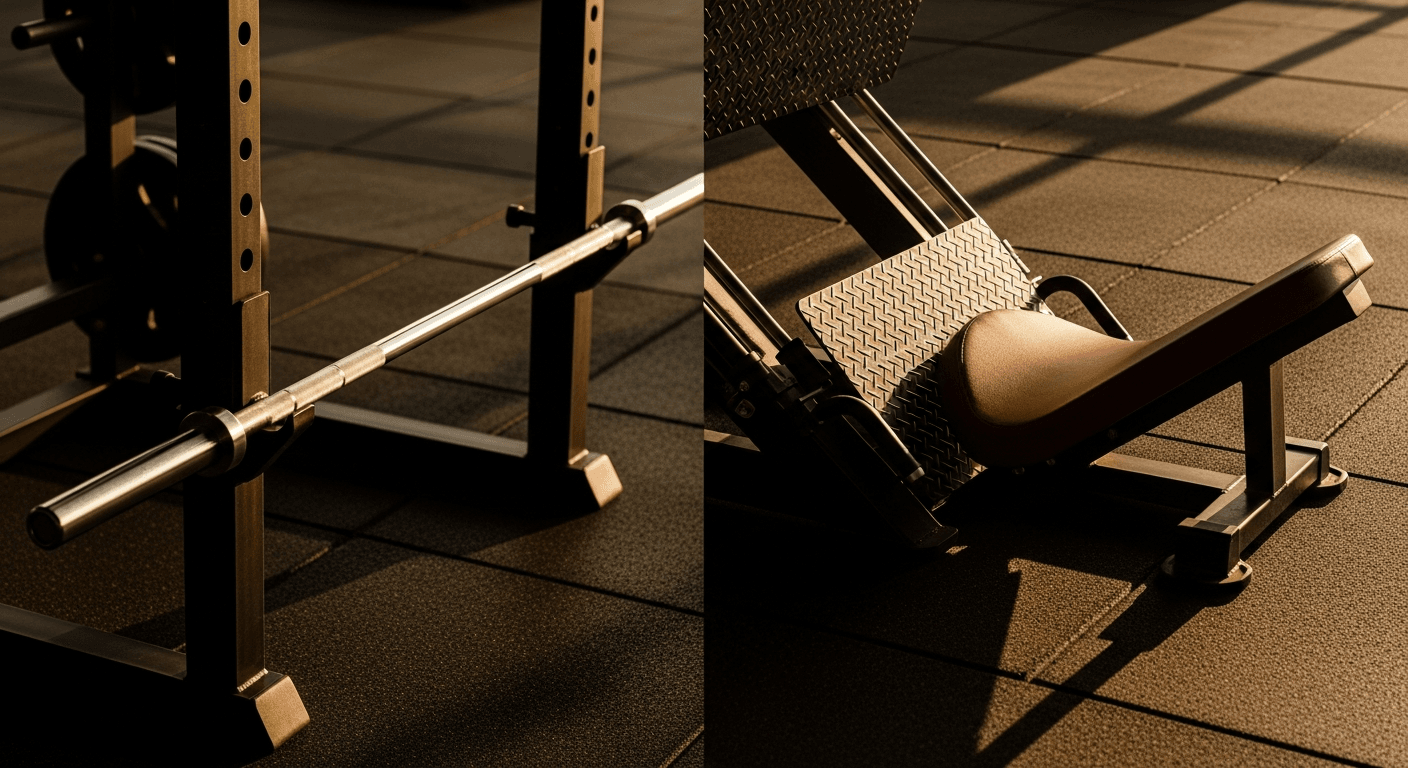
Do You Actually Need Squats to Build Strong Legs?
Ask almost any personal trainer what belongs on leg day, and squats will be the first word out of their mouth. The barbell back squat has held near-mythical status in strength training for decades. It's demanding, it's compound, and it builds serious lower body mass. Nobody's disputing that.
But here's the thing: a growing body of exercise science research suggests the squat isn't irreplaceable. If you're avoiding it because of knee pain, hip impingement, or limited ankle mobility, you're not leaving progress on the table. You're just picking it up from a different shelf.
The Squat Is Effective. It's Not Sacred.
The squat loads the quadriceps, glutes, hamstrings, and adductors across a demanding range of motion. It also challenges your core, your balance, and your coordination. That's a lot of value packed into one movement, which explains why it became the default lower body exercise for generations of lifters.
What research now makes clear, however, is that several other exercises produce comparable muscle growth when performed with sufficient effort. Studies comparing the leg press and hack squat to the barbell squat have found no statistically significant difference in quadriceps hypertrophy when training volume and proximity to failure are matched. Your quads don't know what exercise you're doing. They respond to mechanical tension, metabolic stress, and muscle damage.
The Bulgarian split squat, in particular, has drawn serious scientific attention. Because it loads one leg at a time with a large range of motion, it generates substantial quad and glute activation. Research shows it produces equivalent hypertrophy to bilateral squatting patterns, while placing lower compressive forces on the spine. For athletes and recreational lifters alike, that's a meaningful distinction.
When Squats Are Clinically the Wrong Choice
Here's a number worth sitting with: roughly 25 to 30 percent of people who exercise regularly report some form of knee pain. Hip impingement, a condition where the ball of the hip joint pinches against the socket during deep flexion, affects a significant segment of active adults as well. For both groups, the standard squat pattern can aggravate symptoms rather than build capacity.
That's not a fringe population. That's a large portion of the people in any commercial gym on any given morning.
It's also worth acknowledging that sedentary living is damaging joints earlier than you think, meaning more people are arriving at the gym with pre-existing structural issues than previous generations did. They need effective alternatives, not advice to push through pain.
Clinically, physical therapists and sports medicine practitioners routinely prescribe leg press, step-ups, terminal knee extensions, and split squat variations as rehabilitation tools precisely because they can be loaded heavily without reproducing the pain patterns that squats trigger. If your joints are flagging you, that signal deserves respect, not suppression.
Range of Motion Matters More Than the Exercise Name
One of the most significant shifts in hypertrophy research over the past decade concerns range of motion. The emerging consensus is that training a muscle through a full or long range of motion produces greater hypertrophy than partial-range alternatives, regardless of the specific exercise used.
This finding has real implications for squat alternatives. A leg press performed with a high foot position and deep range of motion, for example, places the quads under substantial stretch at the bottom of the movement. Research suggests that this stretched position may be where the greatest hypertrophic stimulus occurs. The same logic applies to Romanian deadlifts for hamstrings, or sissy squats for quad isolation.
The practical takeaway is straightforward: if you're choosing an alternative to squats, prioritize exercises that allow your target muscles to move through their full working range. A shallow leg press with excessive load does less for you than a controlled, deep rep with moderate weight.
This principle also applies to women. Research across 126 studies confirms that women should follow the same strength training programming as men when it comes to exercise selection, intensity, and volume. There's no biological reason for women to avoid heavy leg training or to treat squat alternatives as a lesser option.
The Best Squat Alternatives, and What They Each Target
If you're building a leg program without the barbell squat at its center, here are the movements that deliver the most evidence-backed results:
- Leg press: Highly adjustable, joint-friendly, and capable of loading the quads and glutes with substantial volume. Foot position changes the emphasis. A lower, narrower stance targets the quads more directly.
- Bulgarian split squat: One of the most effective unilateral movements available. It loads the front leg through a deep range of motion, challenges hip flexor flexibility, and addresses left-right imbalances that bilateral squatting can mask.
- Hack squat machine: The guided movement path reduces the balance and stability demand of a free barbell squat, making it easier to push closer to failure. Hypertrophy research on this movement is favorable.
- Step-ups: Underrated for glute development, particularly when performed with a high step height and a slow, controlled descent. They also improve single-leg stability in a way that most machine work doesn't.
- Romanian deadlift: The primary driver of hamstring hypertrophy in most programs. Performing it with a slight knee bend and a controlled hip hinge loads the hamstrings under stretch, which current research identifies as particularly effective.
- Leg extension and leg curl: Isolation exercises that shouldn't be dismissed. When combined with compound movements, they allow you to target the quads and hamstrings with additional volume without adding axial load to the spine.
Programming for Long-Term Leg Development
The strongest argument for squat alternatives isn't that squats are bad. It's that variety across different movement patterns builds more resilient legs over time.
When you train exclusively with one movement, your body adapts not just in the muscles but in the specific neuromuscular pattern that exercise demands. That creates a narrow competency. Mixing bilateral and unilateral movements, machine and free-weight exercises, and different loading angles distributes stress across tissues more evenly and reduces overuse injury risk.
There's also the longevity factor. This matters especially if you're training into your forties, fifties, and beyond. Getting stronger after 50 requires habits that prioritize joint health alongside muscle stimulus. That often means shifting the emphasis away from high-load barbell squatting and toward a more varied approach that keeps you training consistently for years, not months.
A well-structured leg program might look something like this across a week: one session anchored by the leg press or hack squat as the primary quad movement, one session built around Bulgarian split squats and Romanian deadlifts, and targeted isolation work woven into both. That's a complete stimulus for lower body development without a barbell squat in sight.
Effort, Not Exercise Selection, Is the Deciding Variable
Here's what the research keeps circling back to: proximity to failure is the most important variable in producing hypertrophy. In practical terms, that means the exercise that allows you to train hard and consistently, without pain, without avoidance, and without cutting sessions short, is the exercise that will give you the best results.
If squats hurt, and you perform them anyway with distracted form and reduced range of motion because you're guarding the painful joint, you're getting less stimulus and more risk than someone who loads a leg press to a hard set of ten with full depth. The superior exercise on paper becomes inferior in practice the moment it stops being executed well.
This is also where overall lifestyle factors enter the picture. Recovery quality, nutrition, and sleep all determine how much you get from your training regardless of the exercises you choose. Ultra-processed foods quietly degrade muscle mass and slow recovery in ways that undermine even the most dialed-in programming.
And if you're newer to structured training and wondering whether intensity and volume really matter that much, brief intense workouts carry real, documented health benefits that support the idea that shorter sessions taken to high effort outperform longer sessions done at low intensity.
The Bottom Line on Leg Training
Strong legs don't require squats. They require sufficient mechanical tension on the quadriceps, hamstrings, glutes, and adductors, applied with enough volume and effort over enough time to drive adaptation. The squat is one delivery mechanism for that stimulus. It's not the only one, and for a significant portion of people, it's not the best one.
If you squat without pain and you enjoy it, keep squatting. If you don't, stop treating every alternative as a compromise. The leg press, the Bulgarian split squat, the hack squat, and a well-constructed isolation protocol can build legs that are every bit as strong and developed as those built under a barbell. The science says so. Your programming should reflect that.