

There's a quiet revolution happening in gyms, pools, and parks around the world. People are walking away from high-impact, punishment-style workouts and toward something smarter. Not easier. Smarter. And the science is firmly on their side.
The rise of Japanese interval walking as one of 2026's most talked-about fitness trends isn't a coincidence. It reflects a broader shift in how people think about exercise: you don't need to grind your joints into dust to get strong, lean, and fit. You just need to train intelligently.
What Japanese Interval Walking Actually Proves
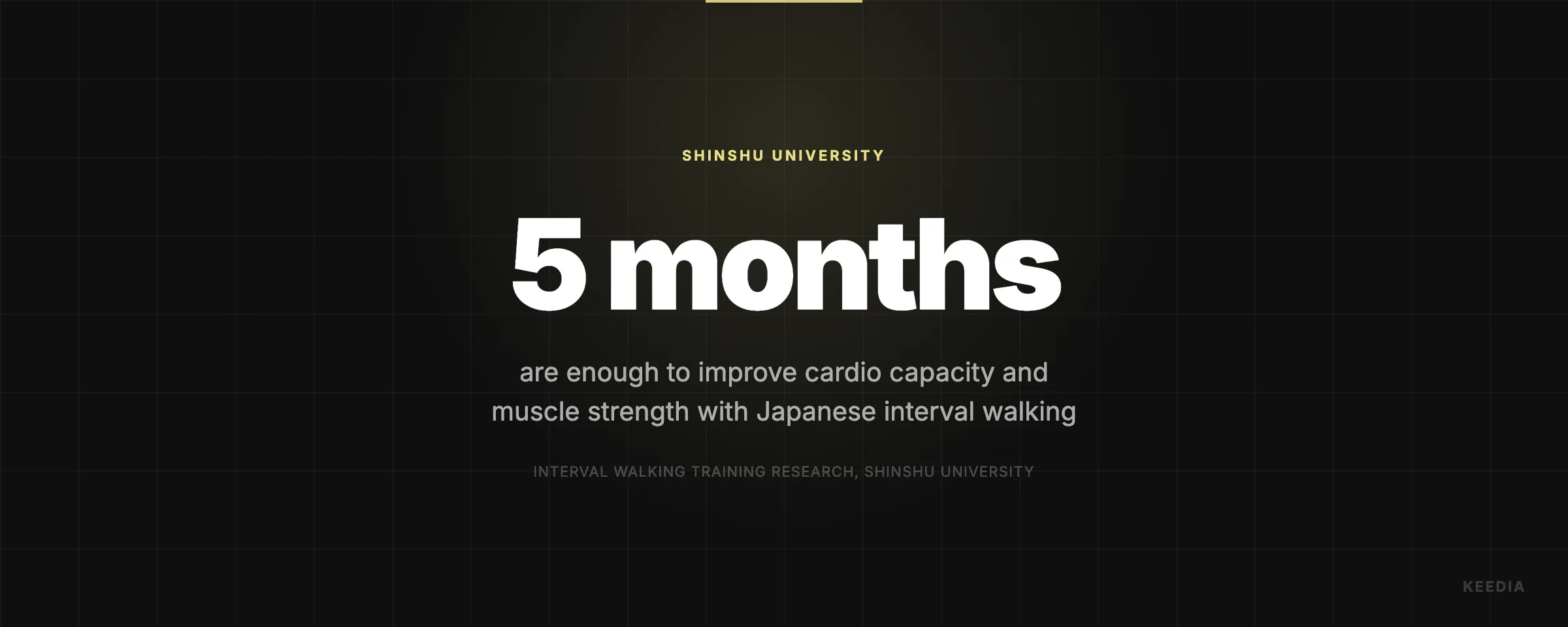
Researchers at Shinshu University developed a specific interval walking protocol where participants alternate between three minutes of brisk walking at roughly 70% of peak aerobic capacity and three minutes of slow walking. Repeated five times per session, five days a week, the results were striking. Participants showed significant improvements in cardiovascular fitness, leg muscle strength, and blood pressure. Some markers improved by 10 to 20 percent over five months.
What makes this research so useful isn't just that the results are good. It's that they're comparable to higher-intensity protocols. That's the critical point. You don't need impact to drive adaptation. You need stimulus, consistency, and progressive challenge.
This is also consistent with a growing body of evidence suggesting that variety in your training approach pays long-term dividends. As explored in mixing up your workouts could help you live longer, rotating training modalities isn't just good for motivation. It may actually extend your healthspan.
Low-Impact Does Not Mean Low-Results
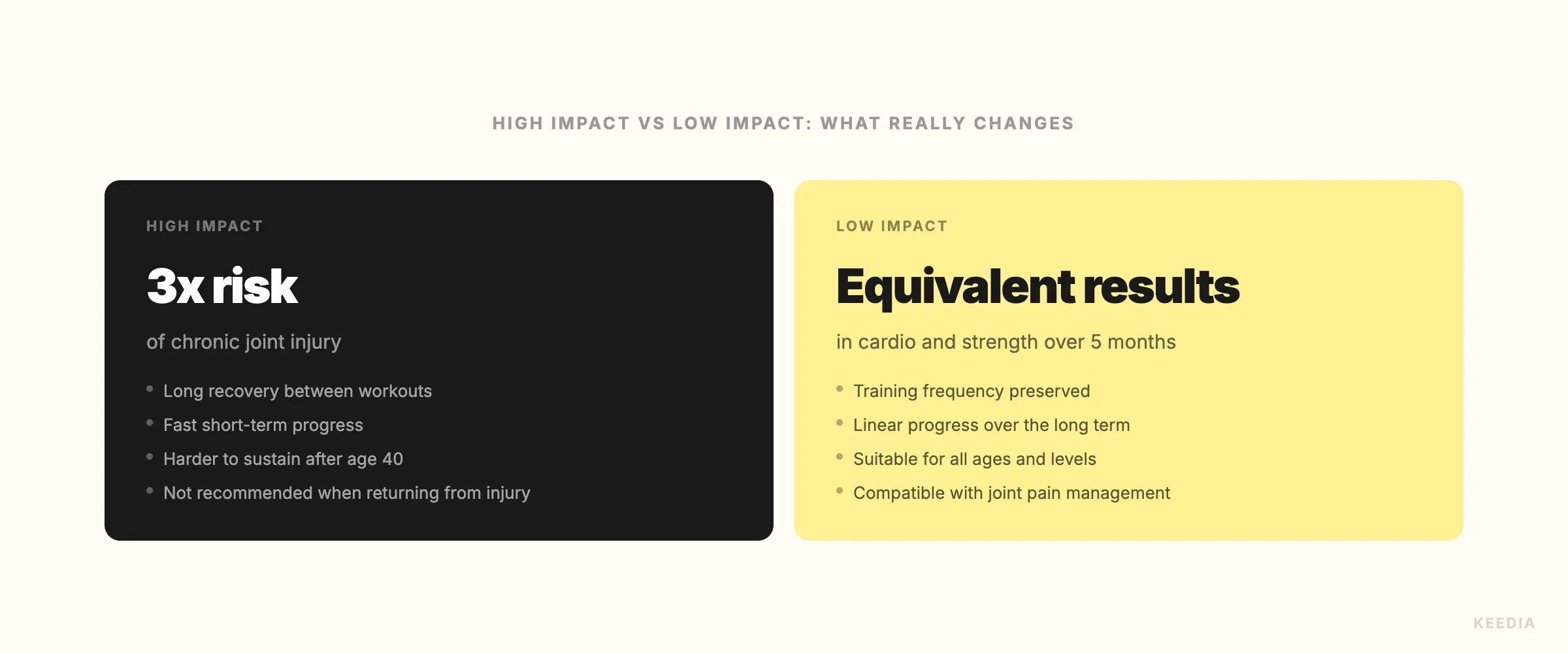
This is the biggest misconception standing between most people and a training approach that actually works for their body. Impact and intensity are two completely separate variables. You can have high intensity with zero impact (cycling at threshold, hard swimming sets, resistance band circuits). You can also have high impact with low intensity (a gentle jog that still hammers your knees).
Once you separate these two ideas, the whole calculus changes. You're no longer choosing between "effective" and "joint-friendly." You're choosing how to combine modality, volume, and intensity to get the result you want without the injury risk you don't need.
This matters practically. A 45-year-old returning from a knee injury doesn't need to give up strength training or cardiovascular fitness. They need to find ways to apply progressive overload through variables that don't stress damaged tissue. That's not a compromise. That's intelligent programming.
Building a Complete Low-Impact Training Week
A well-designed low-impact week hits all the major physical qualities: cardiovascular endurance, muscular strength, mobility, and recovery. Here's how a seven-day structure might look for someone training four to five days:
- Day 1: Japanese Interval Walking (30-40 minutes). Three minutes brisk, three minutes easy, repeat five to six times. Done outdoors or on a treadmill. This is your primary aerobic session.
- Day 2: Resistance Band Full-Body Circuit. Banded squats, rows, hip hinges, shoulder presses, and glute bridges. Three rounds, 12-15 reps each. Bands create tension through the full range of motion with zero joint compression from load.
- Day 3: Swimming or Cycling (45 minutes). Steady-state or include two to three higher-effort intervals. Both modalities are completely non-weight-bearing and effective for cardiovascular development.
- Day 4: Active Recovery and Mobility. Twenty to thirty minutes of targeted mobility work. Focus on hips, thoracic spine, and ankles. This isn't optional filler. It directly supports your training quality on harder days.
- Day 5: Interval Walking or Low-Impact Strength. Rotate based on how your body feels. If energy is high, repeat the band circuit with slight volume increases. If it's moderate, walk.
Two rest days round out the week. Actual rest. Not guilty rest. Sleep, free and proven recovery strategies like contrast showers and light stretching, and good nutrition all count as training investments.
Progressive Overload Without the Punishment
The engine of all fitness progress is progressive overload: giving your body slightly more stimulus over time than it's adapted to. Most people associate this exclusively with adding weight to a barbell. But that's just one lever. Low-impact training has plenty of others.
You can progress by:
- Increasing walking intervals. Start with five rounds of interval walking, build to eight over six to eight weeks.
- Extending session duration. Add five minutes to your swim or cycling session every two weeks.
- Increasing band resistance. Move from light to medium to heavy resistance bands as your strength develops.
- Adding sets. Progressing from two sets to three to four per exercise drives significant volume-based adaptation.
- Reducing rest periods. Keeping work the same but shortening rest increases cardiovascular demand without adding impact.
This approach keeps injury risk low while still creating the consistent forward pressure your body needs to change. You're not plateauing. You're building systematically.
One often-overlooked component in this kind of programming is glute development. The glutes are your largest and most metabolically active muscle group. Training them effectively with low-impact tools is very achievable. Glute bridges and hip thrusts, for example, are entirely joint-friendly and exceptionally effective. If you want to go deeper on technique, the complete guide to hip thrusts for stronger glutes covers everything from setup to progression.
Who Benefits Most From Low-Impact Training
Low-impact training isn't a fallback for people who "can't" do real exercise. But there are specific populations for whom it's genuinely the most effective approach available.
Beginners. If you're new to structured exercise, the biggest risk to your progress isn't under-training. It's injury and burnout from doing too much too soon. A low-impact foundation builds aerobic capacity, motor patterns, and connective tissue strength before layering in higher demands. Starting here isn't slow. It's smart.
People over 40. After 40, recovery time extends and connective tissue becomes more vulnerable to repetitive stress. This doesn't mean your results need to decline. It means the cost-benefit analysis of high-impact methods shifts. Low-impact approaches deliver comparable adaptations with a fraction of the recovery debt.
People returning from injury. Returning to training after a soft tissue injury, stress fracture, or joint procedure requires rebuilding capacity without re-stressing healing structures. Low-impact training gives you a way to stay active, maintain fitness, and progress without gambling on your recovery timeline.
People managing chronic joint pain. Conditions like osteoarthritis, plantar fasciitis, or chronic knee pain don't require you to stop training. They require you to train differently. Water-based exercise, resistance bands, and interval walking are all well-supported by clinical research for these populations.
It's also worth noting that comparing traditional barbell movements like squats and deadlifts to hip-dominant alternatives reveals that you don't always need heavy axial loading to produce strong lower-body adaptation. The evidence for band-based and bodyweight progressions is more robust than most people realize.
Fueling a Low-Impact Program
Nutrition strategy for low-impact training follows the same foundational principles as any other approach: adequate protein, sufficient total energy, and micronutrient support for recovery. Where it sometimes differs is in total caloric need, particularly if you're shifting from higher-volume cardio to a more moderated approach.
Protein targets around 1.6 to 2.2 grams per kilogram of bodyweight remain relevant regardless of training intensity. This range supports muscle protein synthesis whether you're doing heavy barbell work or resistance band circuits.
For those interested in evidence-based supplementation alongside a low-impact program, the research landscape has expanded meaningfully. a review of plant-based muscle support ingredients covers several options with credible research behind them, which is useful context if you're optimizing nutrition around a training approach that prioritizes longevity over peak output.
The Bigger Picture
The fitness industry spent decades selling intensity as the primary marker of a worthwhile workout. No pain, no gain. That framing served some people well and left a lot of others injured, burned out, or simply not training at all.
Low-impact training represents a more complete understanding of how adaptation actually works. Your body responds to stimulus, not suffering. It responds to consistency over months and years, not to the hardest possible session on any given day. Protecting your joints, managing your recovery, and building progressively isn't a shortcut. It's the whole game.
Whether you're 28 and managing an old knee injury, 45 and training around a demanding job, or 62 and looking to stay strong for the next twenty years, a well-built low-impact week delivers what you need. Real cardiovascular fitness. Real strength. Real body composition progress. And a body that holds up long enough to keep showing up.
That's not a compromise. That's the point.