
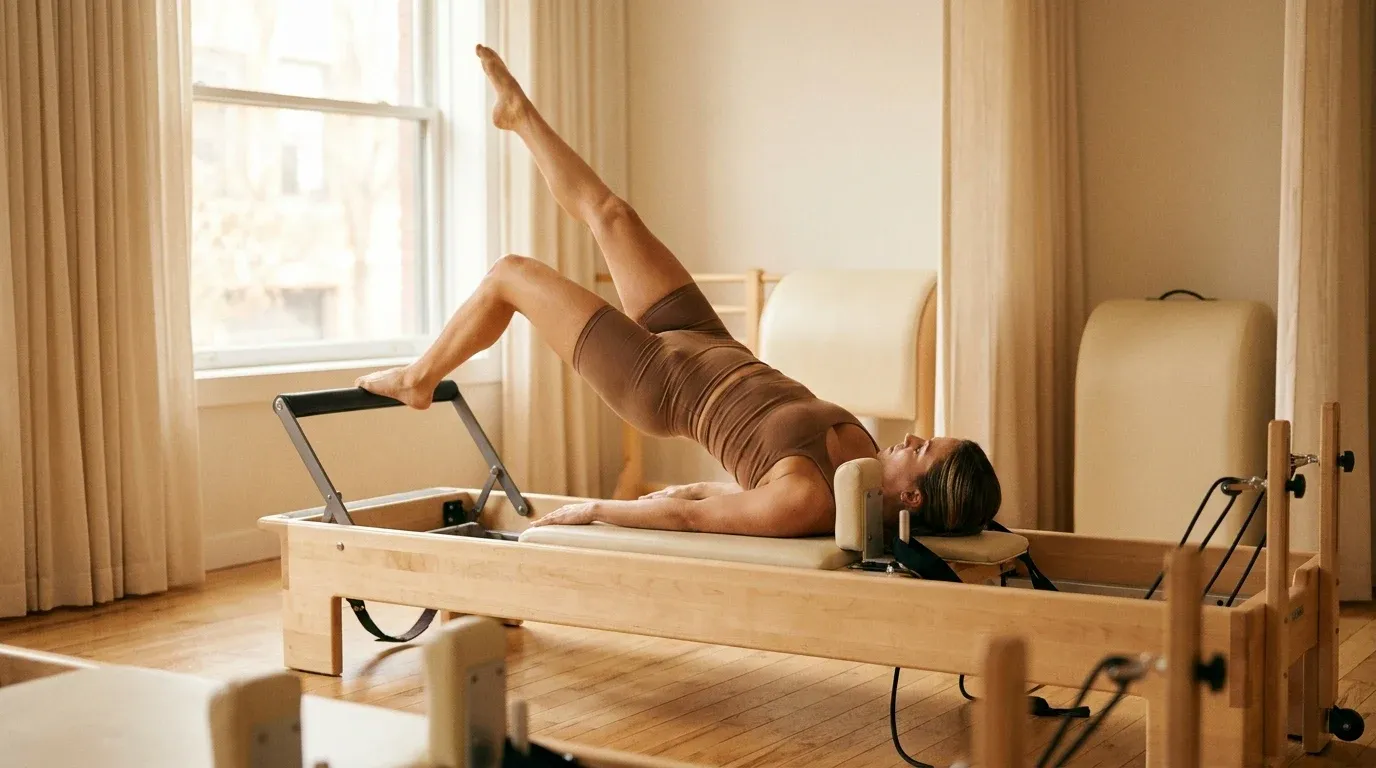
If you've spent years under a barbell, the word "Pilates" probably conjures images of reformer machines, slow music, and light resistance. That reputation is outdated. In 2026, serious lifters, powerlifters, and competitive athletes are integrating Pilates into their programming, not to stretch more, but to get stronger where compound movements don't reach.
Here's what changed: the fitness industry's understanding of stabilizer muscle function has matured, and the evidence supporting Pilates as a performance tool, not just a recovery class, has grown considerably. This isn't about replacing your squat day. It's about reinforcing the infrastructure that makes your squat safer and more powerful over time.
Pilates Is Not What You Think It Is Anymore
Modern Pilates, particularly the equipment-based and clinical variants that have gained traction in performance settings, prioritizes deep muscle activation over passive flexibility. The focus is on the transversus abdominis, multifidus, pelvic floor, and hip stabilizers. These are the muscles that control joint position, manage intra-abdominal pressure, and protect spinal segments under load.
This is a fundamentally different goal than what most lifters associate with flexibility work. You're not trying to stretch your hamstrings. You're training your nervous system to coordinate the small, often underloaded muscles that keep your joints tracking correctly during heavy compound lifts.
Contemporary Pilates programming also incorporates progressive overload logic. Resistance on reformer machines is adjustable and tracked. Movement complexity increases systematically. That's a strength training framework, not a wellness class format.
Stabilizer Weakness Is a Structural Problem in Barbell Training
Compound barbell movements are extraordinarily effective at building global strength. Squats, deadlifts, bench press, and overhead pressing all demand significant output from large prime movers. That's their advantage. But that same efficiency creates a blind spot.
When your nervous system is optimizing for maximal force output, it tends to bypass stabilizer recruitment in favor of prime movers. Over time, this creates functional imbalances. Your quads drive the squat, but your hip external rotators and deep lumbar stabilizers may not be developing at the same rate. The result isn't always pain. Often it's a subtle breakdown in form at higher percentages, reduced performance ceiling, or a nagging injury that never fully resolves.
Research consistently shows that athletes who train exclusively with high-load compound movements exhibit lower activation of deep stabilizer muscles compared to those who include targeted stabilization work. This is not a flaw in barbell training. It's a gap you can fill strategically.
It's also worth noting that grip and extremity stability matter as much as spinal control. Grip strength is a better health predictor than most lifters realize, and developing it alongside core stability creates a more complete structural base for heavy training.
The Industry Signal: NordicTrack's Pilates Pivot in 2026
One of the clearest indicators that Pilates has crossed into mainstream performance fitness is NordicTrack's August 2026 expansion into Pilates content and connected reformer programming. NordicTrack built its brand on treadmills and strength equipment. Its pivot toward Pilates reflects where demand is coming from: not yoga studios, but existing fitness consumers who lift and run and want structured recovery and stabilization work built into their ecosystem.
When a company that markets to serious home gym users starts investing in Pilates programming, it's responding to a real behavioral shift. Fitness technology brands don't move into new categories without meaningful signal from their existing user base. That signal is lifters looking for structured supplemental work that doesn't require a separate gym membership or a completely different training philosophy.
This mirrors broader market movement. The global functional fitness equipment market has expanded substantially since 2022, with reformers and cable-based stability equipment increasingly showing up in commercial and home gym settings outside of dedicated Pilates studios.
What the Research Actually Shows
The evidence base for Pilates as a performance tool has grown well beyond its clinical rehabilitation origins. Studies in sports medicine and exercise science now examine Pilates in the context of athletic populations, not just lower back pain patients.
Key findings from recent research include:
- Core stability transfer: Pilates training produces measurable improvements in trunk muscle endurance and deep core activation patterns that carry over to sport-specific and gym-based movement tasks.
- Spinal health outcomes: Regular Pilates practice is associated with reductions in non-specific lower back pain, improved lumbar mobility, and better control of spinal load during functional movements.
- Movement quality: Athletes who added Pilates to existing training programs showed improvements in balance, proprioception, and joint position sense. These are factors that directly influence technique consistency under fatigue.
- Injury prevention: Several studies in athletic populations link stabilizer-focused training, including Pilates protocols, to lower rates of knee and hip injuries, particularly in movements involving single-leg loading.
Movement quality improvements are particularly relevant for lifters. When you're fatigued at the end of a heavy session, what keeps your form intact isn't motivation. It's the automatic, low-level muscle coordination that your nervous system has trained to handle load. Pilates develops exactly that coordination.
Recovery quality matters here too. If your sleep is disrupted or inconsistent, your ability to adapt to any training stimulus, including stabilization work, is compromised. Sleep consistency has a larger impact on training adaptation than most athletes account for, and it's worth auditing before adding training volume of any kind.
Joint Resilience Over Time
One of the least discussed benefits of stabilizer training is long-term joint resilience. Lifters who train for years accumulate repetitive stress on knees, hips, shoulders, and lumbar segments. Some of that is unavoidable. But a meaningful portion of joint degradation in lifters comes not from load itself, but from poor joint centration during load. That means the joint isn't moving through its optimal path, and soft tissue structures absorb stress they weren't designed to handle.
Pilates directly targets joint centration through controlled, low-load movements that reinforce the neuromuscular patterns responsible for keeping joints aligned. You're essentially teaching your body to move better before adding weight, which then changes how your body handles weight.
This is also why Pilates is increasingly used alongside cold and heat recovery protocols in elite training environments. Understanding which recovery tool actually matches your training stress matters when you're stacking multiple modalities. Pilates fits into a recovery-day structure without the systemic fatigue load of an extra lifting session.
How to Add Pilates Without Disrupting Your Strength Block
The practical question most lifters have is simple: where does this fit without costing me gains? The answer depends on your current training frequency and recovery capacity, but the general framework is straightforward.
Start with one session per week. Place it on a rest day or after a lower-intensity training session. A 45-60 minute reformer or mat-based Pilates session on a Wednesday rest day, for example, adds stabilization stimulus without interfering with Monday/Tuesday or Thursday/Friday lifting performance.
Prioritize lower body and core-focused sessions first. Hip stability, single-leg control, and lumbar stabilization work will deliver the fastest transfer to squat and deadlift mechanics. Ask your instructor to focus on footwork series, hip mobility with load, and spinal articulation patterns.
Add a second session only after four to six weeks. Once you've confirmed that one weekly session doesn't negatively affect recovery or performance, add a second. Place it on a light upper body or active recovery day. Two sessions per week is the research-supported dose for stabilization adaptations to accumulate.
Communicate your goals clearly. If you're working with a Pilates instructor, tell them you're a strength athlete. A good instructor will program differently for you than for someone coming in with no training background. You want neuromotor control and stabilizer activation, not flexibility-first sequencing.
Track performance markers, not just how you feel. Monitor whether your form holds later into heavy sets, whether nagging joint discomfort improves, and whether your movement quality at high percentages becomes more consistent. These are the outcomes that matter for lifters.
Budget-wise, studio Pilates sessions typically run $30 to $60 per class in US markets, with monthly memberships ranging from $120 to $250 depending on the city. Connected home reformer options from brands like NordicTrack now offer subscription-based access at lower per-session costs if you're committing long-term.
The Bottom Line for Serious Lifters
Pilates works for lifters because it trains what barbell work leaves underdeveloped. Stabilizer activation, joint centration, deep core coordination, and neuromuscular control under low load aren't optional extras. They're the foundation that determines how long and how hard you can train without structural breakdown.
The evidence supports it. The industry is responding to it. And the practical integration is simpler than most lifters expect. One or two sessions per week, placed intelligently in your existing schedule, is enough to see meaningful changes in movement quality, joint comfort, and long-term training resilience.
Your compound lifts aren't going anywhere. You're just building a better structure around them. And if you're serious about performance for the next decade, not just the next training block, that infrastructure work is exactly what separates athletes who stay healthy and progress from those who plateau with chronic joint issues. The same logic applies when evaluating any supplemental modality: does it build capacity without eroding your primary training stimulus? For Pilates and lifters, the answer is clearly yes.