
The Cardiff 2026 results are now part of the official 2026 season data cycle, and they're worth your attention whether you're chasing a podium or just trying to set a personal best before the year closes out. This race gave us clean splits across open and age-group categories, and the numbers tell a story that's directly useful for anyone with a late-2026 event on the calendar.
Cardiff wasn't a headline race in the way Stockholm Worlds will be, but that's exactly what makes it valuable. Mid-season European events like this one produce honest benchmarks. Athletes are fit but not peaking, conditions are controlled, and the field is competitive without being stacked with specialists saving themselves for the championship circuit.
Where Cardiff Sits in the 2026 Season Calendar
Cardiff fell into a dense cluster of April and May 2026 European races alongside Lisboa and the lead-up to Stockholm Worlds. That positioning matters. These three events together form a mid-season form guide that competitors and coaches are using to calibrate training blocks right now.
If you raced Lisboa and are targeting Stockholm, Cardiff's data gives you a useful cross-reference point. If you didn't race at all in this window, the splits still tell you what fitness levels are producing which finishing times at this stage of the 2026 season.
The practical upside is that you don't need to have been on the start line in Wales to benefit from the data. Mid-season European results accumulate into a picture of where the sport is right now, and that picture is more useful than any single race result in isolation.
Open Category: What the Finishing Times Tell You
In the Open Men's category, the Cardiff podium finished in a range consistent with other strong 2026 European venues. Top finishers came in under the 60-minute mark, with the winner posting a time that would be competitive at most non-elite European events this season. The depth behind the podium was notable, with a tighter cluster of finishers in the 63-to-68-minute band than earlier 2026 races showed.
Open Women's results followed a similar pattern. The Cardiff podium was clustered within roughly four minutes of each other, suggesting a competitive field without a single dominant outlier. That kind of compression at the top is a sign of a maturing athlete pool in the UK and broader European circuit.
For athletes in the 75-to-90-minute finishing range, Cardiff's data is especially useful. This is where the bulk of open competitors land, and the station-by-station splits from this race reveal where time is being lost most consistently.
Age-Group Highlights
The age-group categories at Cardiff produced some of the most interesting data in the whole results set. The 35-to-39 and 40-to-44 brackets in both men's and women's divisions were particularly competitive, with finishing times that would have placed respectably in open categories at smaller events.
The 50-plus divisions also showed meaningful progression compared to 2025 data from similar venues. Athletes in these brackets are clearly training smarter, and the Cardiff results add to a broader 2026 trend of age-group competitors closing the gap on open-category averages in functional strength stations specifically.
If you're competing in an age-group bracket, it's worth pulling Cardiff's results alongside your own recent training benchmarks. The splits show where experienced athletes are banking time and where they're bleeding it, and the patterns are consistent enough to inform targeted training adjustments through the summer.
Cardiff vs Rotterdam and Cologne: Where Athletes Are Splitting Apart
Comparing Cardiff's splits against the Rotterdam and Cologne April 2026 data is where things get genuinely instructive. Across all three venues, a clear pattern emerges: the stations that are consistently separating podium finishers from mid-pack athletes are not the ones most people obsess over in training.
The Ski Erg and Rowing stations showed relatively compressed splits across finishing positions at Cardiff. In other words, most competitors at a given fitness level perform similarly on those stations regardless of whether they're finishing in the top five or the top fifty. The performance gaps here are real but not decisive.
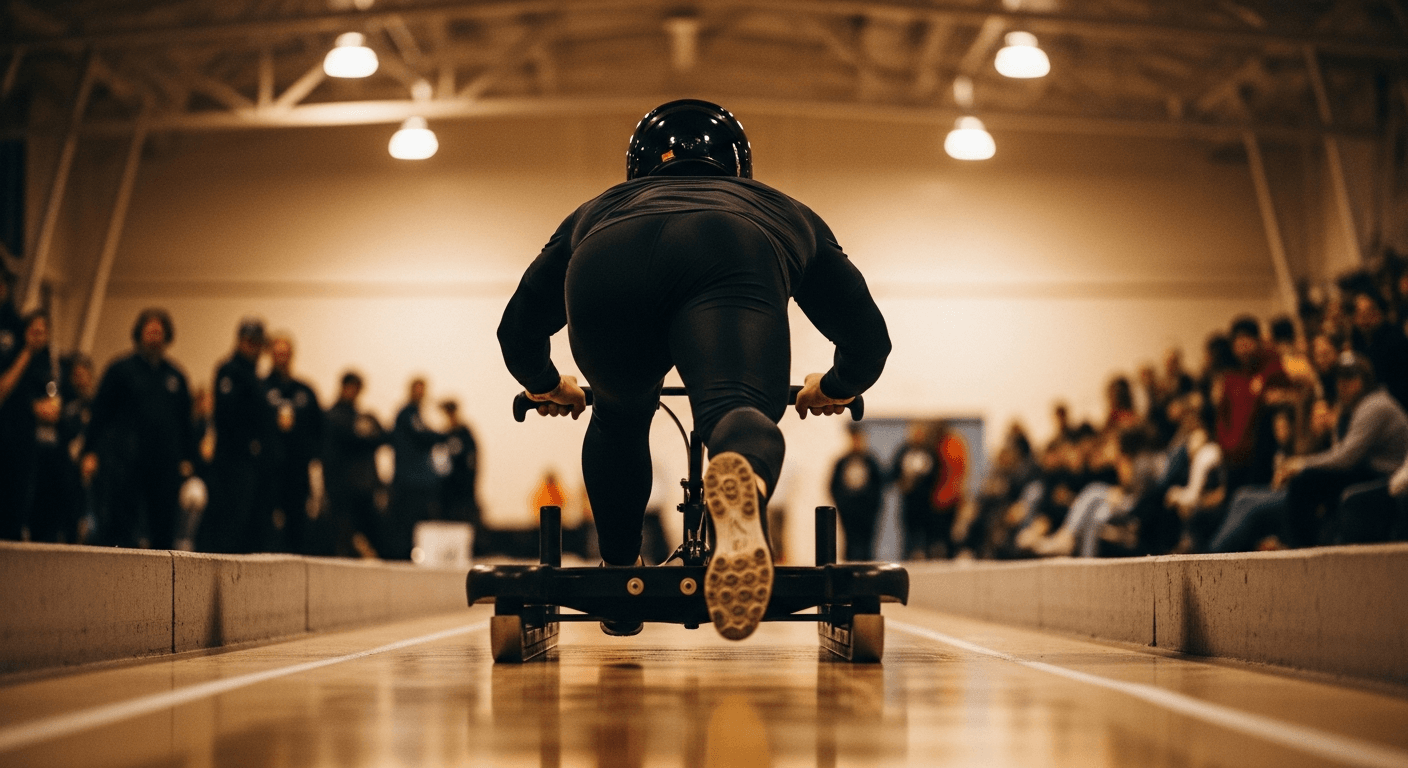
The stations that are actually driving separation at Cardiff, Rotterdam, and Cologne are the Sled Push and Pull, and to a lesser extent the Burpee Broad Jumps. Across all three venues, the time differential between podium finishers and 20th-place finishers on these stations is substantially larger than on the aerobic machines. That's a consistent signal, not noise.
The Lunges are also worth flagging. Cardiff's data showed a wider spread on the Lunge station than Rotterdam, possibly reflecting a difference in surface or setup, but the broader 2026 trend holds: athletes who can maintain pace through the Lunges without an extended recovery period afterward are gaining meaningful time on competitors who can't.
Pacing Strategy: What the Cardiff Run Splits Reveal
HYROX run splits are often underanalyzed, and Cardiff's data corrects that somewhat. The race format's eight one-kilometer runs are where cumulative fatigue becomes visible in the numbers, and Cardiff's results are a useful illustration.
Top finishers at Cardiff maintained consistent run paces across all eight loops with only minor degradation in the final two kilometers. Mid-pack finishers showed a more significant drop-off in runs five through eight, which is where the functional strength stations are also at their heaviest cumulative toll. This is the zone where training decisions made months earlier either pay off or don't.
If your current training block isn't including back-to-back sessions that simulate late-race fatigue, Cardiff's data is a reasonable argument for changing that. The separation in the run splits isn't primarily about raw speed. It's about how well you maintain form and output when you're already carrying the load of four or five completed stations.
Shoe choice matters here too. For athletes rethinking their race footwear after seeing these splits, choosing the right running shoes in 2026 covers the current options in detail, including what's working for hybrid race formats specifically.
What Nutrition Data from This Season Suggests
Performance data from Cardiff and the broader 2026 European circuit doesn't exist in a vacuum. The athletes consistently posting strong splits are also the ones who've professionalized their nutrition approach, and there's a growing body of evidence supporting specific strategies for functional fitness racing.
Anti-inflammatory nutrition protocols in particular have gained traction among hybrid athletes this season. The combination of training load and race-day demands places a significant recovery burden on the body, and plant-based eating combined with structured exercise has shown measurable benefits for reducing that burden in athletes who've adopted it consistently.
For athletes who want to understand the underlying science before changing their approach, sports nutrition in 2026 has shifted in ways that are worth understanding before you make changes to what you're eating around training and race day.
Using Cardiff's Data Before Stockholm
Stockholm Worlds is the obvious endpoint for most serious HYROX competitors in the 2026 season, and Cardiff's results give you a reference point that Lisboa alone doesn't. Two mid-season European data sets, read together, start to show you where the field will be by the time Worlds arrives.
The trend across Cardiff, Rotterdam, Cologne, and Lisboa is that finishing times in the open categories are compressing slightly compared to 2025. More athletes are in the competitive zone, which means the margin for error at Stockholm will be smaller than it was twelve months ago.
For athletes targeting strong Stockholm performances, the lessons from London Marathon 2026 on race-day pacing and mid-season calibration translate more directly to HYROX than you might expect. The mental and physical discipline of maintaining output under pressure in a big European event is a transferable skill.
The summer training window between now and Stockholm is where Cardiff's data becomes most actionable. Use the station-level splits to identify your specific gaps, prioritize the Sled and Lunge work that's consistently separating the field, and protect your run splits by training the back half of your race, not just the beginning.
Cardiff delivered exactly what a mid-season benchmark race should. Honest times, clean splits, and a clear picture of where the 2026 field actually stands. That's the information you need to train smarter between now and your next start line.