
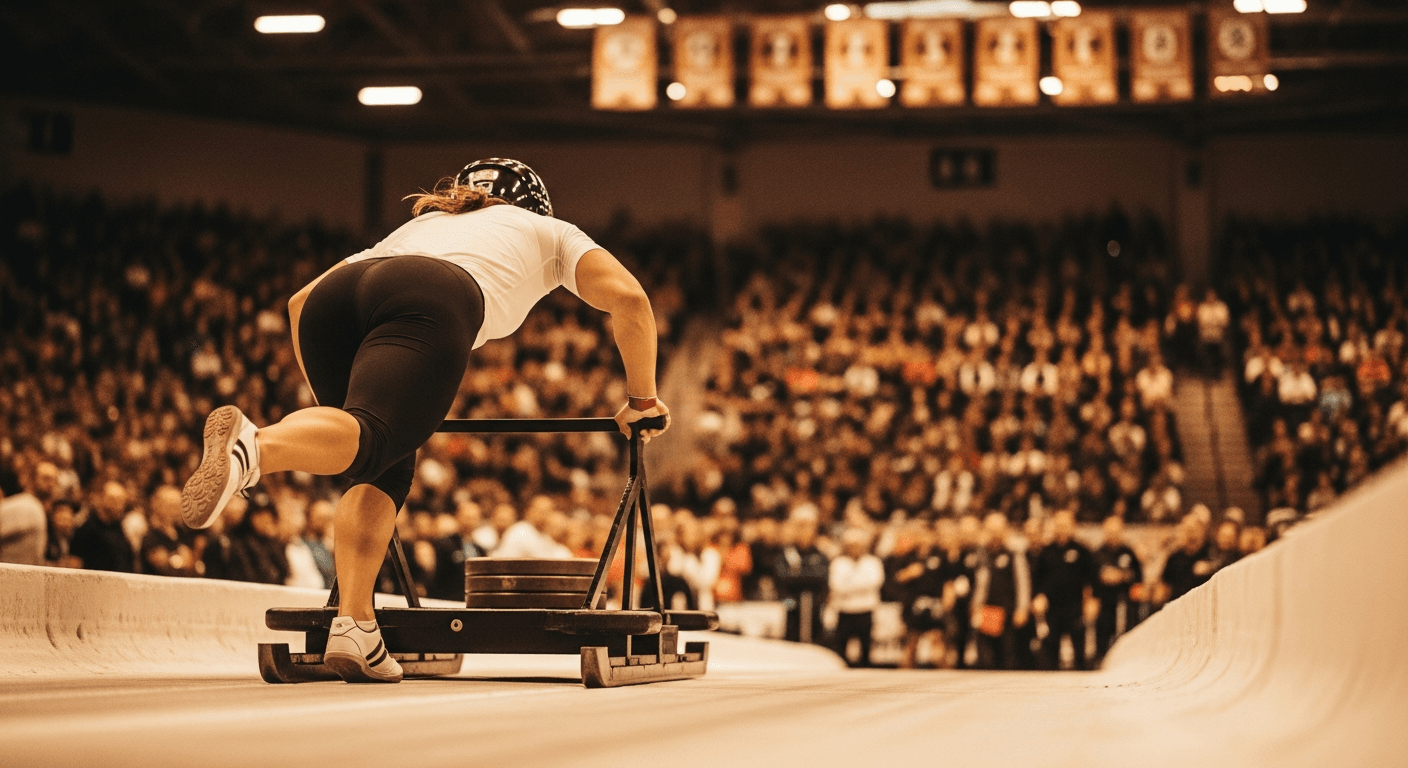
Warsaw 2026 landed at exactly the right moment on the HYROX calendar. With the Stockholm World Championships just weeks away, athletes arrived in Poland with clear intentions: post a time that matters, pressure the field, and answer the question every coach and competitor is already asking. Who is actually ready?
The results from Warsaw don't just fill a spreadsheet. They act as a real-time diagnostic for the entire elite scene heading into what will be the most competitive Worlds field in HYROX history.
Why Warsaw Matters More Than Most Stops
Late-season HYROX events serve a specific purpose. They're not the finale, but they're close enough to it that athletes can't afford to race conservatively. Anyone with a realistic shot at a podium in Stockholm needs proof of form on the floor, not just in training footage.
Warsaw drew a strong field precisely because of its timing. Multiple athletes arrived chasing personal bests, using the race as a final stress test before taper week. That kind of competitive pressure tends to produce fast, honest splits. The athletes who showed up in Warsaw weren't there for points accumulation. They were there to benchmark themselves against the same field they'll see in Stockholm.
That context makes every split from Warsaw worth studying closely. If you're following the Worlds buildup, the Stockholm Worlds elite doubles predictions offer a useful frame for understanding which Warsaw results carry the most strategic weight heading into the final event.
Sinéad Bent's PB Performance: What It Signals
The headline result from Warsaw was Sinéad Bent's personal best finish in the women's individual category. It wasn't just fast. It was the kind of performance that recalibrates expectations for the entire women's field going into Stockholm.
Bent's run showed control across the full race structure. Strong running splits early, efficient transitions, and a station-to-station consistency that's difficult to manufacture under race pressure. Athletes can post fast isolated times in training. Replicating that composure across eight stations in a competitive field is a different challenge entirely.
What makes this result significant for Stockholm isn't just the time itself. It's the signal it sends about depth. When a non-frontrunner posts a genuine PB at a late-season major, it compresses the gap at the top. Other elite women now know the margin for error in Stockholm is smaller than it looked after Rotterdam and Cologne.
Station-by-Station Split Analysis: Where Time Is Won and Lost
To understand Warsaw properly, you need to look at the splits against the earlier season benchmarks from Rotterdam and Cologne. Those two events established a rough baseline for what fast looks like in 2026. Warsaw is where you can see whether athletes have improved, stagnated, or started to fade before the peak.
Here's what the Warsaw split data reveals when stacked against those earlier results:
- SkiErg (1,000m): Several top finishers posted SkiErg splits 8 to 12 seconds faster than their Rotterdam times. That gap is meaningful. It suggests improved upper-body aerobic capacity or better pacing discipline coming off the start, where many athletes historically go out too hard and pay for it on the sled push.
- Sled Push (50m x8): This remains the great equalizer. Warsaw's floor conditions were reported as slightly slower than Cologne, which means direct sled comparisons need a small adjustment. Athletes who maintained their Cologne sled times on a slower surface are effectively performing ahead of their previous benchmarks.
- Burpee Broad Jumps (80 reps): This station consistently separates aerobic capacity from functional fatigue tolerance. In Warsaw, the gap between the top third and bottom third of the elite field widened compared to Rotterdam. That suggests the field is polarizing. The athletes who have specifically trained this station are pulling away.
- Rowing (1,000m): Warsaw rowing splits across the field were broadly consistent with Cologne. No major outliers at the top, which suggests the rowing station isn't where Stockholm podiums will be decided. It's a hold-your-ground station rather than a time-gain opportunity at this level.
- Wall Balls (100 reps): This is where Warsaw produced the most interesting data. A cluster of athletes posted wall ball splits 15 to 20 seconds faster than their Cologne results. That kind of jump this late in the season points to deliberate late-cycle training blocks targeting wall ball efficiency, likely driven by video analysis of previous race footage.
- Running Kilometers: The 1km running splits between stations remain the structural backbone of a HYROX time. Warsaw's overall pace data showed tighter clustering at the top than Rotterdam, meaning the lead group is running together longer before separation happens. Stockholm will likely see that pattern hold until the final two stations.
The Rotterdam and Cologne Comparison: What's Changed
Rotterdam was a strong early-season benchmark. Cologne pushed the field harder and produced some of the fastest splits seen this year. Warsaw sits between them not in quality, but in what it reveals.
At Rotterdam, athletes were still calibrating their race-day form after the off-season. Cologne showed who had built real fitness. Warsaw shows who has maintained it and who has peaked too early. That distinction matters enormously for a Worlds selection perspective.
Athletes who posted times at Warsaw within 1 to 2 percent of their Cologne results are demonstrating consistent peak-level fitness. Athletes who dropped 3 to 5 percent at Warsaw while citing "taper" are taking a risk. The history of HYROX Worlds suggests that athletes arriving slightly undertapered outperform those who arrive overtapered more often than the reverse.
Fueling strategy across these multi-station events also plays a measurable role in split consistency. The principles outlined in the long-duration sports nutrition fueling guide apply directly here. Glycogen availability affects power output on the sled and ski erg more than most athletes acknowledge during race analysis.
Men's Field: No Dominant Narrative, Which Is Its Own Story
The men's results from Warsaw didn't produce a single headline performance the way Bent's did on the women's side. What they produced was something arguably more useful for Worlds analysis: a genuinely unclear picture at the top.
Three to four men finished within a narrow time band that makes a single favorite difficult to identify. That kind of compressed finishing structure late in the season usually means one of two things. Either the field is legitimately even and Stockholm will come down to execution on the day. Or one athlete is managing their effort in public while sitting on a significantly better time in training.
Both scenarios have precedent in HYROX Worlds history. The split data from Warsaw doesn't resolve the question. It confirms it's the right question to be asking.
Recovery and Nutrition in the Final Weeks
For any athlete who raced Warsaw and is targeting Stockholm, the post-race recovery window is now the primary performance lever. Racing hard three to four weeks before a World Championship creates a specific physiological debt that needs to be managed precisely.
Protein intake in the recovery phase is one of the most evidence-backed variables. Updated guidance on the 2025-2030 protein intake targets of 1.2 to 1.6 g/kg reflects what the research now supports for athletes in high-load recovery phases. That range isn't conservative. It's calibrated to actual tissue repair demands in the days following intense competition.
Gut health also becomes a practical factor in the pre-Worlds window. Travel to Stockholm, schedule disruption, and race-day stress all affect gut function in ways that influence nutrient absorption and energy availability. Understanding the connection between gut health and athletic performance isn't abstract physiology at this stage. It's a real performance consideration for athletes flying into a major championship.
What Warsaw Tells Us About Stockholm
The clearest takeaway from Warsaw 2026 is that the Stockholm field will be deeper than last year. The women's side has Bent's PB as evidence of a compressed elite tier. The men's side has no clear favorite, which historically produces fast racing as athletes push each other through the early stations.
If you're tracking Stockholm preparation, watch for three things in the final weeks: which athletes adjust their public training volume downward sharply (taper signal), which athletes post fast running splits in low-key events (fitness confirmation), and whether any last-minute athlete withdrawals shift the competitive dynamics of individual categories.
Warsaw was the dress rehearsal. The split data is the script. Stockholm is where the performance actually gets judged.