
Semaglutide and tirzepatide are reshaping how millions of people relate to hunger. That's not hyperbole. These medications genuinely blunt appetite in ways that feel almost effortless compared to traditional dieting. But that ease comes with a catch most prescribers don't spend enough time on: when you're eating significantly less, what you eat matters far more than how much.
If you're on a GLP-1 receptor agonist and you're physically active, this article is for you. Because the research on very-low-calorie intake and lean mass loss should make every GLP-1 user rethink their plate before they rethink their portions.
The Appetite Suppression Trap
GLP-1 receptor agonists work by mimicking a gut hormone that signals fullness, slows gastric emptying, and reduces appetite-driving signals from the brain. The result is that most users naturally consume fewer calories. Some studies report reductions of 20-35% in daily intake without active calorie restriction. That sounds ideal. In practice, it creates a serious nutritional blind spot.
When you're not hungry, you don't just eat less. You often eat whatever is fast, easy, or convenient. That can mean skipping protein at breakfast, grazing on processed snacks because they're low-effort, and unintentionally neglecting entire food groups. Over weeks and months, those gaps compound into real deficiencies in protein, iron, zinc, folate, and B12.
The medication doesn't discriminate. It suppresses appetite broadly, not selectively. It won't remind you that you haven't had a vegetable in three days or that your protein intake has dropped to half of what your muscles need to stay intact.
The Lean Mass Problem Is Real
Here's the number that should get your attention. Research on very-low-calorie diets consistently shows that without adequate protein intake and resistance training, 30-40% of total weight lost can come from lean mass, not fat. That includes muscle. For active adults, that's not just an aesthetic issue. It's a metabolic one.
Muscle tissue is metabolically active. Losing it lowers your resting metabolic rate, which makes weight maintenance harder over time, not easier. It also increases injury risk, reduces functional strength, and can quietly degrade long-term health outcomes in ways that won't show up on a scale for months.
GLP-1 users are at particular risk because the appetite suppression effect can make it easy to chronically under-eat protein without realizing it. If your total intake has dropped to 1,200-1,400 calories a day and you're not being deliberate about protein, you may be getting 60-80g when your body needs 110-140g or more.
Pairing your medication with structured resistance training is non-negotiable if preserving muscle is a priority. If you're unsure where to start, Stop Grinding: Train Smarter, Not Just Harder outlines exactly how much training is actually needed to maintain and build muscle without overcommitting your schedule.
Protein-First Meal Architecture
The practical solution is to build every meal around protein before anything else. Not as an afterthought, not as a side dish. As the anchor of the plate. Current evidence supports a minimum of 1.6g of protein per kilogram of body weight daily for active adults trying to preserve lean mass during caloric restriction. For someone weighing 75kg (165 lbs), that's roughly 120g of protein per day.
On a reduced appetite, hitting that target requires deliberate planning. Here's what that looks like in practice:
- Start meals with protein. Eating protein before carbohydrates or fats takes advantage of your limited stomach capacity. You fill up on what your body needs most.
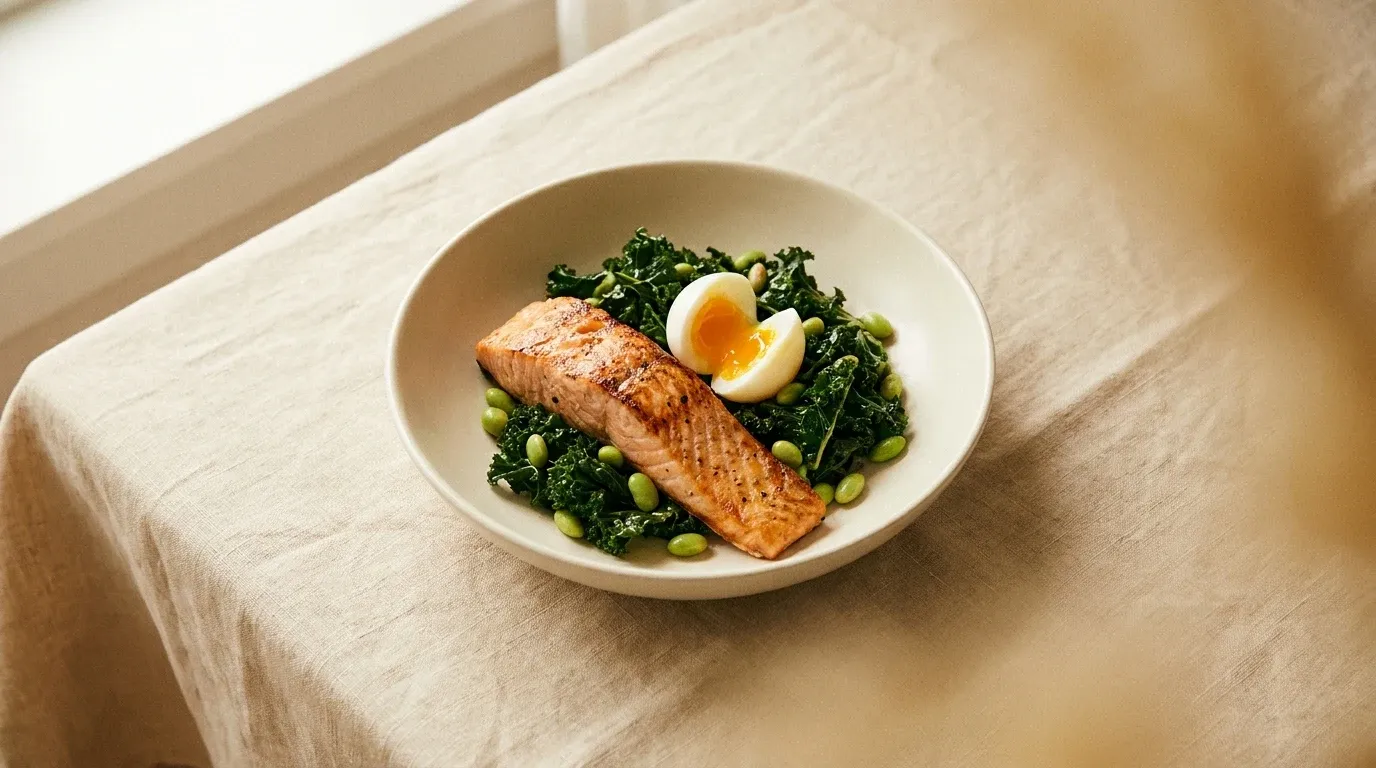
- Choose high-quality sources. Eggs, Greek yogurt, cottage cheese, lean poultry, fish, and legumes all score well on digestibility and amino acid completeness. If you want to understand why protein source matters beyond the gram count, Protein Quality Scores: What They Actually Mean for You breaks down the science clearly.
- Don't rely on supplements to fill the gap. Whole food protein sources come packaged with micronutrients. A chicken breast delivers zinc and B12 alongside its protein. A protein shake does not.
- Distribute intake across the day. Muscle protein synthesis responds better to 3-4 moderate protein servings spread through the day than to one large bolus. Aim for 30-40g per meal.
Fiber, Gut Health, and GI Side Effects
GLP-1 medications slow gastric emptying as part of their mechanism of action. That affects far more than just how quickly you feel full. It changes the entire environment of your gut. Food moves through your digestive system more slowly, which shifts the composition and behavior of your gut microbiome over time.
Some of these shifts are beneficial. Slower digestion can improve blood sugar regulation and extend satiety. But without adequate fiber intake, the microbiome can drift toward compositions associated with increased inflammation and reduced production of short-chain fatty acids, compounds that play a key role in gut lining integrity and immune function.
The common GI side effects of GLP-1 medications, including nausea, constipation, and bloating, are also partly driven by this slowed motility. Strategic fiber intake can help. Soluble fiber, found in oats, apples, flaxseed, and legumes, absorbs water and softens stool, which can directly reduce constipation. It also feeds beneficial bacteria and supports a more diverse microbiome.
Aim for at least 30g of fiber daily. For context, the average American gets around 15g. Getting to 30g on a reduced-calorie diet requires prioritizing fiber-dense foods rather than just eating more of anything.
Fermented foods add another layer. Yogurt, kefir, kimchi, sauerkraut, and miso introduce live bacterial cultures that can support microbiome diversity during the shifts that GLP-1 use can trigger. Including one to two servings of fermented food daily is a low-effort strategy with meaningful upside.
Micronutrient Gaps You Can't Afford to Ignore
Eating less inevitably means consuming fewer micronutrients unless you're extremely deliberate about food quality. For GLP-1 users, four nutrients deserve specific attention: folate, iron, zinc, and B12.
Folate is critical for cell division and DNA repair. It's found in leafy greens, legumes, and fortified grains. If your appetite suppression is pushing you away from vegetables, your folate status may be quietly declining.
Iron is commonly under-consumed on reduced-calorie diets, particularly for women. Fatigue that gets attributed to the medication or to caloric restriction may actually reflect iron insufficiency. Red meat, lentils, spinach, and pumpkin seeds are strong dietary sources. Pairing plant-based iron with vitamin C improves absorption significantly.
Zinc supports immune function, wound healing, and testosterone production. It's found primarily in animal proteins, shellfish, and legumes. If you're reducing meat intake while on a GLP-1, zinc is a gap worth monitoring.
B12 is almost exclusively found in animal products, and deficiency develops slowly but has serious neurological consequences. If you're eating less red meat and fewer eggs than before, B12 deserves attention. If you're fatigued in ways that feel disconnected from your sleep or training, Always Tired? A Practical Framework to Fix Your Nutrition offers a systematic way to identify what's actually going on.
A well-formulated multivitamin can serve as insurance, but it shouldn't replace food quality. Supplements fill gaps. They don't build a nutritional foundation.
A Practical Food Quality Framework for GLP-1 Users
Rather than tracking every calorie on a reduced appetite, shifting to a food quality framework is both more sustainable and more protective. Here's how to structure it:
- Protein minimum: 1.6g per kg of body weight daily. Build every meal around a protein source. Don't let convenience override this.
- Fiber target: 30g daily minimum. Include at least one serving of legumes, two or more servings of vegetables, and whole grains rather than refined ones.
- Fermented foods: one to two servings daily. Greek yogurt, kefir, or a small serving of kimchi at a meal covers this without adding significant volume.
- Micronutrient anchors: leafy greens, eggs, legumes, and lean animal protein at every day. These four food categories collectively cover most of the folate, iron, zinc, and B12 you need.
- Hydration: prioritize water over anything else. Slowed gastric emptying makes dehydration easier to overlook. Aim for consistent fluid intake throughout the day, not just when you feel thirsty.
This framework works precisely because it doesn't fight your medication. It works with the reduced appetite by making every bite count nutritionally, rather than trying to squeeze in volume you won't enjoy or sustain.
The Bigger Picture
GLP-1 medications are genuinely effective tools. But they're tools with trade-offs that require active management. The research is clear: appetite suppression without nutritional strategy leads to lean mass loss, micronutrient deficiency, and gut disruption that can undermine both your health and your long-term results.
Stress compounds these challenges further. If you're managing life pressures on top of significant dietary restriction, Why Stress Kills Long-Term Weight Maintenance explains the physiological mechanisms that make emotional and psychological support just as important as nutritional strategy during weight loss.
Food quality isn't a soft recommendation for GLP-1 users. It's the structural foundation that determines whether you come out of this period healthier, stronger, and metabolically better off than when you started. Calories are the floor. Quality is what builds the house.