
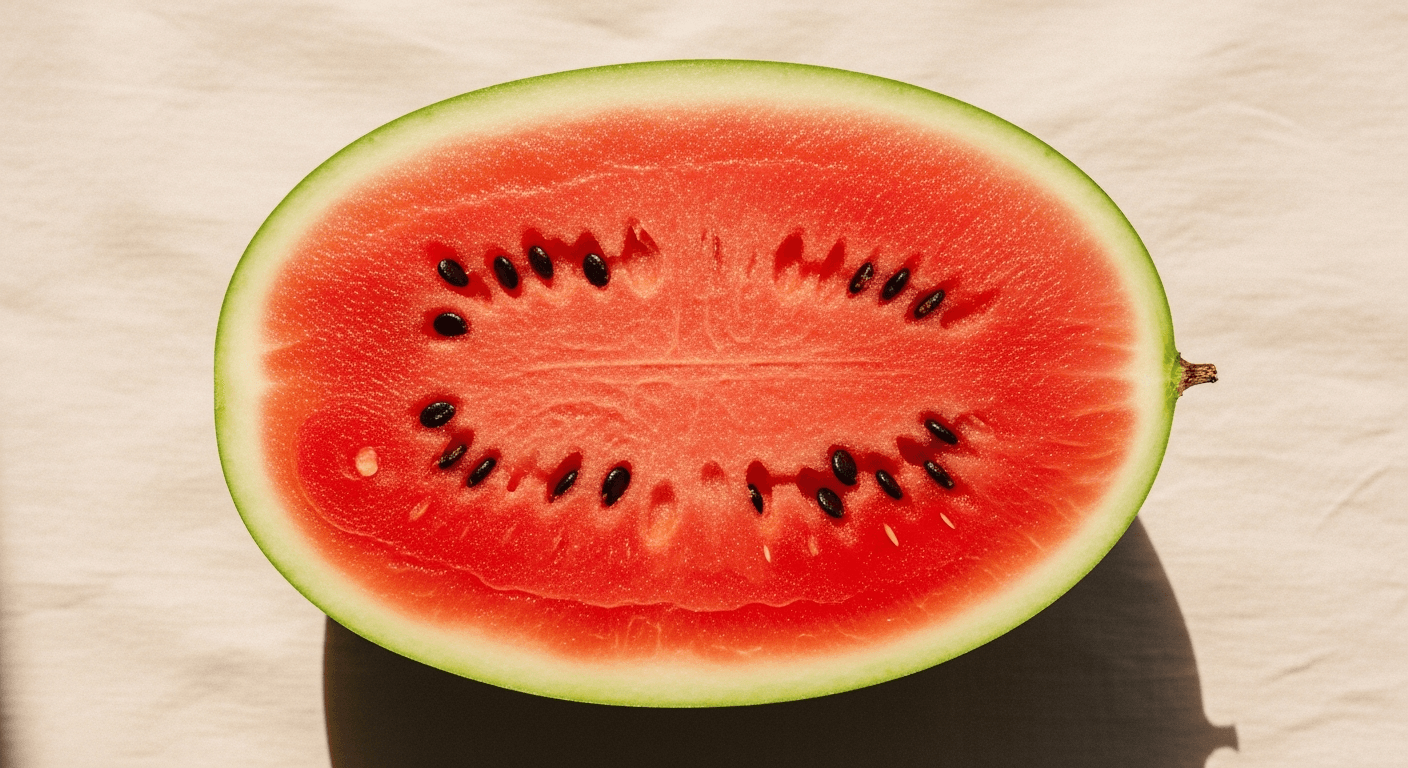
Watermelon has spent decades being dismissed as a watery snack with little nutritional value beyond summer refreshment. That reputation is outdated. A growing body of research shows that watermelon contains compounds that measurably affect muscle recovery, cardiovascular health, and inflammation. If you train regularly, this is a fruit worth paying attention to.
Citrulline: The Amino Acid That Changes the Conversation
The most compelling case for watermelon as a functional food comes from citrulline, a non-essential amino acid found in high concentrations in watermelon flesh. Your body converts citrulline into arginine, which in turn drives nitric oxide production. Nitric oxide relaxes blood vessels, improves circulation, and increases oxygen delivery to working muscles.
That mechanism isn't theoretical. Clinical trials using concentrated watermelon juice have shown reductions in post-exercise muscle soreness of up to 40% compared to placebo, with participants reporting faster recovery 24 to 48 hours after resistance training. The effect is dose-dependent: you need roughly 1 to 1.5 grams of citrulline to see measurable results, which corresponds to about two to three cups of fresh watermelon.
Citrulline is also the active ingredient in many pre-workout supplements sold for $30 to $60 per container in the US market. The difference is that in supplement form, it's typically delivered as citrulline malate at doses of 6 to 8 grams. Watermelon provides a lower dose, but it also delivers water, natural sugars, and a broader micronutrient profile alongside it.
If you're already thinking about how nutrition supports performance alongside training strategy, the logic here connects directly to work on how cardio actually boosts muscle gains rather than undermining them. Both challenge the assumption that one variable works in isolation.
Antioxidants Beyond the Basics
Watermelon is one of the richest dietary sources of lycopene, a carotenoid antioxidant that gives the flesh its red color. Ounce for ounce, watermelon contains more lycopene than raw tomatoes. That matters because lycopene has been consistently linked in observational and interventional research to reduced markers of oxidative stress and lower LDL cholesterol oxidation.
Oxidative stress is a central mechanism in both cardiovascular disease and the inflammatory response triggered by hard training. When you exercise intensely, free radical production spikes. Your body has its own antioxidant defenses, but dietary antioxidants from whole foods appear to complement those defenses rather than interfere with them. This is a meaningful distinction: high-dose antioxidant supplements have been shown in some studies to blunt training adaptations, while food-based sources don't carry that risk.
Watermelon also contains cucurbitacin E and beta-carotene, along with modest amounts of vitamin C and potassium. None of these are present in extraordinary quantities compared to other fruits, but together they contribute to what researchers describe as a favorable antioxidant matrix. The whole is somewhat greater than the sum of its parts.
For context on how specific nutrients interact with health at a biological level, the emerging data on grapes and UV protection through gene expression pathways offers a useful parallel. Whole fruits regularly turn out to have more targeted effects than their basic nutrition labels suggest.
Cardiovascular Effects: What the Data Actually Shows
Beyond lycopene, studies using watermelon extract and whole fruit have documented reductions in aortic blood pressure in adults with prehypertension. The proposed mechanism involves the citrulline-to-arginine-to-nitric oxide pathway described above, which reduces arterial stiffness independent of any physical activity. In one randomized trial, participants consuming watermelon extract daily for six weeks showed meaningful reductions in both systolic and diastolic pressure.
The cardiovascular data is not yet strong enough to treat watermelon as a therapeutic intervention for diagnosed hypertension. What the evidence does support is watermelon as a functional addition to a diet already oriented toward cardiovascular health. It works with other inputs, not instead of them.
This becomes more relevant as you get older. Arterial stiffness increases with age, and maintaining vascular flexibility is a legitimate target for nutrition strategy. Research on how strength declines starting around age 35 underlines that the body begins to require more deliberate support across multiple systems from midlife onward. Nutrition is one of those systems.
Hydration and Electrolytes: Still a Real Benefit
Dismissing watermelon's hydration value because it seems obvious would be a mistake. Watermelon is approximately 92% water by weight, and it delivers that water alongside natural sugars and potassium. During and after exercise, particularly in warm conditions, that combination supports both fluid replacement and glycogen replenishment simultaneously.
Potassium plays a role in muscle contraction and nerve signaling, and most adults in Western markets don't consume enough of it. A two-cup serving of watermelon provides around 320 milligrams of potassium, roughly 7% of the daily recommended intake. That's not dramatic, but it's real, and it comes packaged in a food with a high palatability and a low glycemic load relative to its sugar content.
The glycemic index of watermelon is often cited as a concern. At around 72, it sits on the higher end of the glycemic index scale. But the glycemic load per serving is low because the actual carbohydrate density is modest. Eating two cups of watermelon delivers around 22 grams of carbohydrates. That's a manageable amount even for people monitoring blood sugar, and it's useful fuel for recovery in the post-exercise window.
What Actually Moves the Needle for Athletes
Here's where the practical framing matters. The citrulline research is real, but the doses used in the strongest clinical studies often relied on concentrated watermelon juice rather than whole fruit. To reach the threshold where effects are consistently measurable, you'd need roughly two to three cups of fresh watermelon consumed about an hour before training, or immediately after.
That's achievable and not excessive. It's also not a substitute for an otherwise poor recovery strategy. If your sleep is inconsistent, your protein intake is low, or your training volume exceeds your recovery capacity, watermelon won't compensate. It's an addition to a solid baseline, not a shortcut around one.
The honest answer to "does watermelon actually work" is: yes, within a specific context. Pre-exercise, it may modestly support blood flow and delay onset muscle soreness. Post-exercise, it contributes to rehydration and carbohydrate replenishment. For cardiovascular health over time, regular consumption contributes to antioxidant intake and may support arterial health alongside other dietary patterns.
What it doesn't do is replicate the effects of pharmaceutical-grade citrulline supplementation, serve as a primary protein source, or replace the fundamentals. The supplement industry has done an effective job of borrowing watermelon's credibility to market citrulline malate products. The fruit itself has a real but more modest effect profile. That's still worth knowing.
How to Use Watermelon Strategically
The most practical approach is to treat watermelon as a performance-adjacent whole food rather than a supplement. Here's what the evidence supports:
- Pre-workout (60 minutes before): Two to three cups of fresh watermelon provides citrulline and carbohydrates for fuel without sitting heavily in your stomach.
- Post-workout recovery: Combine watermelon with a protein source. The carbohydrates support glycogen replenishment; the protein covers muscle repair. The pairing matters.
- Daily cardiovascular support: Regular consumption, even a cup or two per day, contributes to lycopene intake and supports the antioxidant profile of a varied diet.
- Hydration in heat: On high-output training days or in warm weather, watermelon is a practical way to increase fluid intake palatably, especially for people who struggle to drink enough plain water.
The rind deserves a mention. Watermelon rind actually contains higher concentrations of citrulline than the flesh. It's edible, mildly flavored, and can be blended into smoothies or pickled. Most people discard it, which means most people are leaving the most citrulline-dense part of the fruit in the bin.
Recovery nutrition is one piece of a broader system that includes sleep, training structure, and stress management. If you're building out that system, understanding which metrics reflect genuine recovery progress is as important as what you eat. The relationship between nutrition inputs and recovery outputs is measurable. Watermelon is a small but legitimate part of that picture, and science has made a stronger case for it than most people realize.
Whole foods that deliver specific, research-backed compounds alongside a broader micronutrient matrix are increasingly what nutrition science is identifying as the most sustainable dietary strategy. Watermelon earns its place in that category. Just make sure you're eating enough of it to matter, and pairing it with the fundamentals that make any single food's contribution visible.