
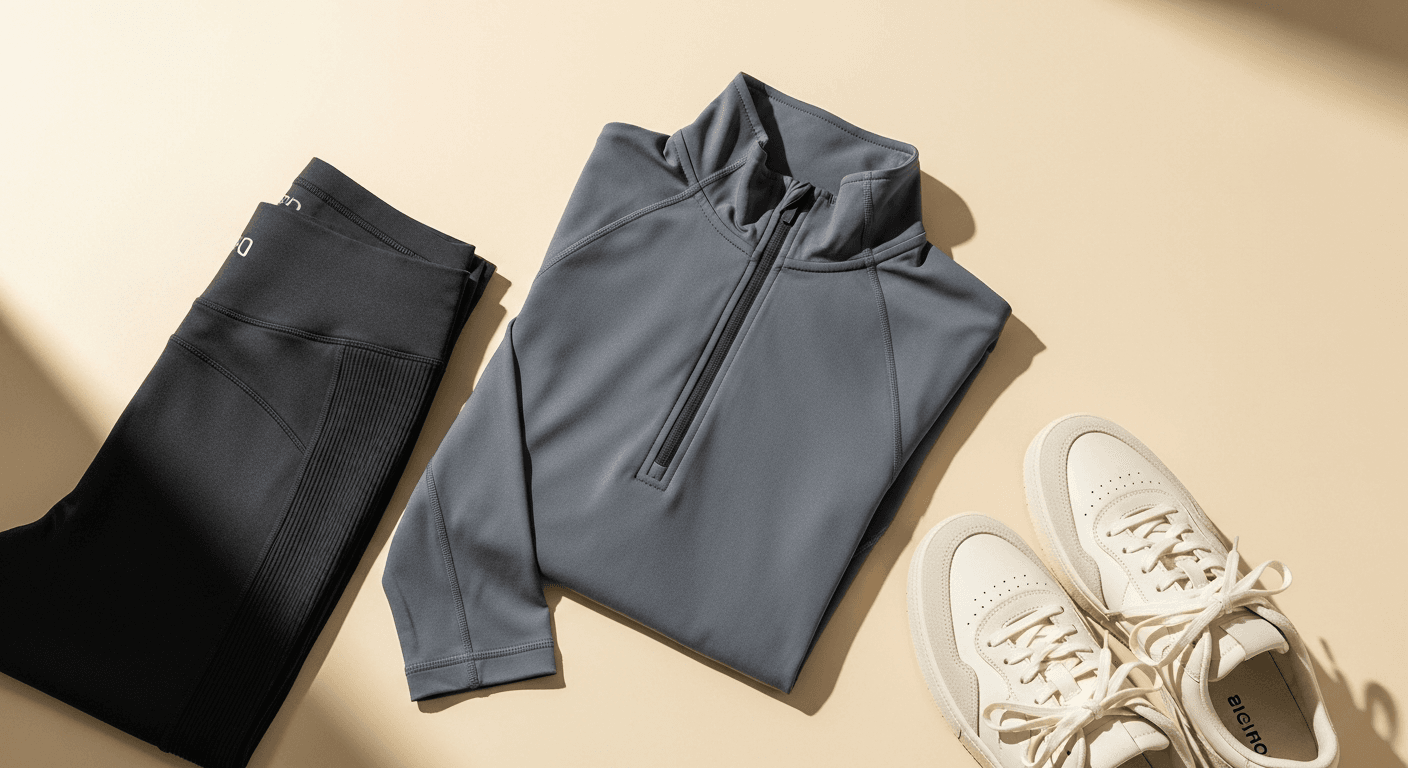
The global athleisure market is not slowing down. Valued at $473.8 billion in 2026, it's projected to reach $902.4 billion by 2033 at a compound annual growth rate of 9.7%, according to an April 2026 market report. That's a near-doubling in seven years. But if you're building or advising a brand in this space, the aggregate number is almost beside the point. The real story is where the growth concentrates, and right now, it's concentrating at the top.
Volume is real. Margin is selective. And the brands that understand that distinction in their 2026 planning cycles are the ones that will still be relevant in 2030.
Premium Is the Growth Engine, Not the Exception
Within the broader athleisure expansion, premium athletic wear is the fastest-growing sub-segment. Consumers are not just buying more. They're buying up. Water-resistant fabrics, thermal regulation, four-way stretch, odor management, UV protection: these are no longer luxury features. They're the baseline expectation for anyone spending $90 or more on a pair of leggings or a performance hoodie.
What's driving this isn't vanity. It's functionality that crosses occasions. The same consumer who runs five miles on Tuesday morning wants to wear something that looks credible in a hybrid office by 10 a.m. That behavioral shift is structural, not cyclical, and it directly rewards brands that have invested seriously in R&D.
Brands that have built proprietary fabric technologies, whether that's moisture-wicking membranes, bio-based stretch fibers, or engineered compression systems, are now capturing a disproportionate share of wallet. The performance-lifestyle crossover positioning isn't a marketing choice anymore. It's a category architecture that determines whether a consumer considers you at all in the premium tier.
The Hybrid Workplace Is a Structural Demand Driver
Remote and hybrid work normalized through 2025 and into 2026 has done something that no marketing campaign could have engineered: it expanded the addressable occasion for athleisure from weekend use and gym sessions to daily, office-adjacent wear.
When your customer is on a video call in the morning, picking up a child at school in the afternoon, and heading to a fitness class in the evening, the product that survives all three contexts wins. That's not a niche. That's a large and growing segment of the working adult population in the US, UK, Canada, and Australia.
This is also why the fitness and wellness industries are increasingly intertwined with apparel strategy. As more consumers build movement into their daily routines, whether through structured training or shorter, incidental activity, the demand for clothing that performs across contexts grows with it. Research covered in how 1-2 minute exercise snacks actually build muscle illustrates just how fragmented modern fitness behavior has become. Athleisure is the uniform of that fragmentation.
M&A Is Telling You Something About Tier Strategy
Two deals define the current strategic landscape at the volume tier, and both of them confirm the same thesis.
The Anta-PUMA combination targeting the $473 billion market signals that scale and supply chain efficiency are the primary weapons at the mass-market level. Anta brings manufacturing leverage and distribution reach. PUMA brings brand recognition. Together, the bet is that you can compete on cost, speed, and shelf presence across global markets.
The Gildan-Hanesbrands activewear merger follows the same logic. These are not premium brands chasing innovation premiums. They're consolidating to reduce cost structures, improve sourcing efficiency, and defend margin through volume rather than through perceived value.
Read together, these deals are a clear signal: at the volume tier, the winners will be massive, lean, and operationally dominant. If you're a mid-market brand without that scale, you cannot win on their terms. That's not a threat. It's a positioning clarification.
The Mid-Market Squeeze Is Real and Getting Tighter
Here's where it gets uncomfortable for a lot of brands. The mid-market, roughly defined as products priced between $40 and $80, is facing a classic double squeeze.
On one side, merged volume giants are becoming more cost-efficient and increasingly capable of delivering acceptable quality at aggressive price points. On the other side, premium brands with genuine technology credentials and strong brand narratives are pulling aspirational consumers upward. The consumer in the middle is being asked to choose, and they're choosing based on clear value signals that many mid-market brands simply haven't built.
The strategic options are not complicated, but they require honest self-assessment. You either invest to move up, which means committing to product R&D, fabric sourcing, and brand storytelling at a level that earns a premium price point. Or you optimize to move down, which means operational efficiency, supply chain partnerships, and margin management at scale. There is no stable ground in between. Planning cycles in 2026 need to reflect that.
This dynamic mirrors what's happening across adjacent categories in the fitness industry. As Peloton's Q3 results show with Pilates up 48% and a new hardware play in the fall, even in equipment and content, the brands that are thriving are those with a clear premium identity or a defined operational edge. Unclear positioning is expensive.
Where Brand Equity Actually Gets Built in 2026
The premium tier isn't just about the product. It's about the total signal the brand sends. Fabric technology is the entry ticket. But brand equity at this tier is built through several reinforcing elements:
- Community and credibility: Premium athleisure brands increasingly operate as lifestyle anchors, not just apparel companies. Their association with specific fitness cultures, whether running, strength training, or studio fitness, creates identity-level loyalty that volume brands can't replicate.
- Retail environment and experience: Direct-to-consumer flagships, curated wholesale partnerships, and a deliberate absence from certain discount channels all protect perceived value. Where you sell is as much a positioning signal as what you charge.
- Sustainability credentials: At the premium tier, environmental claims are no longer optional brand garnish. Consumers paying $120 for a sports jacket want to know what the fabric is made from. Brands that can articulate a credible material story are building a moat. Brands that can't are leaving a gap their competitors will fill.
- Cross-category coherence: The most effective premium brands are building ecosystems. Apparel that pairs logically with accessories, footwear, or even wellness products creates higher average order values and reduces churn.
The gym and fitness operator channel is also underutilized as a brand-building tool. Operators with strong membership data and community presence are natural distribution and co-branding partners for premium athleisure. Understanding how gym operators are using foot traffic data strategically gives you a window into the consumer behavior patterns that should be informing your retail and partnership strategy.
The Consumer Trading Up Is Not Going Back
One of the more durable post-pandemic behavioral shifts is that consumers, particularly in the 30 to 55 age bracket, have increased their baseline investment in health and fitness. That includes what they wear. The democratization of performance fabrics means consumers now recognize quality at a tactile level. They can feel the difference between a $30 polyester blend and a $110 engineered performance knit. And once they've made that comparison, the downgrade is psychologically difficult.
This is relevant beyond apparel. The same consumer investing in premium athleisure is often the one investing in structured fitness programming, quality nutrition, and recovery tools. As covered in research on how strength starts declining at 35 and what you can do about it, the 35-plus demographic is highly motivated, has disposable income to deploy, and is actively seeking products and experiences that match their performance goals. That's your premium athleisure buyer.
What the $902B Number Actually Means for Strategy
Market size projections are useful as directional signals, not as guarantees. The $902.4 billion figure tells you the category is growing and that consumer demand for performance-lifestyle products is durable. It does not tell you that every brand in the space will benefit proportionally.
The brands that will capture a meaningful share of that growth are the ones making a deliberate bet right now. Either build the technology, the brand narrative, and the retail architecture to compete at premium. Or build the scale, the supply chain, and the cost discipline to compete at volume. The $902 billion market will be generous to both approaches. It will be brutal to anything in between.
If you're in a planning cycle right now, the athleisure market is not telling you to grow faster. It's telling you to get clearer. The margin lives at the edges, not the middle, and the window to choose your edge is narrowing.