
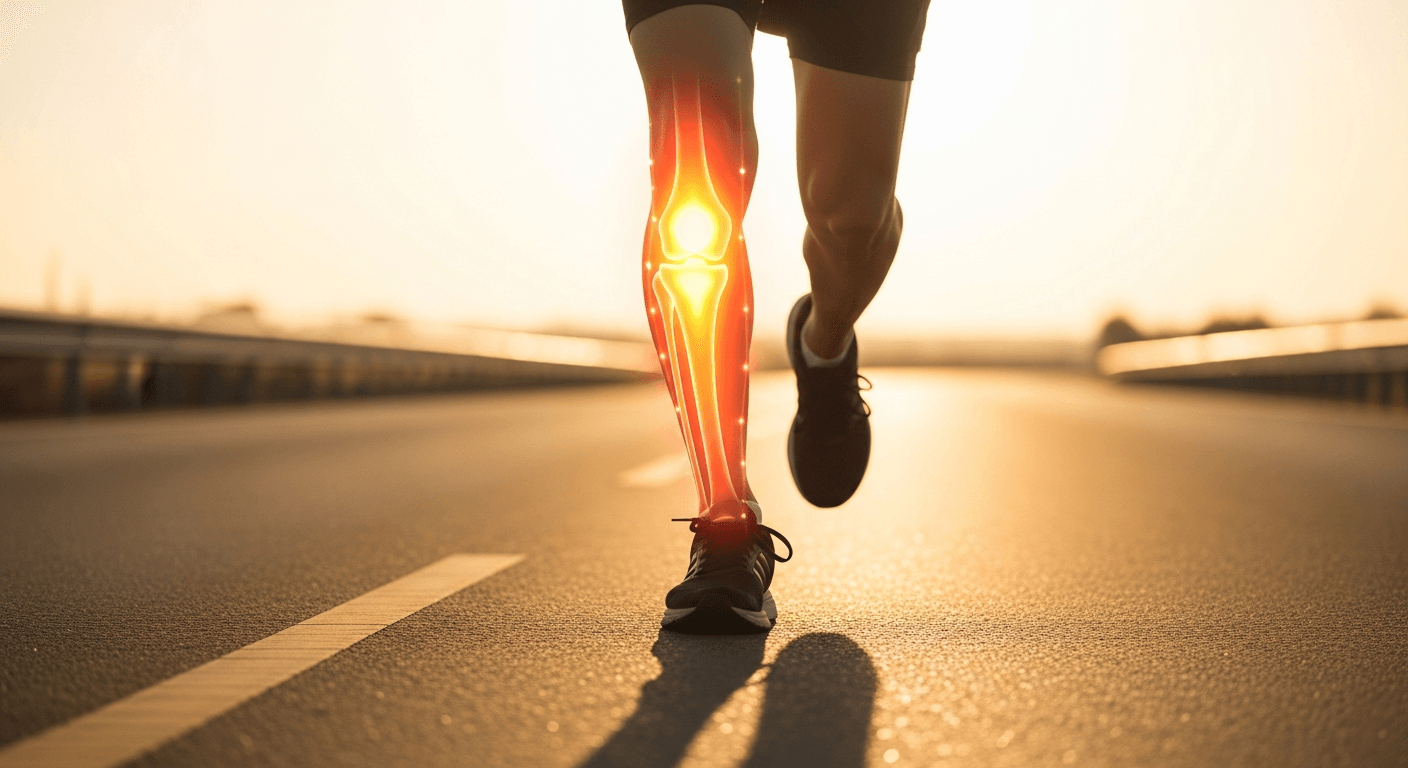
If you've ever been sidelined by a stress fracture, a tight IT band, or a nagging Achilles tendon, you know the frustration. You rest, you ice, you see a physiotherapist, and eventually you get back out there. Then, a few months later, it happens again. For most runners, injury has always been reactive. Something breaks down, and then you fix it.
That model is being replaced. In 2026, AI-powered tools are giving everyday runners access to predictive, personalized injury management that was previously available only to professional sports franchises and Olympic programs. Here's what's actually changing, and what it means for your training.
Reading the Warning Signs Before You Feel Them
The most significant shift isn't in treatment. It's in detection. Modern AI systems can analyze continuous streams of data from consumer wearables and identify subtle biomechanical changes that precede injury by days or even weeks. A slight increase in ground contact time on your left foot. A gradual shift in your cadence under fatigue. A change in your heart rate variability pattern that correlates with connective tissue stress.
None of these signals, in isolation, would raise a flag. But AI models trained on millions of running sessions can recognize combinations of micro-signals that humans simply can't process in real time. A 2025 study published in the British Journal of Sports Medicine found that machine learning models predicted running-related injuries up to three weeks before symptom onset with an accuracy rate above 74 percent in recreational athletes.
That's not a guarantee. But for a runner training for a target race, three weeks of early warning is enough time to modify load, address a weak link in the kinetic chain, and avoid a full breakdown. That changes everything about how you approach a training block.
Computer Vision Is No Longer Just for Elite Labs
A few years ago, getting a gait analysis meant booking a session at a university sports science lab or a specialized running clinic. You'd run on a treadmill surrounded by motion capture cameras, and a specialist would spend time reviewing your footage. It cost anywhere from $150 to $400 per session, and most runners only did it once.
In 2026, that same quality of biomechanical insight is available through your smartphone. Apps like NURVV, Volumental, and a growing list of AI-native platforms use computer vision and on-device processing to analyze your gait in real time. You prop your phone against a wall, run a few laps, and within minutes you receive a detailed report on your foot strike pattern, hip drop, cadence variability, and trunk lean.
The consumer versions are not quite as granular as a full lab setup. But research comparing AI-based gait analysis tools to gold-standard 3D motion capture has shown correlation coefficients above 0.88 for key variables like step width and vertical oscillation. For the purposes of injury risk screening, that's clinically meaningful data.
Wearable insoles have also matured significantly. Devices that fit into your existing running shoes now measure plantar pressure distribution across hundreds of data points per stride. If you're consistently overloading the lateral edge of your left foot, the system flags it before your peroneal tendon starts complaining.
From Reactive Treatment to Predictive Rehabilitation
The traditional model of running injury management looks like this: you get hurt, you stop running, you see a professional, you follow a rehab protocol, you return to training. The protocol is usually generic, built around population averages rather than your specific biomechanics, training history, and load tolerance.
AI is replacing that framework with something more dynamic. Platforms like Hinge Health, Kaia Health, and newer running-specific tools now build personalized rehabilitation programs that adapt week to week based on your performance data, pain reports, and biomechanical feedback. If your form deteriorates on longer runs but holds up during shorter efforts, the algorithm adjusts your return-to-run protocol accordingly. It doesn't wait for you to report a problem. It sees it first.
This matters especially for high-mileage runners. Training for a marathon involves sustained exposure to mechanical stress over months. Even small inefficiencies compound. If you're preparing for a major race like one of the spring marathons and want to understand how to structure your build without breaking down, the AI-driven load management tools now available are worth understanding before you hit peak weeks. Whether you're targeting everything Boston Marathon week throws at you or preparing for a European major, the planning principles are the same.
Recovery nutrition also plays a role that AI platforms are beginning to integrate more seriously. Some systems now cross-reference training load data with dietary inputs, flagging under-fueling as a risk factor for bone stress injuries. Given what current research says about protein timing and tissue repair, that integration makes sense. The science on protein and gut health for recovery continues to point toward higher intake windows around training as a meaningful variable in injury resilience.
Real Numbers: What the Research Is Showing
The outcomes data is starting to catch up with the technology. A 2024 randomized controlled trial across three European university sports medicine centers found that runners using AI-guided load management tools experienced 31 percent fewer running-related injuries over a six-month period compared to a control group using standard training logs. Time lost to injury dropped by an average of 17 days per affected athlete.
In professional sports, the numbers are even more pronounced. NBA and Premier League clubs using AI biomechanics platforms have reported reductions in soft tissue injury rates of 20 to 40 percent over multiple seasons. Those results are now being replicated in amateur populations as the tools become cheaper and more accessible.
The cost picture has shifted dramatically. Enterprise-level AI biomechanics platforms used by pro teams once cost upward of $50,000 per year. Consumer equivalents in 2026 typically run between $15 and $30 per month for subscription-based services, with hardware costs for smart insoles ranging from $200 to $350. That's a fraction of the cost of a single MRI scan or a series of physiotherapy sessions.
Strength Training as the Missing Layer
AI tools are consistently flagging something that sports medicine has known for years but runners often deprioritize: strength deficits are among the most reliable predictors of running injury. Weak hip abductors, inadequate single-leg stability, and poor ankle dorsiflexion show up repeatedly in biomechanical injury profiles.
What's changed is that AI-driven platforms can now connect the dots between your gait data and your strength gaps in real time. If your hip drop worsens on mile seven of every long run, the system doesn't just note it. It generates a targeted strength protocol aimed at the specific muscle groups failing under fatigue. Long-term data on strength training and longevity in athletes supports making this a permanent part of any runner's program, not just something you do when injured.
The integration of strength work into AI-driven running programs is one of the clearest signs that these platforms are thinking about the whole athlete rather than just optimizing pace data.
What This Means for Your Next Training Block
You don't need to be a professional athlete to benefit from what's available right now. Here's what the current landscape offers everyday runners:
- Wearable gait sensors that monitor your biomechanics across every run and flag deviation from your established baseline.
- AI-powered training load management that balances acute and chronic workload ratios to keep you in a safe training zone without relying on guesswork.
- Personalized rehab platforms that adapt in real time to your recovery data rather than following a fixed, generic timeline.
- Nutritional integration that connects energy availability and protein intake to injury risk modeling. If you want to dig into current recommendations, the 2026 protein intake guidelines are more nuanced than most runners realize.
- Computer vision gait tools accessible via smartphone that bring lab-quality screening to your driveway or local track.
The barriers are lower than they've ever been. The data is more actionable than it's ever been. And the gap between what a professional athlete and an amateur runner can access for injury prevention has never been smaller.
The Limits Worth Keeping in Mind
AI-driven injury prevention is not a substitute for clinical judgment. If you're managing a complex injury, a qualified physiotherapist or sports medicine physician still provides context that no algorithm fully replicates. Pain quality, tissue palpation, patient history, and clinical reasoning remain domains where human expertise matters.
There's also the data quality problem. These systems are only as good as the inputs they receive. If your wearable fits poorly, if you skip logging your soreness, or if you run a significant portion of your miles on a treadmill when the model was calibrated on outdoor data, the outputs lose precision.
And pre-race nutrition strategy still requires thought that no app fully automates. Getting your fueling right on race day, particularly for longer distances, is a separate problem from injury prevention. The evidence on race-day nutrition timing remains one of the most practical areas for runners to study independently of any AI platform.
Used correctly, though, AI-driven tools in 2026 represent a genuine shift in how runners can relate to injury. The goal isn't to eliminate risk entirely. It's to stop being surprised by it.