
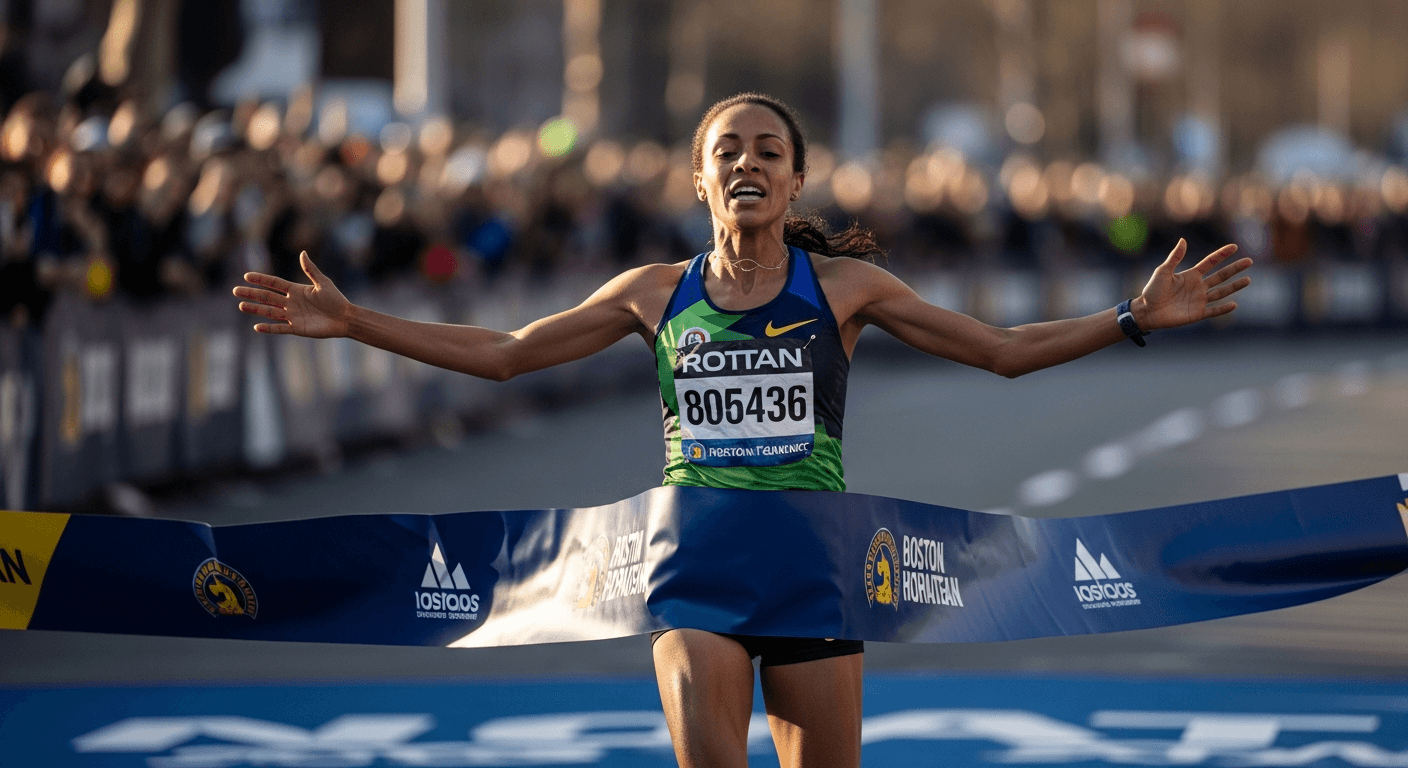
April 20, 2026 delivered one of the most memorable Patriots' Day weekends in the Boston Marathon's 130-year history. Sharon Lokedi crossed the finish line on Boylston Street for the second consecutive year, Marcel Hug cemented his status as the greatest wheelchair racer the event has ever seen, and the weekend kicked off with a world record set not on the course itself, but on a treadmill inside the Boston Expo. Here's what happened.
Lokedi Makes It Back-to-Back
Sharon Lokedi of Kenya defended her Boston Marathon women's title with a dominant performance that silenced any debate about whether her 2025 victory was a one-off. Running in cool, favorable conditions, Lokedi controlled the race through the Newton Hills and pulled clear on the descent into Brookline, finishing ahead of a competitive international field.
It's the kind of repeat that places her firmly in the conversation with the sport's all-time Boston women. Back-to-back wins on this course, with its notorious elevation changes and unpredictable spring weather, require both fitness and tactical maturity. Lokedi showed both.
Her victory is also a statement about the depth of Kenyan women's marathon running. The pipeline of elite talent from East Africa continues to produce athletes who don't just compete at Boston. They dominate it.
Marcel Hug and a Number That Speaks for Itself
If Lokedi's win was the emotional highlight of the women's field, Marcel Hug's performance in the men's wheelchair race was the defining moment of the entire weekend. The Swiss athlete crossed the line in 1:16:06, claiming his ninth Boston wheelchair title. There is no comparable achievement in the history of the division.
Hug, known as "The Silver Bullet," has been competing at the elite level for nearly two decades. At an age when most athletes in any sport are winding down, he's still setting the pace, literally, on one of the most demanding wheelchair courses in the world. Boston's rolling terrain tests chair handling as much as raw power, and Hug reads it better than anyone alive.
Nine titles. Let that settle for a moment. The next closest active competitors have a fraction of that total. Hug's longevity, his ability to adapt his racing strategy across different eras of wheelchair technology, and his consistency at this specific race make the achievement extraordinary by any athletic standard.
Eden Rainbow-Cooper Wins Women's Wheelchair Race
On the women's wheelchair side, Eden Rainbow-Cooper of Great Britain took the title in 1:30:51. It's a significant result for British para-athletics, and Rainbow-Cooper's performance confirmed her status as one of the leading forces in women's wheelchair racing on the world stage.
The women's wheelchair field at Boston has grown increasingly competitive in recent years, attracting athletes who combine explosive upper-body power with the ability to manage Boston's downhill sections without losing control or burning out their shoulders. Rainbow-Cooper handled all of it effectively and finished with time to spare.
The Weekend Started With a World Record at the Expo
Before a single runner had toed the Hopkinton start line, the Boston Marathon weekend had already produced a historic performance. On April 19, the day before the main event, Ashley Paulson set a 100-mile treadmill world record at the Boston Marathon Expo.
The attempt drew a crowd inside the convention space, with spectators watching in real time as Paulson pushed through the physical and mental barriers that come with ultra-distance efforts of this kind. A 100-mile treadmill record is not a soft achievement. The monotony, the need to maintain form across many hours, and the physiological demands of running a distance most people will never attempt on a track, let alone a moving belt, make it a serious athletic feat.
You can follow the full story of the attempt in our dedicated coverage of the 100-Mile Treadmill Record Attempt Live at Boston Expo, which tracked the record effort hour by hour.
Placing this kind of event at the Expo rather than a separate venue was a smart move by the organizers. It brought elite-level performance directly to the tens of thousands of runners collecting their bibs, and it gave the weekend an extra layer of athletic storytelling beyond the road race itself.
A Weekend That Went Beyond the Race
Boston 2026 also stood out for the breadth of stories happening around the main event. The para-athletics divisions continue to grow in both depth and visibility. The wheelchair results this year were not footnotes to the open race. They were headline moments.
The inclusivity dimension of the weekend extended further. Boston 2026 featured one of its largest-ever contingents of visually impaired runners competing alongside their guide partners, a reminder that the marathon's reach extends well beyond elite open racing. Our piece on Boston 2026: Hundreds of Visually Impaired Runners Take the Start covers that side of the weekend in full.
The brand presence at Boston also reflected where road running is heading commercially. Equipment partnerships, athlete signings, and technology integrations were all on display in the Expo halls. Suunto's expanded road running roster ahead of Boston 2026 was one of the more visible examples of how watchmakers and performance tech brands are investing in the marathon space.
What These Results Tell You About Elite Marathon Running in 2026
Lokedi's back-to-back, Hug's ninth title, Rainbow-Cooper's wheelchair win, and Paulson's treadmill record are not isolated achievements. They reflect broader patterns worth paying attention to if you follow the sport seriously.
Consistency is becoming rarer and more valued. The marathon calendar has never been more competitive, with major city races, World Marathon Majors, and a deepening global talent pool making it harder to win once at a top race, let alone twice in succession. Lokedi's repeat puts her in rare company.
Para-athletics is generating its own stars. Hug's career arc is not just a wheelchair racing story. It's an elite sport story about what sustained excellence looks like over two decades. Rainbow-Cooper's win adds another chapter to a women's wheelchair division that's producing athletes with real international profiles.
The marathon weekend is expanding its footprint. Paulson's record at the Expo is a sign of where endurance sports culture is heading. The main race is still the centerpiece, but the surrounding events, the Expo performances, the charity runners, the visually impaired competitors, are becoming part of the core narrative rather than sidebars to it.
Looking Ahead
For Lokedi, the question now is whether she can chase a third consecutive title in 2027, or whether she sets her sights on the major fall marathons in the meantime. For Hug, the question isn't really about what's next. It's about how long he can keep adding to a record that already looks untouchable.
For the rest of us watching, Boston 2026 was a reminder of why this race holds a unique place in the global running calendar. The course is hard. The history is deep. And this year, the performances matched both.
If you're tracking the broader world of endurance events, the Marathon des Sables 2026 results from earlier this spring offer another data point on where ultra and desert running is headed in a year that's already been full of landmark athletic moments.