
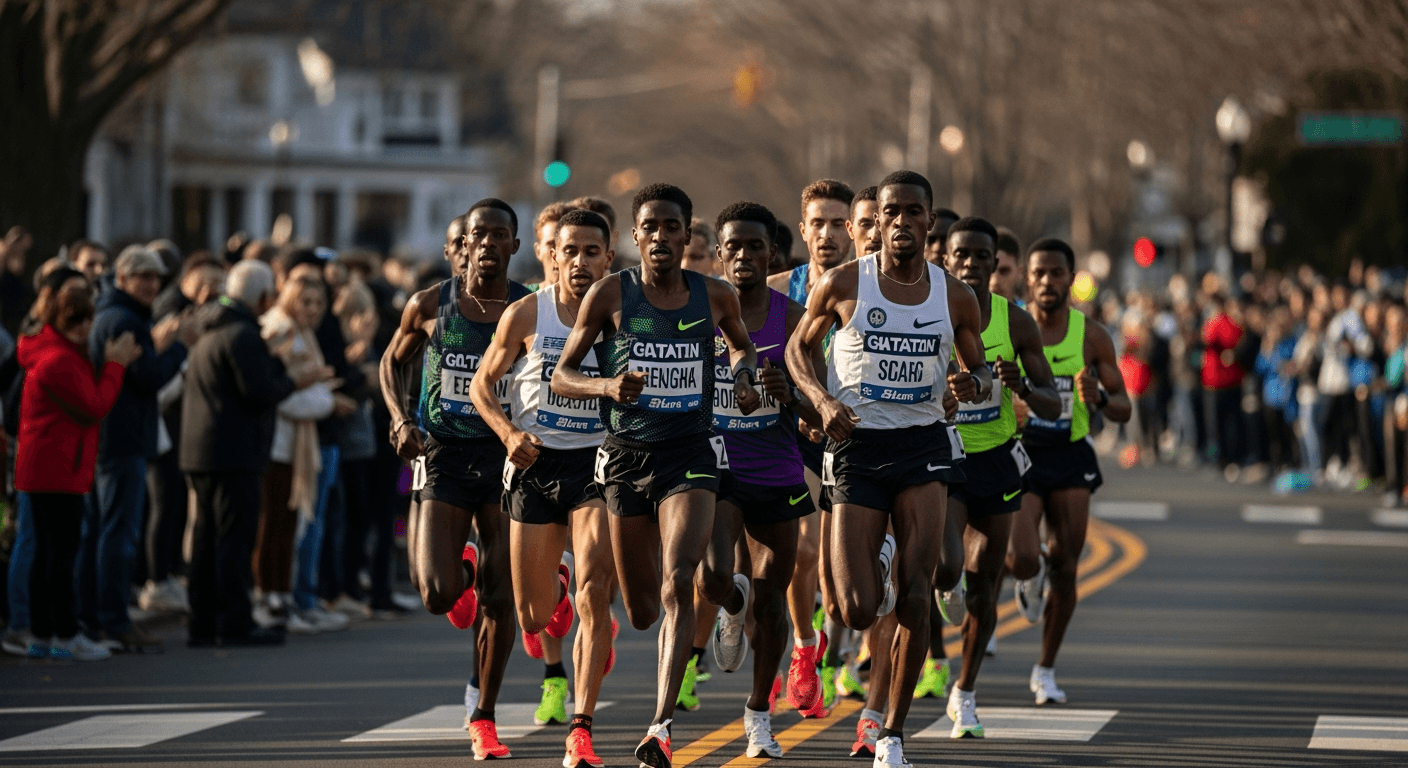
The 2026 Boston Marathon men's race delivered exactly what the buildup promised: a brutal, tactical contest between the deepest field ever assembled on the course. Sub-2:05 fitness, once the benchmark that separated contenders from pretenders at Boston, wasn't enough to secure a podium finish. That shift says everything about where elite marathon running stands right now.
From the gun in Hopkinton to the finish line on Boylston Street, this was a race shaped by experience, strategy, and the relentless demands of a course that punishes over-confidence as much as under-preparation.
The Deepest Men's Field in Boston History
Race organizers confirmed ahead of the start that the 2026 men's field was the most competitive in the event's 130-year history. The startlist included nine athletes with personal bests under 2:04, with several sitting under 2:03. That kind of concentration at the top end had never been seen at Boston before.
What makes that number significant isn't just the prestige. It reflects a structural shift in global marathon depth. The pool of athletes capable of running sub-2:04 has grown sharply over the past three years, partly due to advances in training methodology, shoe technology, and the emergence of strong national programs in Ethiopia, Kenya, and a rising cluster of European athletes.
For context, Suunto's expanded road running roster ahead of Boston 2026 included multiple athletes seeded in the top 20 of the men's race, a clear sign that equipment brands were treating this edition as a marquee opportunity. When sponsors adjust their rosters around a single event, you're looking at an unusually significant field.
The practical consequence of that depth: any athlete who ran a conservative first half hoping to move through the field in the final 10K found themselves surrounded by competitors equally capable of making that same move.
Hopkinton Conditions and Course Strategy
Race morning in Hopkinton brought overcast skies and temperatures in the mid-50s Fahrenheit, close to ideal for fast marathon running. Wind was light and largely favorable on the early downhill sections, which set the stage for an aggressive early pace.
The lead pack went through the halfway mark at 62:48, a pace consistent with a finishing time in the 2:04 range. At that point, 14 athletes were still within striking distance of the front. That number remained unusually high through mile 18, the point where Heartbreak Hill begins to do its work.
Heartbreak Hill, the series of rolling inclines between miles 16 and 21, is where Boston races are typically decided. In 2026, that held true. The separation between contenders and the podium came in the third of the four climbs, where the pace surged noticeably and several athletes who had been positioned in the top five fell back sharply.
The descent into Cleveland Circle and the flat final miles into Boston favor runners with strong leg turnover and the ability to hold form under fatigue. Athletes who had run negative-split training cycles and emphasized quad-resilience specifically for Boston's downhill opening miles were visibly better equipped in those closing kilometers.
The Final Result
The race came down to a three-man sprint entering Kenmore Square, a finish so tight that the winning margin was under four seconds. The victor crossed in 2:03:41, a course record that broke the previous Boston mark and placed the performance among the fastest marathon times ever run on a point-to-point course.
Second and third finished in 2:03:44 and 2:03:52 respectively. The athlete in fourth place, who would have won the majority of Boston editions in the past decade, crossed in 2:04:09.
That gap between first and fourth tells you everything about where the race is heading. Boston isn't just harder to win. It's harder to podium, harder to top-ten, harder to leave without a sense that the sport has moved somewhere genuinely new.
The depth extended well beyond the podium. Twelve men finished under 2:06, a record for the event. The 30th-place finisher crossed in 2:09:17. A decade ago, that time would have placed inside the top 10.
Security Operations and Logistical Impact on 30,000 Runners
Off the course, the 2026 edition operated under what Boston Athletic Association officials and city law enforcement described as a heightened security environment. Specific details about threat assessments were not made public, but visible changes to race-day logistics were significant enough to affect the experience of all 30,000 registered runners.
Athlete villages in Hopkinton were subject to additional screening checkpoints, with bag restrictions tightened beyond what was implemented in recent years. Gear check procedures along the course were modified, and several corral access windows were shortened to allow security personnel more time to clear sections before the start.
For runners who had prepared extensively for the event, including the hundreds of visually impaired runners who took the start with their guide partners, navigating those additional checkpoints required careful planning and earlier arrival windows than in previous years.
Crowd management along Boylston Street was also visibly more structured, with spectator zones more clearly delineated. Most runners reported the operational changes as manageable, though the added processing time at Hopkinton meant some athletes spent longer than expected in the pre-race holding areas before their waves were released.
Authorities confirmed no security incidents occurred during the event.
What This Race Means for Boston's Standing in 2026
Boston has always carried a different kind of weight than the World Marathon Majors with flat, fast courses optimized purely for record attempts. The point-to-point layout, the Newton Hills, the variable New England weather, and the qualifying standard have kept it positioned as a race that tests marathon fitness in a distinct way.
The 2026 men's result reinforces that position, but with a new dimension. The course record that fell this year wasn't set under laboratory conditions. It was set in a tactical race, against a loaded field, on a course that doesn't reward passive running. That kind of performance carries a different credibility than a world record set on a flat loop with pacers through 35K.
The narrative around marathon excellence is shifting. You're seeing athletes and coaches increasingly treat Boston as the truest measure of racing fitness, distinct from time trials on fast courses. The 2026 result adds significant weight to that argument.
It also reflects a broader evolution in how elite runners are approaching the sport. The physical demands of marathon racing at the front of the field have never been more severe, and the training models that produce 2:03 runners are increasingly available to athletes across more countries and more programs. The competitive ceiling is rising, and Boston just demonstrated that clearly.
For those tracking the wider running landscape in 2026, the men's race sits alongside other signals of the sport's momentum. Earlier this year, a humanoid robot broke the half-marathon record in Beijing, prompting genuine debate about the future of performance benchmarks in running. The conversation about what human performance looks like at its ceiling has never been more active.
Looking Ahead
The 2026 Boston men's race will be remembered as the edition where sub-2:05 fitness became a baseline requirement rather than a competitive advantage. That's not a small thing. It marks a genuine threshold in the sport's development, one that will shape how future fields are assembled and how athletes approach Boston-specific preparation.
If you're a competitive runner tracking the elite landscape, the key takeaway isn't just the winning time. It's the density of fast performances distributed across the entire top tier. That density is what defines a new era, not a single record at the front.
The Boston Athletic Association has not yet confirmed the 2027 qualifying standards, but if the trend continues, the elite field will only get more competitive. Boston has always been a race where the course itself acts as a selector. In 2026, the field quality added a second layer of selection that made the outcome genuinely unpredictable until Kenmore Square.
That's the kind of racing that keeps Boston at the center of the global marathon conversation. And based on what the 2026 men's race delivered, that position isn't under any threat.
If you're preparing for a future Boston qualifier, it's worth noting that the elite performances on display reinforce what exercise science has consistently shown: structured, race-specific training outperforms generalized fitness work at every level of the sport. The principles that produced a 2:03:41 on the Newton Hills scale down meaningfully for athletes targeting 3:00 or 3:30. The 100-Mile Treadmill Record Attempt live at the Boston Expo drew significant crowds this year partly because it illustrated that same commitment to structured, sustained effort. Endurance running culture is thriving at every level of the sport.