
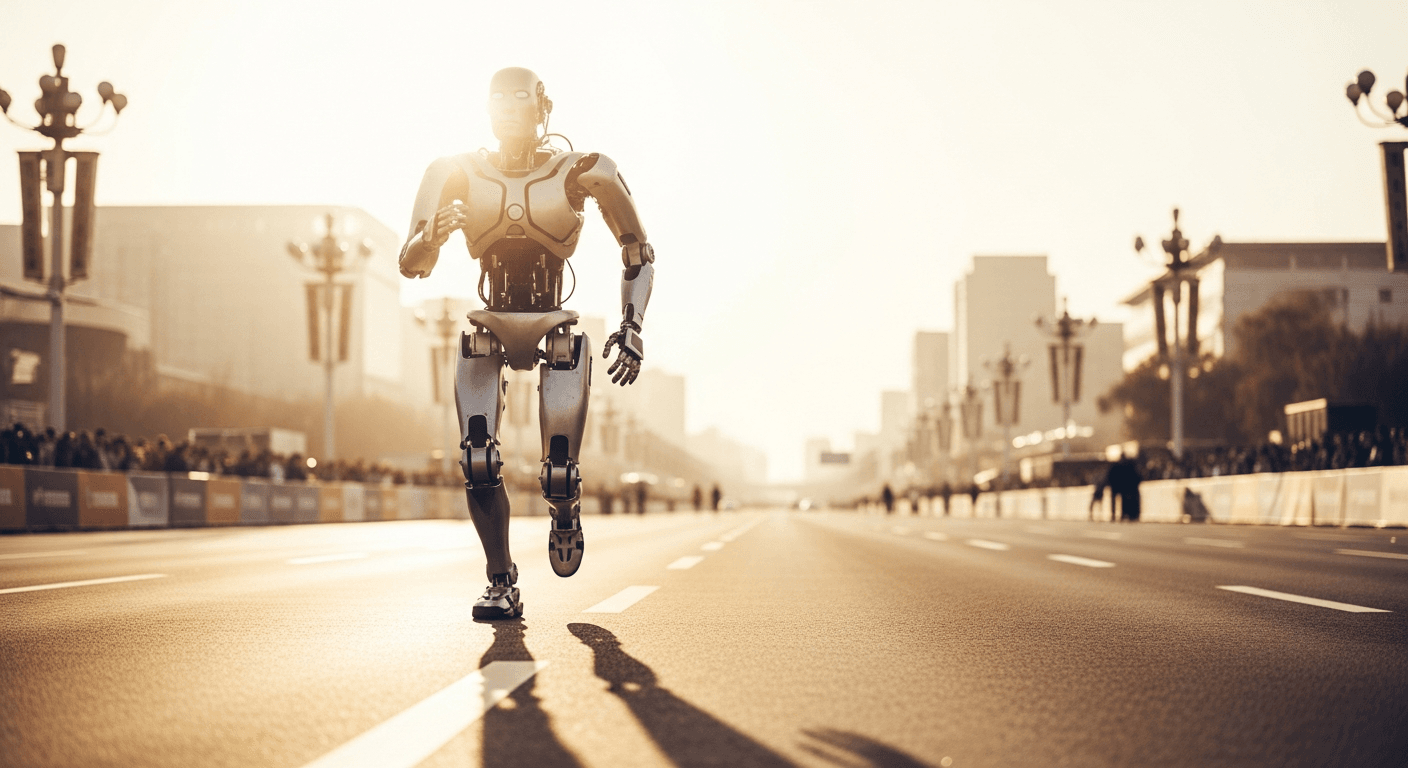
On April 19, 2025, a bipedal humanoid robot named Tiangong Ultra crossed the finish line of a half-marathon in Beijing in 2 hours, 40 minutes, and 42 seconds. That time sits well above the human world record of 57:31 set by Jacob Kiplimo. But here's the part worth paying attention to: it finished. Upright. On two legs. Covering 13.1 miles across a live race course, alongside human competitors.
It wasn't just a lab demonstration. It was a formal endurance event, organized by the Beijing Economic-Technological Development Area, where 21 humanoid robots from different manufacturers lined up at the start. Six completed the full distance. The rest dropped out due to mechanical failures, overheating, or falls. The experience looked, from the outside, like any other race day. Except the athletes were machines.
What Actually Happened on That Course
Tiangong Ultra, built by the Beijing Humanoid Robot Innovation Center, maintained an average pace just over 12 minutes per mile across the entire half-marathon distance. That's slower than most recreational runners, but the significance isn't in the speed. It's in the sustained, autonomous bipedal locomotion across real-world terrain, without stopping, without external support, and without human intervention.
The robot ran on battery packs that required swapping mid-race. Technicians were on hand for that specific task, which some observers flagged as a technical caveat. Multiple robots required battery changes or brief maintenance stops. Whether that disqualifies a performance under any formal athletic framework is a question nobody had a rulebook ready to answer, because nobody had quite planned for this.
One robot fell. Several overheated. The attrition rate among the field was roughly 70 percent. That failure rate is actually useful context. It tells you that running a half-marathon, even slowly, remains a brutally demanding physical task. Human bodies have evolved over millions of years to do exactly this. Robots are still catching up.
Why a Race Setting Changes the Conversation
There's a meaningful difference between a controlled lab test and a competitive race environment. Road surfaces are uneven. Weather adds friction and heat load. Crowds create noise and navigational interference. A formal start line, a timed finish, and other competitors alongside you turn a benchmark into an event.
The Beijing race was structured like a real athletic competition, which makes it harder to dismiss as a publicity stunt. The robots were registered participants. Times were recorded. The organizers clearly intended to draw a line between engineering demonstrations and actual athletic performance. That framing matters, because it puts the conversation inside the world of sport, not just the world of technology.
Endurance running is already absorbing technological disruption at pace. Wearable platforms are converging with performance data in ways that would have seemed far-fetched a decade ago. The HYROX and Amazfit three-year global partnership is one example of how fitness competitions are formalizing their relationship with hardware manufacturers. Robots competing in races is a more radical version of the same trend line.
What the Running Community Is Actually Asking
The reaction from serious runners has been a mix of curiosity and philosophical discomfort. Not because anyone feels threatened. But because a robot finishing a half-marathon forces you to ask what a record actually means.
Athletic records exist to measure human achievement against human limits. When Jacob Kiplimo ran a half-marathon in under 58 minutes, that number told you something profound about what a human body can do under optimal conditions. It captured training, physiology, willpower, and competitive pressure compressed into a single data point. A robot's finishing time tells you something different. It tells you about motor control engineering, battery efficiency, and software iteration.
Those are genuinely impressive things. But they're not the same thing. And conflating the two categories risks making both measurements less meaningful.
Mass participation running has also been expanding its own definition of what counts as a legitimate athletic achievement. Events like the Boston Marathon 2026, where 30,000 runners converge on Hopkinton, or the Jerusalem Marathon where 50,000 runners completed the course despite ongoing conflict, are testaments to what human bodies accomplish under pressure, fatigue, and emotion. That context is part of what makes a finishing time mean something.
The Physiology Lesson You Didn't Expect
Here's one underappreciated angle: watching robots struggle with a half-marathon illuminates human physiology in a surprisingly useful way.
Consider what engineers had to solve to get Tiangong Ultra to the finish line. Dynamic balance across shifting terrain. Real-time gait adjustments to manage energy expenditure. Thermal regulation under sustained cardiovascular load. Joint mechanics that distribute impact forces without catastrophic failure. Every one of those engineering problems is something the human body solves automatically, refined through evolutionary pressure over tens of thousands of generations.
The overheating failures among competing robots underscore how sophisticated human thermoregulation is. You sweat. You redistribute blood flow. You slow down when core temperature rises and accelerate recovery. No current robot does any of that with comparable elegance. The 70 percent attrition rate in Beijing was, in a strange way, a tribute to how extraordinary human endurance actually is.
That perspective reframes how you think about your own training. The mechanical challenges engineers are still solving are things your body handles every time you lace up. The limits you're working against are different in kind from mechanical failure. They're neurological, metabolic, and psychological. Which makes the work of improving them genuinely interesting.
Should Sports Governing Bodies Respond Now?
World Athletics and national governing bodies have not issued formal statements classifying robotic participation in road races. That's understandable. One event in Beijing doesn't require an immediate policy framework. But the conversation is worth starting before it becomes urgent.
A few practical questions are already on the table. Should robots be permitted to enter open road races alongside human participants? If a robot eventually completes a half-marathon faster than any human, does that time appear in any record book? Should there be a separate competitive category entirely, the way para-athletics developed its own classification system? And who governs that category if commercial manufacturers are the primary developers?
None of these are simple questions. But the running community is well-practiced at navigating difficult ones. The integration of carbon-plated footwear into elite competition triggered years of debate about technological advantage and athletic legitimacy. Innovations like hands-free performance running shoes continue to push the boundaries of what footwear assistance means. Robotic participation is a larger version of the same question: where does human performance end and technology-assisted performance begin?
The Competitive Record Question
It's worth being precise about what didn't happen in Beijing. No human world record was broken. The robots ran slower than any elite human. The headline framing that a robot "broke" a record was misleading in that technical sense.
What did happen is something more interesting. A machine completed a standardized endurance distance in a formal race environment for the first time, demonstrating that bipedal robots can now sustain long-duration locomotive effort under real-world conditions. That's a genuine milestone in robotics, even if it's not a milestone in athletics.
The distinction matters because conflating the two does a disservice to both fields. Engineers deserve credit for an engineering achievement. Runners deserve a record category that remains a measure of human capability. Keeping those frameworks separate isn't defensive or reactionary. It's just precise.
What you can reasonably expect is that robotic half-marathon times will drop significantly over the next decade. The engineering trajectory from lab prototype to competitive pace is steep but predictable. When robots start running sub-90-minute half-marathons, which is plausible within years rather than decades, the governance conversation will no longer be optional.
What You Take Away From This
If you're a runner, the Beijing event is worth knowing about for reasons beyond the headline novelty. It offers a concrete illustration of what your body does every time you run. The systems you take for granted. The adaptations you've built through training. The physiological intelligence your legs carry that no current robot can fully replicate.
It's also a signal that competitive sport is entering territory where the rules haven't been written yet. Endurance running has always been a sport defined by human limits. How the community chooses to protect and evolve that definition will shape what records mean for the next generation of athletes.
The race in Beijing didn't change running. But it started a conversation that running can't afford to ignore.