
Walk into any specialty running store right now and you'll face a wall of trail shoes that looks nothing like it did five years ago. Max-cushion options like the ASICS Trabuco MAX 6 sit next to stripped-back race models, minimalist fell shoes, and everything in between. If you're new to trails, the choice is genuinely overwhelming. And most of the buying guides online don't help, because they skip the three variables that actually determine which shoe works for you.
This guide cuts through the noise with a decision framework built around terrain, distance, and how your body moves. Get those three things right and the rest of the spec sheet falls into place.
The Three Variables Most Beginners Ignore
Trail running attracts a lot of road runners looking to change things up, and the instinct is to grab a trail shoe the same way you'd grab a road shoe: pick a trusted brand, check the price, and go. That approach breaks down quickly once the terrain gets interesting.
The three variables that actually drive shoe selection are terrain type, weekly mileage, and foot strike pattern under fatigue. That last one matters more than most people realize. Your foot strike at mile two is not your foot strike at mile eighteen. A shoe that feels responsive and controlled early in a run can expose you to impact forces later when your mechanics deteriorate. Any shoe recommendation that ignores this is incomplete.
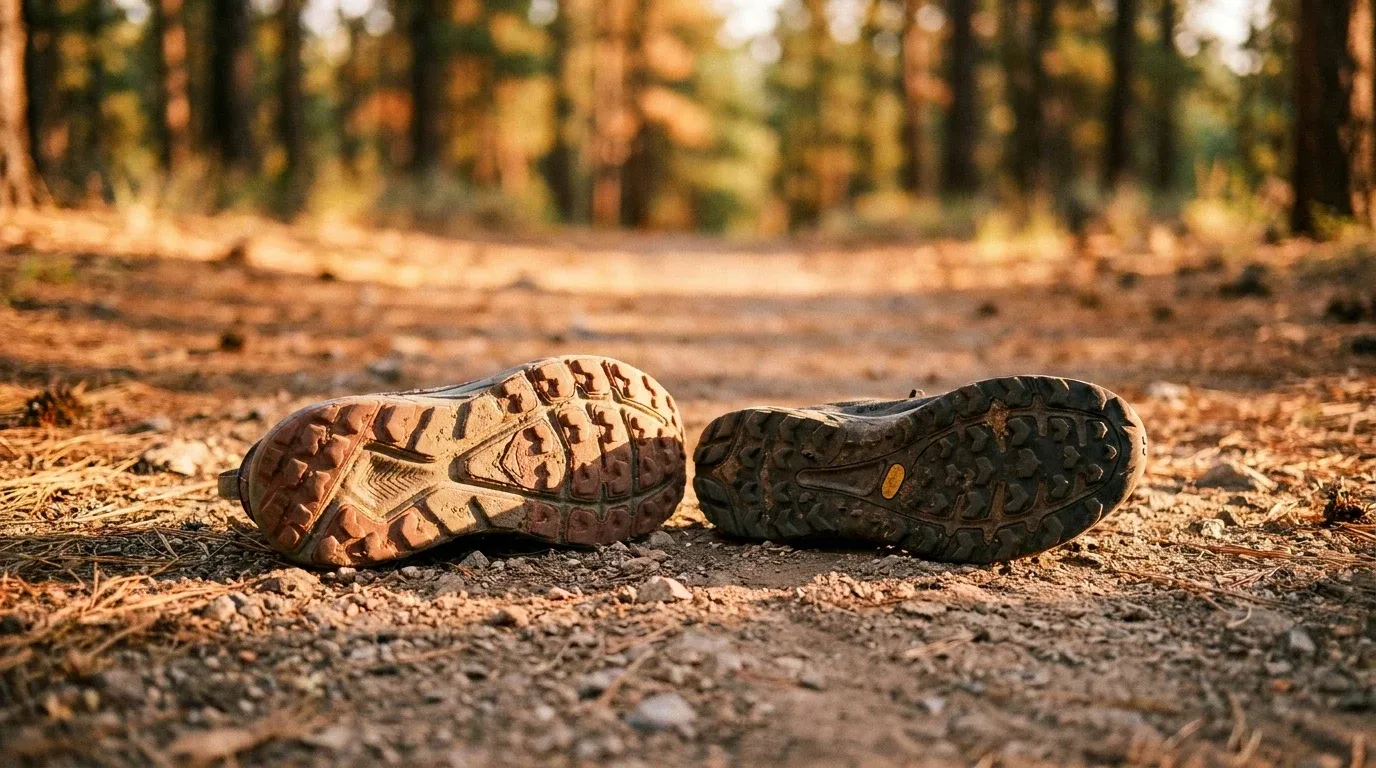
Terrain type breaks down into three broad categories: packed dirt and gravel trails, technical rocky terrain, and wet or muddy conditions. Each demands different things from your outsole. Packed dirt is forgiving and doesn't require aggressive lugs. Rocky terrain rewards lower stack heights and stiffer rock plates that protect the foot without sacrificing feel. Mud demands widely spaced, deep lugs that shed debris rather than clog.
Weekly mileage determines how much cushioning you need. If you're running three to four hours a week on trails, a mid-stack shoe in the 25-30mm range gives you protection without killing ground feel. Push past seven or eight hours a week on technical or mountainous terrain and the case for a max-stack build gets much stronger.
Max-Stack vs. Low-Stack: What the Trade-Off Actually Means
The arrival of max-cushion trail shoes has changed the market in ways that weren't predictable even two years ago. The ASICS Trabuco MAX 6, with its thick stack of FF BLAST+ foam, represents a philosophy borrowed directly from road ultra training: protect the legs over very long efforts so you can keep moving comfortably for hours.
That philosophy makes sense for the right runner. If you're preparing for a 50-miler on mixed terrain, or you're a heavier runner covering sustained distances, a max-stack shoe reduces cumulative fatigue significantly. It's not a gimmick. Studies on long-distance running consistently show that cushioning delays the onset of muscle damage markers when load is high enough.
But there's a real cost on technical terrain. High stack heights raise your center of gravity and reduce the proprioceptive feedback your foot sends to your brain. On loose rock, that feedback is what keeps you from rolling an ankle. When trail runners talk about "ground feel," they're describing a genuinely functional safety mechanism, not just a preference.
Low-stack trail shoes, typically 20-25mm at the heel, keep you closer to the ground. They're faster and more responsive on technical sections, but they demand more from your legs over long efforts. For short, aggressive mountain runs or races with significant technical content, they're often the better tool. For 40-mile weeks on mellower singletrack, the max-stack option is worth serious consideration.
The growth of longer trail and ultra events has accelerated this split. As prize money reshapes the ultra-running landscape, more runners are logging serious volume on trails for the first time, and their shoe needs look very different from those of a weekend warrior doing two-hour runs in the hills.
Lug Depth, Rubber Compound, and Drop: Why They Can't Be Separated
Trail shoe specs list lug depth, outsole rubber compound, and heel-to-toe drop as separate numbers. In practice, they interact with each other and with your running form in ways that make a one-number approach misleading.
Lug depth is measured in millimeters and ranges from about 3mm on hardpack-focused shoes to 6mm or more on mud-specific models. Deeper lugs grip better in soft ground but create an uneven contact surface on hard-packed dirt, which can actually reduce grip and increase energy cost. Match lug depth to your most common surface, not your most dramatic planned adventure.
Outsole rubber compound affects both grip and durability. Softer compounds like Vibram Megagrip deliver outstanding traction on wet rock but wear faster on abrasive dry trails. Harder compounds last longer but can feel slick in wet conditions. Most mainstream trail shoes use a blended compound that balances the two, which is fine for most beginners. If you're running predominantly on wet British Columbia or Scottish Highland terrain, it's worth looking specifically for Megagrip or equivalent soft-rubber outsoles.
Heel-to-toe drop is the height difference between the heel and forefoot, measured in millimeters. Road runners often move to trail with a 10-12mm drop shoe, which is fine for maintaining Achilles comfort on technical descents. Lower drop shoes (4-8mm) encourage a more midfoot strike, reduce braking forces on downhills, and pair well with stronger calf and foot strength. If you're coming from zero strength work, dropping your heel-to-toe drop aggressively overnight is a reliable way to earn a calf strain.
The interaction between drop and lug depth is subtle but real. A high-drop shoe with deep lugs changes your contact angle in ways that can stress the ankle on uneven surfaces. A low-drop shoe with a stiff rock plate and moderate lugs tends to be more stable across varied terrain. These aren't combinations you'll find spelled out on a spec sheet, which is why hands-on fitting at a specialty store still matters.
How to Actually Test a Trail Shoe Before You Buy
Most runners buy trail shoes the same way they buy road shoes: try them on, jog a few steps on a flat store floor, and decide. That process tells you almost nothing useful about trail performance.
When you try on a trail shoe, here's what to actually test. Walk on the steepest incline in the store to check heel lockdown. If your heel lifts in the collar on a simple incline, it'll lift on descent and you'll lose toenails on longer runs. Push down on the toe box with your thumb to check rock plate stiffness. Flex the shoe laterally to feel how much torsional stability it offers. And pay attention to fit in the forefoot: trail shoes generally need a wider toe box than road shoes to accommodate foot splay on uneven terrain.
Many specialty stores offer outdoor test loops now. Use them. Even a short run on dirt or gravel will tell you more than ten minutes on carpet.
Budget-wise, entry-level trail shoes from reputable brands start around $110-130. Mid-tier options with better outsoles and protection land at $150-180. Max-stack and premium race models typically run $180-220. You don't need to spend at the top end to start, but buying a $60 trail shoe from a non-specialist brand is a false economy when your safety on loose terrain depends on outsole grip and ankle support.
Matching the Shoe to Where You're Actually Headed
If you're just getting started on trails and your runs look like 60-90 minute efforts on well-maintained dirt or gravel paths, a mid-stack all-rounder with 4mm lugs and a 6-8mm drop is probably your best starting point. It won't be perfect for anything, but it'll be competent across the range of conditions you'll encounter.
If you're planning to push into longer efforts, your nutrition strategy matters as much as your shoe choice. Consistent training volume is built on recovery, and factors like how ultra-processed foods affect your recovery become more relevant as mileage climbs. Your gear choices and your fueling strategy are part of the same system.
If technical mountain running is your goal, start with a lower-stack option with a Vibram or equivalent soft-rubber outsole and accept that the learning curve on rocky terrain is steep regardless of what's on your feet. No shoe substitutes for time on trail.
And if you're genuinely targeting long ultras in the next eighteen months, the max-cushion category is worth taking seriously. Events like Tunnel Hill are producing fast times on high-volume training, and the runners logging those efforts aren't choosing max-stack shoes arbitrarily. Leg preservation over distance is a legitimate performance strategy.
One More Thing Worth Knowing
Trail shoe fit changes as the category evolves. The shoe that suits you at 20 miles per week may not suit you at 50. Build in a reassessment point after three to four months of consistent trail running. By then you'll know your terrain preferences, your fatigue patterns, and whether the cushioning level you chose is working for you or against you. Your first trail shoe is a starting point, not a permanent answer.
The runners winning trail ultras at the top level, as seen at events like Ultra-Trail Ninghai, are using highly specific equipment matched to course conditions. That specificity is built on years of terrain experience. Your job right now is to build that experience, one honest run at a time.