
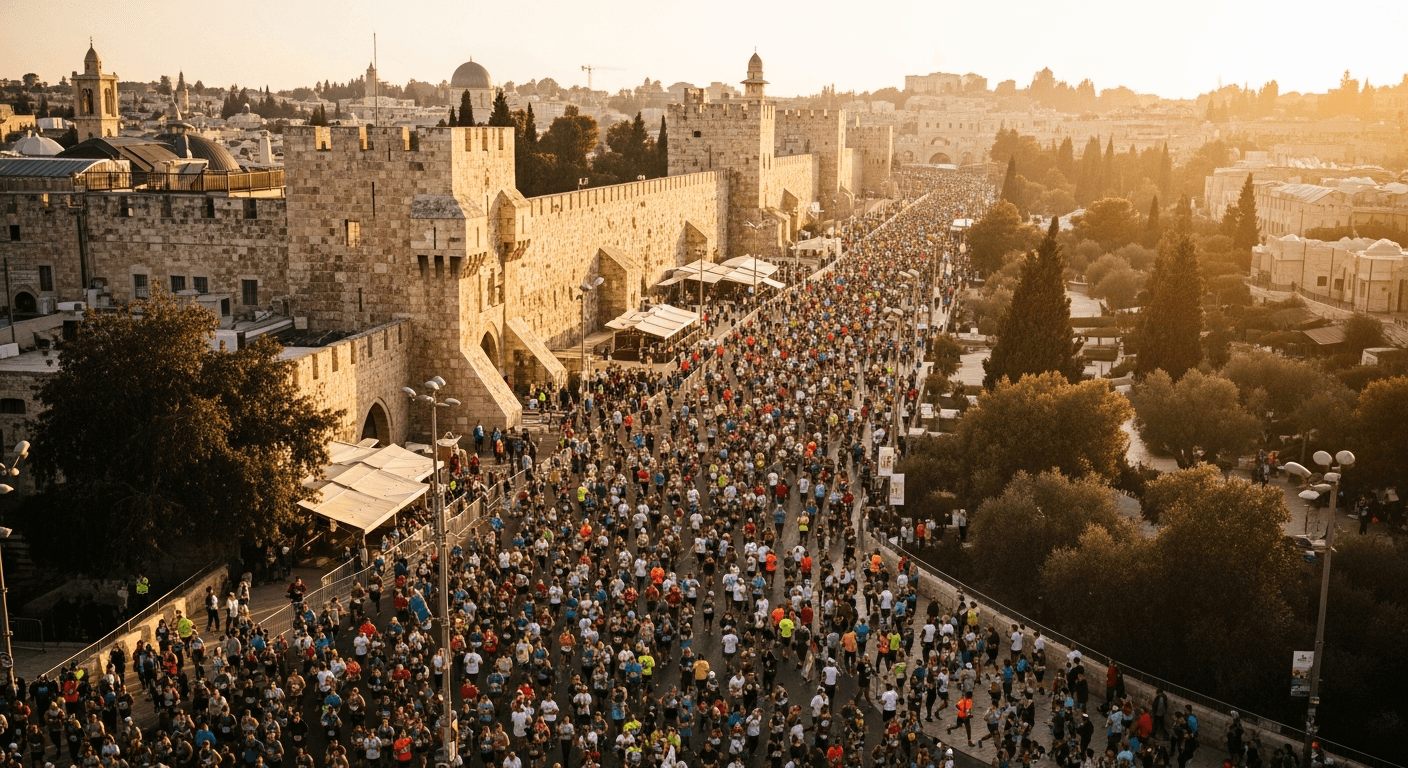
There are races that exist purely as performance events. Then there are races that mean something beyond the finish line. The 2026 Jerusalem Marathon belongs firmly in the second category. With 50,000 participants crossing the start line through a city that remains at the center of one of the world's most active regional conflicts, the event delivered something that no training plan or race calendar could have scripted.
This wasn't just a marathon. It was a statement about what running communities do when the world outside gets harder.
A Race That Almost Didn't Happen
Organizing a mass participation event of this scale is a logistical challenge under any circumstances. Doing it against the backdrop of ongoing regional conflict requires a different level of commitment entirely. Race organizers, city officials, and security forces worked in close coordination to make the event viable, with enhanced safety protocols in place across the course.
The fact that 50,000 people showed up anyway says everything. Entries came from dozens of countries, with both local Israeli runners and international participants making the decision to travel and compete. For many, pulling out would have been the easier choice. They didn't.
The Jerusalem Marathon has always carried a particular weight. The course winds through ancient streets, past landmarks that carry centuries of contested history, through neighborhoods that exist nowhere else on Earth. Running it is a different experience from running Berlin or Chicago. The 2026 edition made that contrast even sharper.
One of the Largest Mass Participation Runs in the Middle East This Year
By participation numbers alone, the Jerusalem Marathon ranks as one of the biggest running events in the Middle East in 2026. Fifty thousand runners across multiple distances, from a full marathon to a 10K, made it a genuine mass participation occasion rather than an elite-focused race.
For context, the global running calendar has been remarkably active this year. Rotterdam Marathon earned World Athletics recognition for its course quality and organization standards. Boston Marathon 2026 continued to draw the sport's top competitors and over 30,000 finishers. Jerusalem now sits alongside those events not necessarily on performance metrics, but on the sheer scale and significance of the gathering.
What's worth noting about mass participation events in particular is that the majority of runners aren't chasing podiums. They're chasing personal milestones, community connection, or in some cases, a reason to keep moving forward when life makes that difficult. Jerusalem 2026 had all of that, amplified considerably by its context.
Running as a Resilient Act
Sport has a long history of continuing through crisis. The Olympics proceeded under extraordinary political tension throughout the Cold War. City marathons returned to New York, Boston, and London in the wake of terrorist attacks. What these moments share is a refusal to let fear permanently close the space that sport creates.
Running is particularly suited to that role. It requires almost nothing in the way of infrastructure. You don't need a facility, a team, or an opponent. You need shoes, a surface, and the will to move. That simplicity is part of why running communities tend to be resilient. They can adapt, relocate, reduce, and still keep going.
The research on exercise and psychological resilience is consistent on this point. Regular aerobic activity is associated with lower rates of anxiety and depression, improved stress tolerance, and stronger social bonds when practiced in group settings. A marathon, by that measure, isn't just a physical challenge. It's a collective act of stress regulation at scale.
For runners preparing for their own events, the Jerusalem Marathon is also a reminder of what proper training commitment looks like. If you're building toward a long-distance goal, understanding how AI tools are changing injury recovery for runners in 2026 can help you stay on course when setbacks threaten to derail your preparation.
Who Was Running and Why
The participant breakdown at Jerusalem 2026 reflects the broad appeal of the event. Local runners made up a significant portion of the field, with many citing a determination not to let the conflict dictate the rhythms of normal life. International runners came from Europe, North America, and beyond, some specifically motivated by the political situation rather than deterred by it.
Charity running was also a major component. Multiple organizations used the race as a fundraising platform, a common feature of large city marathons that transforms individual athletic goals into collective social purpose. When you're running for a cause that matters to you, the difficulty of the distance changes character. It becomes something you endure on behalf of something larger.
The diversity of motivation on a start line like Jerusalem's is part of what makes mass running events genuinely moving to witness, even on paper. The 50,000 people who ran weren't a uniform group with a single agenda. They were runners, in all the variation that word covers.
What Events Like This Tell Us About Running's Global Reach
The Jerusalem Marathon sits within a broader trend worth paying attention to. Running participation globally has not declined in the face of geopolitical instability, economic pressure, or the lingering behavioral changes from the pandemic years. If anything, the data points in the other direction.
Trail running has seen particularly strong entry numbers this year. The latest participation data on trail running shows consistent growth in race entries across North America, Europe, and Asia Pacific, suggesting that people are actively seeking out challenging physical experiences rather than retreating from them.
Road marathons tell a similar story. Events with strong local identity and cultural resonance continue to draw fields that would have seemed aspirational a decade ago. Jerusalem is a case in point. The fact that 50,000 runners gathered there in 2026 isn't incidental to the conflict. For many participants, it's directly because of it.
Training for High-Stakes Events
If the Jerusalem Marathon has you thinking about committing to a major race yourself, the training principles that apply are the same regardless of geography. The physical demands of a marathon don't change because the course runs through a contested city.
What does matter is that you train smart. Recovery is increasingly recognized as the variable that separates consistent performers from those who plateau or break down. Understanding recovery-first training principles applies as much to endurance athletes as it does to strength-focused gym goers. You build fitness during rest, not during the run itself.
Nutrition also plays a role that often gets underestimated in marathon preparation. Gut health in particular has emerged as a meaningful factor in endurance performance. Runners who experience gastrointestinal distress during races often find that their training nutrition didn't adequately prepare their digestive system for race-day demands. The connection between the microbiome and athletic performance is better understood now than it was even five years ago.
Sleep, stress management, and volume periodization all feed into the same equation. The runners who finished in Jerusalem had put in weeks and months of work to get there. The circumstances of the race added an emotional layer that no training block could have anticipated, but the physical preparation still had to happen.
Why This Race Matters Beyond the Results
Race results from Jerusalem 2026 will filter through the athletics community in the usual way. Course records, age group winners, and finish time distributions will be analyzed and cataloged. That data will matter to the athletes who chased it.
But the larger significance of this event doesn't live in a results spreadsheet. It lives in the image of 50,000 people choosing to run through a city that the world has been watching with anxiety, choosing to line up together, choosing to move forward.
Running has always been this. It existed before organized sport, before timing chips, before GPS watches. It's one of the oldest human movements, and communities have used it to process grief, mark transitions, and assert that life continues. Jerusalem 2026 is a particularly vivid example of that impulse. It won't be the last.
If you're building toward your own race this year, whether that's a local 10K or a destination marathon, the Jerusalem Marathon is a useful reminder of what the finish line actually represents. It's not just a time on a clock. It's evidence that you kept going.