
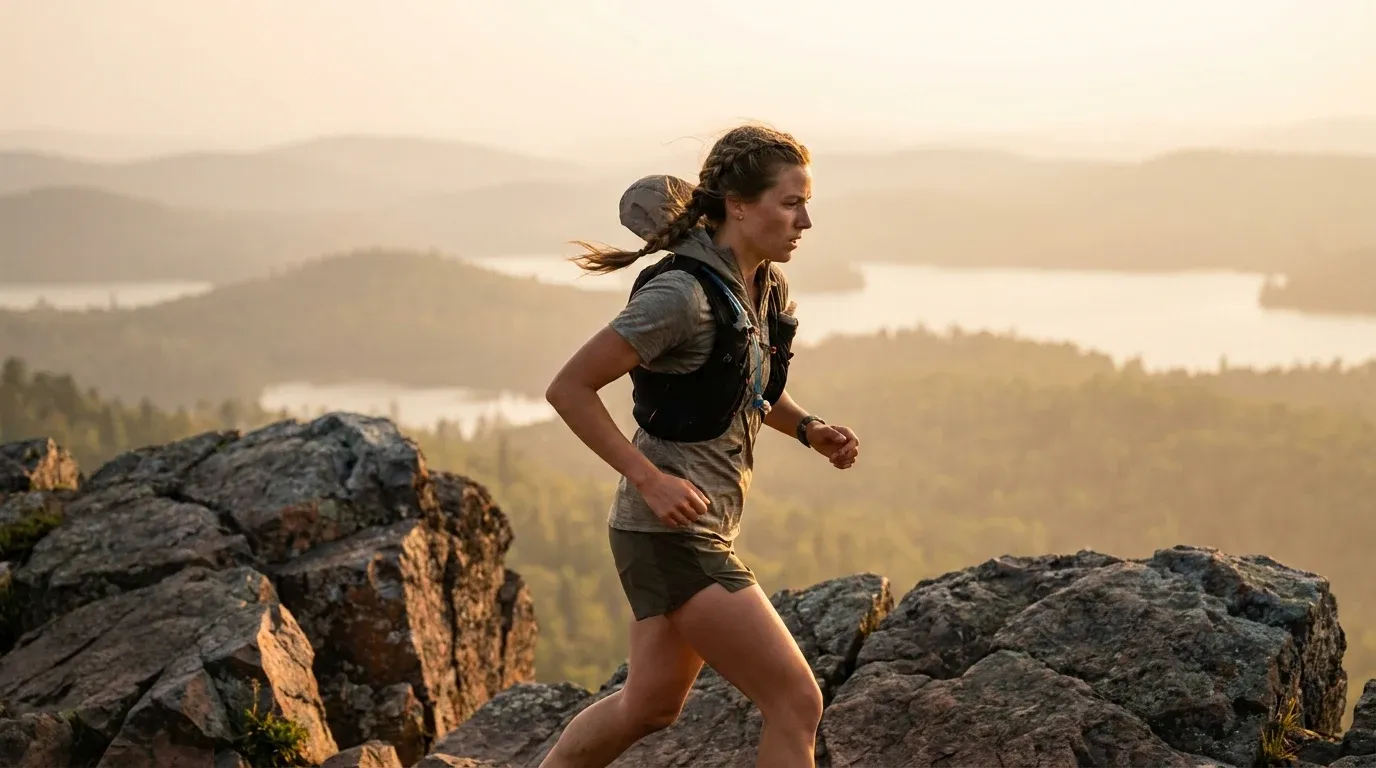
There's a version of athletic retirement that looks like a slow fade: fewer competitions, a book deal, maybe a coaching role. Jessie Diggins is writing a different story. On September 17, 2026, the two-time Olympic cross-country skiing champion crossed the finish line of the Superior Fall Trail Race in northern Minnesota. First place, women's division. First time racing 100 miles on foot. At 35 years old.
It's one of the most compelling crossover performances in endurance sport this decade, and it raises a real question: what separates elite athletes who successfully pivot sports from those who don't?
What the Superior Fall Trail Race Actually Demands
The Superior Fall Trail Race runs along Minnesota's North Shore, tracing the Superior Hiking Trail through dense forest, over exposed ridgelines, and across terrain that punishes anything less than full technical attention. The course is notoriously rocky. Wet rocks, loose rocks, root tangles that look like solid ground until they aren't. Rain is a near-constant variable in mid-September, and 2026 was no exception.
This isn't a road ultra with a trail aesthetic. The Superior 100 is a race where raw fitness only gets you so far. You need ankle stability, proprioception, the ability to read ground conditions at speed, and the mental architecture to keep moving when your body is filing loud complaints. The average finishing time for competitive women hovers above 30 hours. Diggins finished ahead of that curve.
If you want to understand the specific demands placed on the posterior chain during races like this, Glute Training and Biomechanics: Why Most Lifters Get It Wrong offers a useful breakdown of why hip extension power and glute activation matter far more on technical terrain than most runners appreciate.
A Career Built on Suffering Well
Diggins won gold at the 2018 Winter Olympics in the team sprint relay, then added an individual gold in the skiathlon at the 2022 Beijing Games. Cross-country skiing at the Olympic level demands a VO2 max in the top fraction of human capacity, the ability to sustain near-maximal output for extended periods, and perhaps most critically, a high tolerance for the specific misery of oxygen debt and muscle burn that most people step away from.
That psychological skill doesn't transfer to a new sport automatically. But it does create a foundation. Diggins has spoken in past interviews about learning to separate the sensation of discomfort from the meaning she assigns to it. Pain as information, not as a stop sign. That's a trained skill, and it's directly applicable to the final 30 miles of a 100-mile trail race when every logical signal in your body is arguing for the exit.
Her skiing background also provided a cardiovascular engine that trail running training could build on rather than construct from scratch. The aerobic demands of skate skiing and classical skiing are extreme. Studies on elite cross-country skiers consistently place their VO2 max values among the highest ever recorded in any sport, with top performers regularly exceeding 80 ml/kg/min. That base doesn't disappear when you change disciplines. It gets redirected.
The Training Pivot: How She Made It Work
Diggins began logging serious trail miles in early 2026, roughly nine months before the race. By most standards, that's a short runway for a 100-mile debut. Elite ultramarathon runners typically spend years accumulating the volume and vertical gain that make the distance manageable. But Diggins wasn't starting from zero fitness. She was converting it.
The debate around Intensity vs. Volume: What Actually Matters for Ultra Training is worth reading here, because her preparation appeared to lean heavily on volume. Long days on technical terrain, back-to-back efforts that simulate race fatigue, and a deliberate focus on running economy over raw speed.
She also leaned into the specificity of the Superior course itself, training on comparable terrain in the months prior. Trail running rewards course-specific preparation in ways that road racing often doesn't. The rock type, the elevation profile, the drainage patterns after rain. These aren't abstract factors. They determine whether your ankles and hips hold up when you're 70 miles in and operating on two hours of sleep.
What Nutrition Looks Like at 100 Miles
Fueling a 100-mile effort is a different equation than fueling a marathon. The caloric demand is enormous, the gut is under sustained stress, and palatability shifts in ways that can derail even well-prepared athletes. Liquid calories, simple carbohydrates, and small-volume high-density foods become the architecture of race-day nutrition.
The sports nutrition landscape has shifted dramatically on this front in recent years. From Steak to 120g/hr: How Cycling Rewrote Sports Nutrition documents how the ceiling on carbohydrate absorption has been pushed upward through gut training, a strategy increasingly adopted by ultra runners who need to sustain output across 24-plus hours.
There's also growing interest in whether certain foods support performance at a more granular level. Research into whether blueberries actually boost trail running performance points to antioxidant and anti-inflammatory mechanisms that could matter across a multi-day effort, though the evidence remains preliminary. What's clear is that nutrition at this distance is as much about damage mitigation as it is about energy delivery.
What Makes This Crossover Story Different
Athlete crossover stories happen every year. Cyclists take up running. Swimmers try triathlon. Former collegiate rowers show up at CrossFit competitions. Most of these transitions produce respectable results, occasionally impressive ones. Diggins winning a 100-miler on debut at 35 sits in a different category.
It's not just that she won. It's the specific demands of what she won. The Superior Fall Trail Race isn't a soft entry point into ultra running. It's one of the gnarlier 100-mile courses in North America. Technical trail skills, weather adaptability, multi-hour night running through rocky forest. These are competencies that typically take years to develop, and she put them together in under a year at a competitive level.
The ultra running community has noticed. Part of what makes that community remarkable is its openness to exactly this kind of story, as explored in Why Trail Running's Community Culture Is Unlike Any Other Sport. The culture rewards grit and process over pedigree, which means a two-time Olympic champion gets the same trail respect as a first-time finisher, earned mile by mile in the dark.
What This Tells You About Athletic Longevity
There's a persistent narrative in sport that peak performance has an expiration date, and that 35 represents the beginning of the end rather than the beginning of something new. Diggins is not the first athlete to challenge that, but she's making the case loudly.
Elite endurance athletes who pivot sports later in their careers tend to share a few characteristics. They carry a massive aerobic base. They've developed sophisticated body awareness from years of high-level training. And they've built the psychological tools to manage discomfort across long efforts. These assets don't age at the same rate as raw speed or explosive power. In some ways they compound.
Strength and longevity research increasingly supports the idea that older athletes can maintain and even develop capacity in ways that weren't previously understood. Recovery protocols, strength work targeting movement quality rather than load, and strategic periodization all allow athletes to extend their performance window well past conventional assumptions. The body at 35 is not the same as the body at 25, but it's not a decline story by default. It's a different optimization problem.
Why You Should Pay Attention to What Comes Next
Diggins hasn't announced whether the Superior win is a one-off experiment or the start of a sustained ultra running career. Given her history, a single race feels like a data point rather than a conclusion. Olympic athletes with her profile tend to be methodical, goal-oriented, and motivated by new challenges rather than comfort.
If she continues in ultra running, the 2027 calendar will be worth watching. Western States. UTMB. Hardrock. These are the races that define careers in the discipline, and a debut victory at Superior suggests she's not merely participating. She's competing.
For now, the win stands on its own. An Olympic champion, 35 years old, crossing a finish line in northern Minnesota after 100 miles of wet rock and forest trail, having started that race for the first time. It's the kind of performance that reminds you the most interesting chapters don't always come first.