
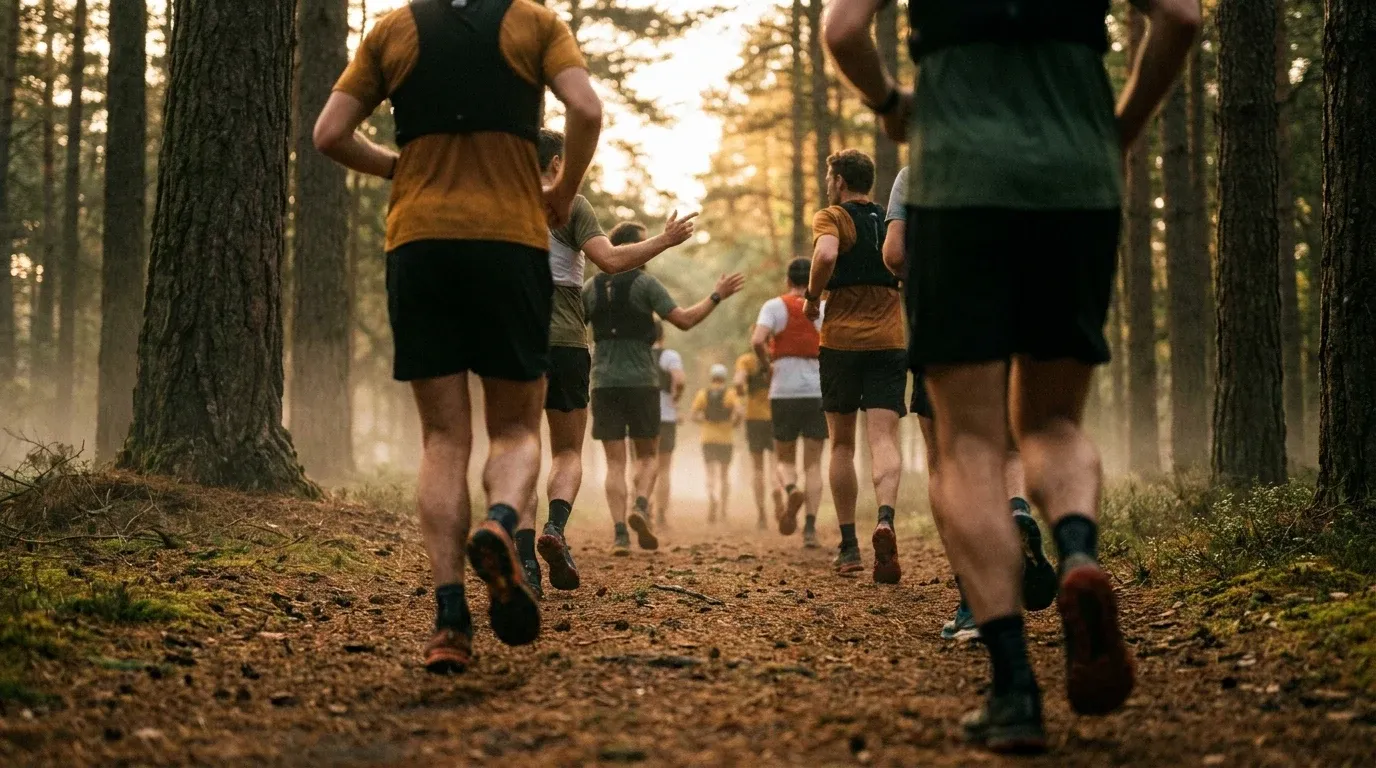
You can finish a road marathon and never learn the name of the person who ran beside you for 20 miles. That rarely happens in trail running. Something about sharing a muddy ridgeline, navigating a technical descent together, or stumbling into an aid station at mile 40 strips away the social barriers that keep endurance athletes isolated in other disciplines.
Trail running has quietly built one of the most cohesive community cultures in sport. It's not accidental. The terrain, the format, the culture of mutual support, and the grassroots structure of most events all push runners toward each other in ways that road racing simply doesn't.
The Terrain Changes Everything
Road running is largely a solitary pursuit, even in crowds. You line up, you run your pace, you finish. The course is predictable, the conditions are controlled, and your success depends almost entirely on your own preparation and fitness.
Trail running removes that predictability entirely. A technical single-track trail demands constant attention. Weather shifts. Routes require navigation. Aid stations can be 10 or 15 miles apart. In that environment, the runner next to you stops being a competitor and becomes something closer to a co-conspirator.
This isn't anecdotal. Research into endurance community behavior consistently finds that shared adversity accelerates social bonding. Trail running delivers adversity by design. The mountains don't care about your finishing time, and that humbling reality tends to make runners more generous with each other.
It's common at trail ultras to see faster runners loop back to pace struggling friends through a hard section. Aid station volunteers often train for events themselves, and the line between competitor and crew is blurry by intention. You're expected to help. That norm is embedded in the culture from the start.
Why Trail Running Attracts a Different Kind of Athlete
The people who gravitate toward trail running tend to share certain traits: a tolerance for discomfort, a preference for experience over outcome, and often a background in other outdoor pursuits. Hikers, cyclists, climbers, and backpackers frequently find trail running before road running finds them.
That mix matters socially. Trail running communities don't sort themselves by pace the way road running clubs often do. A 14-minute-mile hiker-runner and a sub-7-minute mountain runner can share the same 50K course, the same aid station tent, and the same post-race conversation. The sport's emphasis on finishing over time, particularly at longer distances, creates a more inclusive social structure.
Cutoff times at ultras are typically generous enough to accommodate a wide range of fitness levels. Events like those in the UTMB World Series attract both elite competitors and back-of-pack enthusiasts who share the same course. Kaçkar by UTMB 2026, which drew 2,000 runners into Turkey's mountains, is a clear example of how the sport can scale globally while preserving that inclusive, communal atmosphere.
Grassroots Organizations and Local Trail Series
One of the defining structural features of trail running is how much of it is still organized locally. Unlike road racing, which is dominated by large race management companies and municipal permits, trail running has a robust grassroots infrastructure. Local running clubs, regional trail series, and volunteer-run organizations form the backbone of the sport in most markets.
These organizations don't just host races. They build trails, maintain them, advocate for land access, and run weekly group runs on the same courses where events are held. That continuity creates a sense of ownership and belonging that's hard to replicate in a one-time-entry road race.
In the US, regional series like those in the Pacific Northwest, the Colorado Rockies, and the Appalachian trail corridor have developed loyal followings over decades. Runners return year after year, not just to race but to reconnect with the community that's formed around a specific landscape. The trail becomes a shared identity, not just a venue.
Even as the sport has globalized, with events on nearly every continent and social media connecting runners across time zones, that local identity has stayed intact. The growth of international races hasn't replaced local culture. It's layered on top of it, giving trail runners both a neighborhood community and a global one.
The Culture of Mutual Support in Practice
Walk into any trail race start line and you'll notice things you don't see at road races. Runners sharing food before the gun. Strangers offering gear advice without being asked. Experienced athletes talking openly about their worst races, their failures, their bad days in the mountains.
That openness is a cultural norm. Trail running has never fully embraced the polished, competitive image that defines road running's mainstream marketing. The aesthetic leans toward grit, honesty, and humor about the absurdity of voluntarily running 100 miles through the night. That self-awareness creates psychological safety. You're allowed to struggle. You're expected to.
Events like the Wasatch Front 100 exemplify this duality. Elite performances at the front of the field draw attention, but the culture of the event runs on the volunteers, the pacers, the crew members, and the back-of-pack runners who keep moving through the second night. Every finisher gets the same belt buckle. That's a deliberate statement about values.
Female athletes have also found trail running to be more welcoming than many other endurance disciplines. Representation at the front of the field is stronger, women's divisions receive comparable coverage at many events, and feats of athleticism are celebrated regardless of gender. Lucy Gossage's women's FKT on the Pennine Way generated the kind of community excitement that reflects how trail running treats its athletes, not as niche stories, but as central ones.
Recovery, Nutrition, and the Practical Side of Community Knowledge
One underappreciated aspect of trail running's community culture is how freely practical knowledge moves through it. Experienced runners share nutrition strategies, recovery protocols, and gear recommendations openly, often at races, on group runs, or in online forums. There's no gatekeeping of information the way you sometimes find in more elite-focused sports.
That knowledge-sharing extends to performance science. Discussions about recovery nutrition are common, and communities tend to stay current on emerging research. For example, recent findings on antioxidant supplementation have filtered through trail communities quickly. Studies on blueberry supplements and trail running recovery have generated real discussion among serious runners, not just researchers.
Gut health is another topic that comes up constantly in trail communities, given the demands of fueling during long mountain efforts. Conversations about fermented foods, gut microbiome function, and race-day nutrition have become mainstream in ways that reflect how seriously trail runners take the body's full system. If you're training for your first ultra, the community will have opinions about your nutrition strategy before you even ask.
What Road Runners Should Expect When They Make the Switch
If you're coming from a road background, the physical adjustment to trail running is obvious. Slower paces, more elevation, technical footing, different footwear. But the social and cultural shift is just as significant, and in many ways more rewarding.
Here's what to expect when you cross over:
- People will slow down to run with you. In road racing, you run your pace. In trail running, it's common for experienced runners to match your pace on a hard section to keep you company or help you navigate. Accept it.
- Aid stations are social spaces. Don't rush through them on your first trail race. Volunteers often know the course better than anyone and will tell you what's coming. The community gathers there.
- Finishing time matters less than you think. Trail running measures effort relative to terrain and conditions. A 7-hour finish on a brutal mountain course earns as much respect as a 3-hour road marathon. Recalibrate your expectations.
- Show up to group runs before you race. Most trail communities organize weekly runs on local trails. This is where relationships actually form. Races are where they're celebrated.
- Volunteer at least once before you race. It's a trail running norm, and it gives you a completely different perspective on what the community actually runs on. It's people, not prize money.
The road running world has produced extraordinary athletes and massive events. But it hasn't built the same culture of interdependence that trail running has. When the terrain gets hard enough, and the distances get long enough, you stop performing for an audience and start depending on the people around you. That shift, repeated across thousands of events and millions of training miles, is what makes trail running's community genuinely different.
If you're considering the switch, don't wait until you feel ready. Show up, introduce yourself, and let the trail do the rest. The community will meet you there.