
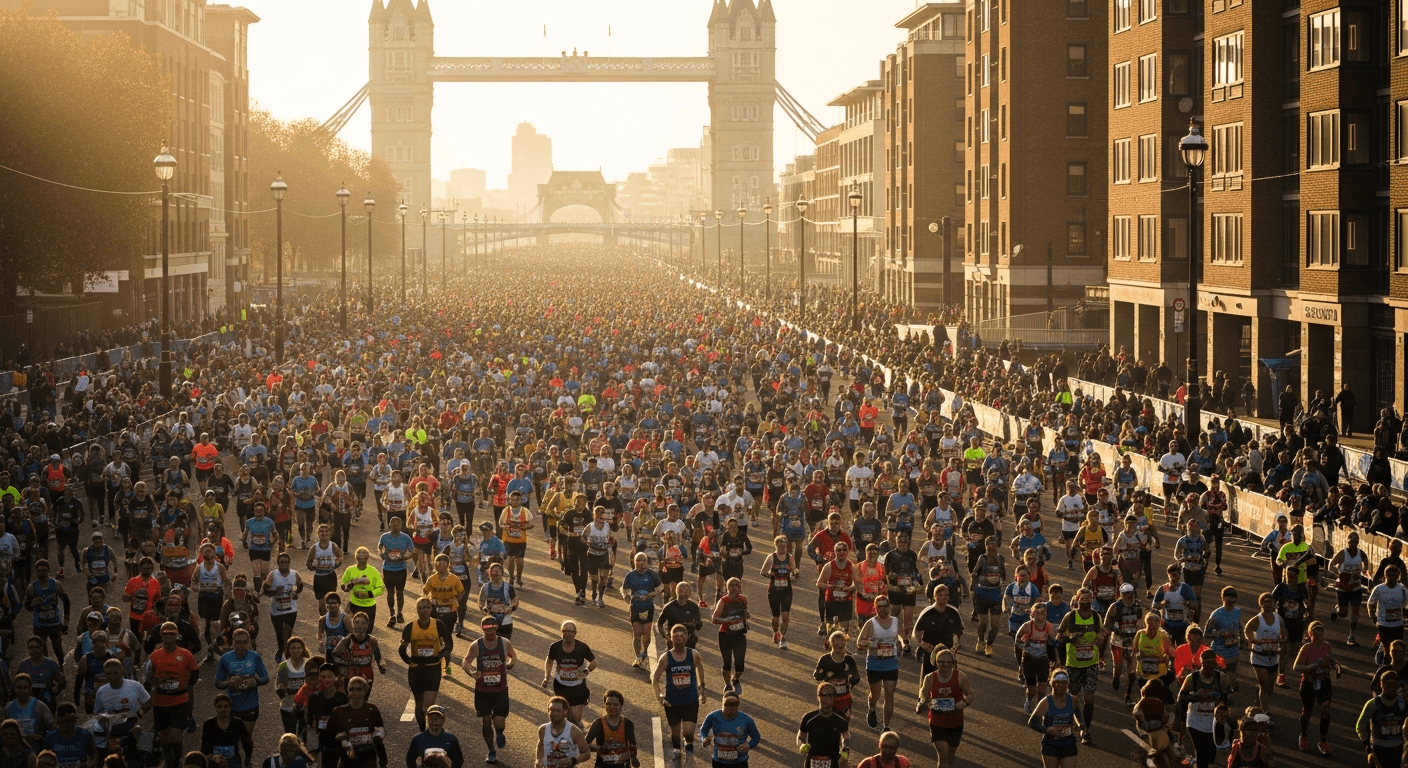
The London Marathon has always been about scale. More than 840,000 people applied for a 2024 ballot place, competing for roughly 50,000 spots. That ratio tells you everything about the demand problem organizers have been wrestling with for years. In 2027, they're making their biggest structural move yet: splitting the race across two days to accommodate 100,000 runners, doubling the field and reshaping what it means to run one of the world's most celebrated races.
It's a decision that will ripple through the entire mass participation running world. Here's what it means for you, whether you're already on the start line or still chasing your first ballot entry.
A First for the World Marathon Majors
No World Marathon Major has ever split its race across two days. Berlin, Chicago, Tokyo, Boston, New York. they've all grown their fields incrementally, added charity places, and tweaked wave structures. None has restructured the event calendar itself. London is doing something genuinely unprecedented.
The logic is straightforward. Demand for mass participation events has outpaced the physical constraints of a single race day. A city like London can only absorb so many runners, support crews, road closures, and spectators at once. Spreading 100,000 participants across Saturday and Sunday isn't just a capacity fix. It's a fundamental rethink of what a marathon can be as a civic event.
Whether other Majors follow will depend on how 2027 lands. But the pressure exists everywhere. This structural experiment in London is being watched closely by race directors across the globe.
What a Two-Day Format Actually Changes
For runners who care about atmosphere, the immediate question is whether a split field dilutes the experience. The honest answer: it depends on execution. London's course through Tower Bridge, past Canary Wharf, and along the Embankment draws enormous crowds precisely because tens of thousands of runners create a spectacle worth showing up for. Halving the field on each day could thin that energy, or it could make both days more manageable and enjoyable for everyone on the road.
Crowd behavior at major marathons is driven partly by runner volume and partly by event identity. If London markets both days with equal weight, spreads elite races and entertainment across the weekend, and keeps spectator infrastructure strong, there's a real case that Saturday and Sunday each become distinct, fully realized events rather than a divided version of one.
The elite race placement will matter enormously here. Which day hosts the men's and women's professional fields sets the tone for perceived prestige. If elites race Sunday, Saturday runners may feel they're running the opening act. These are decisions organizers will need to get right.
Ballot Strategy Just Got More Complicated
If you've been navigating the London Marathon ballot, you already know the odds aren't in your favor. A field of 100,000 sounds like better news, but it comes with new variables. Will there be separate ballots for each day? Can you request a preference? Will charity places, Good for Age entries, and championship places be distributed evenly across both days or concentrated on one?
None of these details have been confirmed yet, and that uncertainty is exactly why you should start thinking strategically now rather than waiting for the registration portal to open.
A few things worth planning around:
- Track announcements closely. London Marathon organizers are likely to release format details in phases. Sign up for official communications and set calendar reminders so you're not caught off guard when registration opens.
- Consider your training calendar. If you're a serious runner targeting a specific time, which day you run matters. Saturday races can carry different psychological weight than Sunday races, and your taper and post-race recovery may shift depending on placement.
- Charity places remain your most reliable route in. With a larger field, charity entries will likely increase proportionally. If London is on your bucket list, this is still the most controllable path to a guaranteed bib.
- Don't sleep on Good for Age criteria. Standards may tighten or shift with a restructured field. If you're close to qualifying, prioritize races over the next 18 months that give you a verified finishing time.
The runners who adapt earliest to the new structure will have a meaningful edge. This is true of any major logistical shift in racing. Richmond Half Marathon selling out for the third consecutive year is a useful reminder of how fast demand moves and how quickly registration windows can close when a race builds momentum.
The Bigger Picture: Mass Participation Is Booming
London's decision doesn't exist in isolation. The global fitness market reached $142 billion in 2026, and mass participation events are one of its most visible growth engines. Running specifically has benefited from a post-pandemic surge in people seeking structured, goal-oriented physical challenges with a social component built in.
That pattern isn't unique to running. HYROX crossed 1.5 million participants, demonstrating that competitive fitness events can scale rapidly when the format resonates. The common thread across running and functional fitness is that people want to do hard things alongside other people. Events that deliver that experience at scale are the ones seeing demand outpace supply.
Marathon entries reflect this precisely. The gap between applicants and available places at majors like London and Tokyo has grown every year. Organizers face a genuine problem: how do you honor the event's character while serving more of the people who want to be part of it? The two-day format is London's answer. It won't be the last experiment of this kind.
Course Experience and Logistics: What to Expect
Running 26.2 miles through central London is a specific kind of experience. The route is iconic. The crowds at the halfway point and through the final miles near Buckingham Palace are genuinely moving in a way that's hard to replicate. The question for 2027 is whether that atmosphere holds across two days or whether one day ends up clearly superior.
Research on marathon pacing and performance consistently shows that the psychological experience of a race shapes physical outcomes. Studies on pacing strategy confirm that men hit the wall twice as often as women, and a significant driver of that is misjudging early effort based on crowd energy and event atmosphere. A thinner crowd could actually help certain runners pace more conservatively. But for runners who thrive on external energy to push through difficult miles, the stakes of day selection are real.
On the logistics side, a two-day event could reduce congestion at bag drops, start corrals, and post-race meeting points. Anyone who's tried to find a friend in a field of 50,000 runners knows that the post-race experience at a major marathon can be chaotic. A smaller single-day field might smooth that out meaningfully.
Training Timelines: Start Adapting Now
If you're targeting London 2027, your training window is closer than it feels. A standard 16-to-20-week marathon build puts your serious training starting around late 2026 at the latest. But preparation for a race of this magnitude starts earlier with your aerobic base, your injury prevention work, and your race calendar for the qualifying period.
The structural shift to two days also means you might benefit from longer-duration strength and conditioning work to stay healthy through an extended preparation cycle. The off-season is where that foundation gets built. Off-season strength training is consistently where the biggest fitness jumps happen, and that principle applies directly to marathon runners looking to build durability ahead of a high-stakes race.
Don't treat 2027 as a distant target. The runners who show up to the start line in peak condition are the ones who started building 18 to 24 months out.
What This Means for the Future of Major Marathons
London's two-day format is a test case the entire running world will study. If it succeeds, meaning both days feel like full London Marathon experiences and the ballot process adapts cleanly, other Majors will face pressure to consider their own structural evolution. If it struggles, it will serve as a cautionary reference point for what happens when a single event tries to be two.
Either way, it signals that the era of incremental field expansion has limits. The next decade of mass participation running will involve more creative thinking about how races are structured, when they're held, and how the event experience is maintained as fields grow. Race directors are already pushing boundaries in other ways. Some are deliberately making courses more challenging to preserve a sense of earned achievement as participation broadens.
The London Marathon has always set the tone for what a city marathon can aspire to. In 2027, it's setting a new kind of tone entirely. Whether you're chasing a ballot place, a personal best, or simply the experience of running through one of the world's great cities, the calculus has changed. Start planning accordingly.