
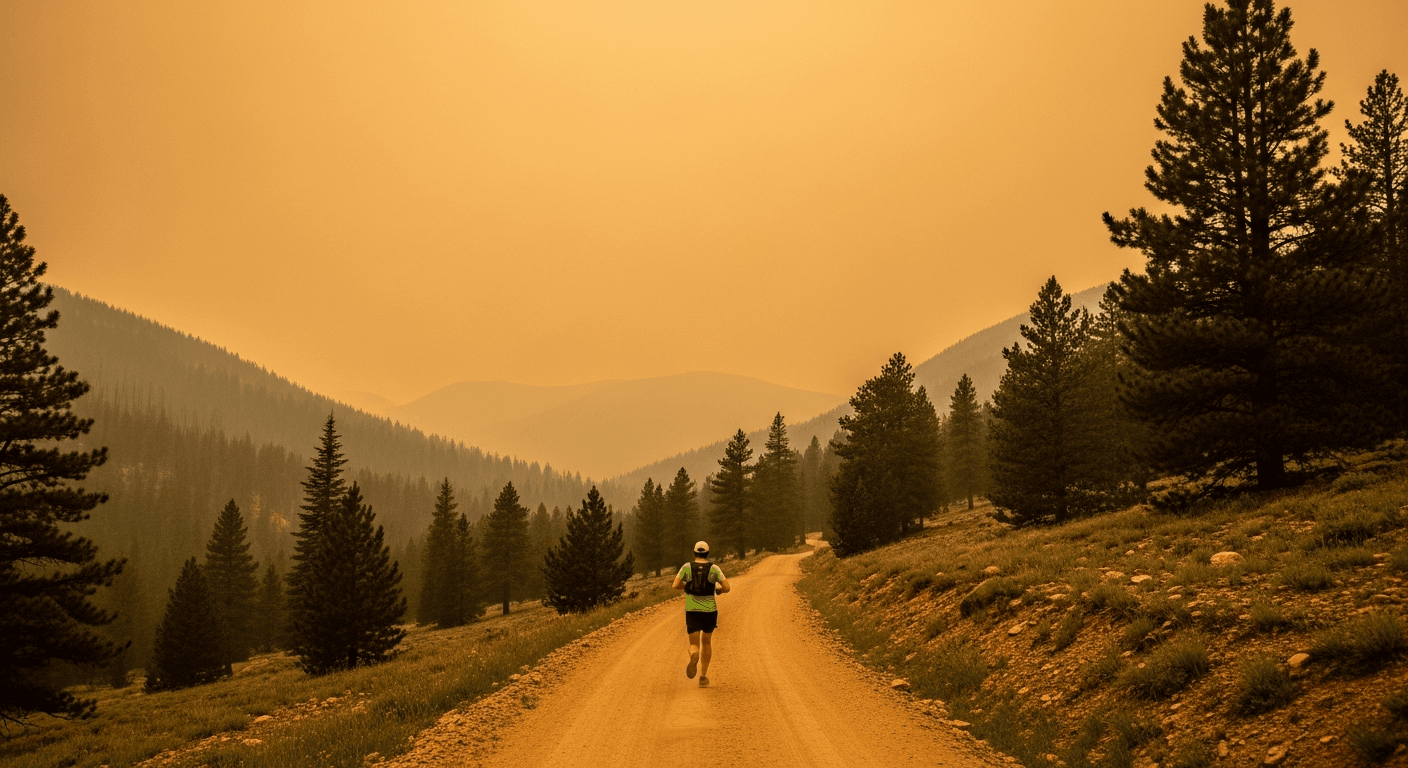
If you've spent the last several months logging high-altitude miles, pushing through back-to-back long runs, and dialing in your race-day nutrition, the news coming out of Colorado this summer hits hard. Wildfires sweeping across the Rockies are gutting the ultra calendar in real time, and race directors don't have the luxury of waiting to see how things develop. Events are being canceled, postponed, or held under a cloud of uncertainty, sometimes with just days of notice.
Here's what's happening, which races are affected, and what you should do if your event is still on the schedule but the situation around it keeps shifting.
Silver Rush 50 Is Off. Here's Why.
The Leadville Race Series made the call to cancel the Silver Rush 50-mile, scheduled for July 11, citing the Willow Fire, deteriorating air quality, and the strain that a large-scale event would place on already stretched public safety resources. For runners who had traveled or planned to travel to Leadville, the decision landed without much warning.
The reasoning is sound. Running a 50-mile mountain race in smoke-filled air isn't just uncomfortable. Research on wildfire smoke exposure during sustained aerobic exercise shows measurable drops in lung function and elevated cardiovascular stress, even in trained athletes. Race directors aren't being overly cautious when they cancel under these conditions. They're making the only defensible call.
Leadville has built its reputation on difficult races in difficult terrain. The Silver Rush, a high-altitude out-and-back through the San Isabel National Forest, demands everything from participants even in ideal weather. Asking runners to push those limits while smoke fills the valleys and fire crews are already deployed nearby isn't a risk any responsible organization should take.
Hardrock Ran. Ouray Didn't.
Not every race director reached the same conclusion. The Hardrock 100, one of the most iconic and punishing ultras in North America, chose to proceed after organizers closely monitored smoke behavior and fire movement in the San Juan Mountains. The decision was made with input from land managers and local authorities, and the race went forward.
If you're not familiar with the Hardrock and why it commands the level of devotion it does from the trail running community, Hardrock 100: Why This Race Captivates Runners is worth your time. The course covers 100 miles and more than 33,000 feet of elevation gain, almost entirely above treeline. That context matters when understanding why its community is so protective of the event and why the decision to run carried so much weight.
The Ouray 100, however, was called off entirely. Ouray sits in a tight canyon surrounded by steep terrain, the kind of geography where fire behavior becomes unpredictable quickly and evacuation routes can become compromised. Race leadership determined that proceeding was not viable. For runners who had entered a notoriously difficult lottery to get a spot, it's a significant loss.
The contrast between Hardrock and Ouray illustrates something important. These aren't arbitrary decisions. They reflect highly specific assessments of fire proximity, wind patterns, available emergency response, and terrain. Two races in the same region can legitimately arrive at different conclusions.
Leadville Trail 100 Is Still an Open Question
The August race that looms largest over all of this is the Leadville Trail 100. With thousands of registered runners preparing for what is, for many, the athletic event of their lives, the uncertainty is genuinely difficult to sit with.
As of now, the Leadville Trail 100 has not been canceled. But the Silver Rush cancellation, and the broader fire activity across Colorado, has put the running community on alert. Leadville organizers will be watching air quality data, fire containment reports, and coordination with local agencies throughout the coming weeks.
If you're registered for Leadville in August, the most useful thing you can do right now is stay close to official communications. Follow the Leadville Race Series directly. Don't rely on social media speculation. Race directors in these situations are balancing real-time data against significant logistical and financial pressures. When they have something definitive to say, they'll say it.
In the meantime, keep training. Modifying your taper based on incomplete information or anxiety-driven assumptions won't serve you. Focus on what you can control: sleep, nutrition, and maintaining fitness without overreaching. The 10% Rule Is Wrong: New Injury Science is a useful read if you're trying to calibrate your final weeks of preparation without adding unnecessary injury risk.
This Isn't Just a 2025 Problem
What's happening in Colorado this summer isn't an isolated disruption. It's part of a longer trend that race directors and land managers across the American West have been tracking with increasing concern.
Wildfire seasons in the western United States have grown longer and more destructive over the past two decades. The number of acres burned annually has roughly doubled since the 1990s, according to federal land management data. Peak fire season, which once fell reliably in late summer and fall, now regularly extends into June and July. That overlap with the prime trail racing calendar is no longer a rare coincidence. It's becoming structural.
For race organizers, this creates a planning problem that has no clean solution. Permit applications for events on national forest land are submitted months in advance. Athletes register and pay entry fees, often $200 to $400 or more for a competitive ultra, and begin structured training blocks six to nine months out. The financial and personal investment on both sides is substantial. When a fire ignites three weeks before race day, there's no playbook that makes everyone whole.
Some organizations are beginning to explore contingency formats: alternate courses on lower-risk terrain, back-up dates later in the season, or virtual options for athletes who can't absorb a reschedule. None of these are perfect substitutes. But the alternative, which is to keep running the same event calendar and hope for favorable conditions, is no longer viable for races in fire-prone corridors.
What to Do if Your Race Is in Jeopardy
If you're registered for a summer trail race in Colorado or anywhere in the western United States, here's a practical framework for the next few weeks.
- Monitor official channels only. Race directors will communicate through their websites and verified email lists first. Social media speculation can circulate faster than facts and cause unnecessary anxiety.
- Review your entry terms now. Understand what your race's policy is on refunds, deferrals, and transfers in the event of cancellation. Most major ultras have these terms posted. If yours doesn't, contact the organization directly.
- Have a backup plan, but don't activate it prematurely. Identify one or two alternative fall events that match your current fitness trajectory. Hold them loosely. Switching your training target too early based on speculation can undermine months of race-specific preparation.
- Keep your fitness intact. If your race is canceled, your fitness doesn't vanish with it. A structured block of training has value beyond any single event. Fall ultras in less fire-prone regions, including events in the Pacific Northwest, the Northeast, and the Mid-Atlantic, often have spots available through waitlists or late registration.
- Protect your recovery. Stress about a canceled race is real and it affects training quality. Prioritize sleep and nutrition. Blood Biomarkers Are Now Part of Personalized Nutrition covers how individualized data can help you fine-tune your fueling strategy during a period of disrupted training, which is exactly the kind of variable that goes sideways when your race calendar shifts unexpectedly.
The Bigger Picture for Trail Running
Trail running has grown fast. Participation in ultramarathons in North America has increased by more than 1,500 percent since the early 1990s, according to Running USA data. That growth has filled permit allotments, expanded the economic footprint of destination races like Leadville and Hardrock, and created a community with genuine depth and ambition.
It's also placed a larger number of athletes in the path of climate-driven disruptions they have limited ability to control. The runners showing up at the start line of a Colorado hundred-miler aren't casual participants. They've restructured their lives around these events. When a race disappears, the loss is personal and significant.
That's worth acknowledging. And it's also worth recognizing that the sport will adapt. Race formats will evolve. Permit strategies will become more sophisticated. Some events will shift to earlier or later windows to reduce fire exposure. The running community has always rewarded problem-solving and resilience. Those qualities aren't going to disappear just because the calendar is harder to plan around.
What won't change is the pull of high-altitude terrain, the satisfaction of a long effort through mountains, and the specific kind of community that builds itself around suffering voluntarily and well. That part of trail running is durable. The logistics around it are just going to require more flexibility than they used to.
If you're deep in a training block right now and feeling the uncertainty of what July and August might bring, the best version of you is still the one who shows up, adapts, and keeps moving. Whether that's in Colorado this summer or somewhere else in the fall.