
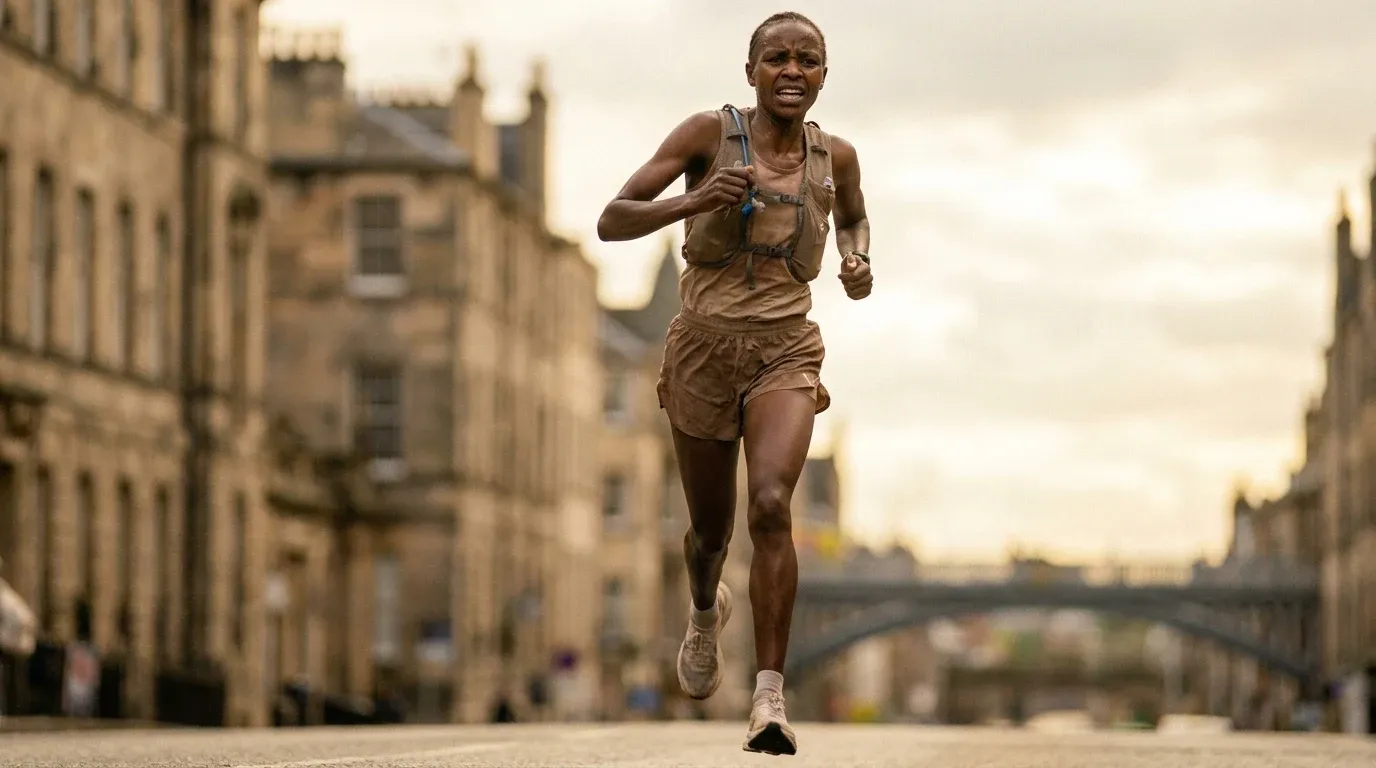
Ngetich Shatters Records at World Road Running Championships
Something shifted in Copenhagen in September 2026. Agnes Jebet Ngetich didn't just win the women's race at the World Athletics Road Running Championships. She rewrote what the world thought was possible on asphalt, posting a performance that sent ripples far beyond the finish line on Rådhuspladsen.
The 23-year-old Kenyan, already known for her aggressive front-running style and a jaw-dropping 10km world record set earlier in her career, delivered a championship run that made the crowd go silent before they erupted. Ngetich's time at the Copenhagen championships set a new world best for the course, cementing her status not just as a dominant force in road running, but as a defining athlete of this era.
What Ngetich Actually Did in Copenhagen
Ngetich's race plan was simple and ruthless. She went out hard, split perfectly through the opening kilometers, and never gave her rivals a window to respond. By the halfway point, she had opened a gap that looked manageable on paper. By 8km, it was over.
Her finishing time shattered the previous championship record and placed her performance among the fastest ever recorded by a woman over the distance on a record-eligible course. Race officials confirmed the splits, the course certification, and the conditions. The result stands.
What made the run especially striking wasn't just the clock. It was how controlled she looked. No grimace, no desperate lean at the tape. Just an athlete operating at the outer edge of her capability and making it look methodical.
Copenhagen as a Stage for Road Running's Ambitions
World Athletics didn't pick Copenhagen by accident. The Danish capital has one of the most active running cultures in Europe, consistently ranking among the top cities globally for running participation per capita. Its flat, spectator-friendly urban layout makes it ideal for record attempts, and its logistics infrastructure can handle the scale a world championship demands.
The 2026 edition of the World Road Running Championships also reflected something broader. Road running's profile has climbed sharply over the last two years, driven by surging participation numbers, major broadcast deals, and a new generation of fans who came to the sport during and after the pandemic and never left. Running's biggest boom in a decade has reshaped the economics and ambitions of the sport, and the Copenhagen championships felt like the first world-stage event fully built to meet that moment.
Ticket demand exceeded capacity. Live streaming numbers broke previous championship records. Athletes from 74 nations competed across the full program. Road running, once seen as the quieter sibling of track and field, is now drawing audiences and investment that would have seemed unlikely five years ago.
Part of a Larger Pattern for Women in 2026
Ngetich's performance didn't emerge from a vacuum. It's the latest in a string of elite women's performances in 2026 that have pushed road and endurance running into genuinely uncharted territory.
Earlier this year, women's road race records fell at multiple major international events. The depth of competition at half marathons and 10km championships has reached a point where times that would have been considered extraordinary five years ago are now required just to make the podium. Ngetich's Copenhagen run sits at the top of that trend, but it's not an outlier. It's a continuation.
That context matters because it changes how you interpret what you're watching. This isn't one exceptional athlete having one exceptional day. It's a cohort of elite women who have trained differently, recovered smarter, and raced more strategically than any previous generation. The evidence keeps compiling. Women are rewriting endurance running across every distance, and road racing is the most visible front of that shift.
Research published in 2026 across multiple sports science journals has confirmed that women's endurance performance continues to close the gap with men's records at a faster rate than previously modeled. The gap in elite road running times has narrowed by a measurable percentage over the past decade. Ngetich's mark fits that trajectory precisely.
What Makes Ngetich Different
Ngetich has always been a front-runner, which in women's road racing is a riskier strategy than it sounds. Most elite competitors prefer to sit in a pack, conserve energy, and make their move in the final two kilometers. Ngetich treats the entire race as an attack.
Her training background includes heavy emphasis on threshold work and race-specific pace conditioning, according to interviews her coaching team gave ahead of the championships. She runs high weekly mileage but structures her hardest sessions around sustained efforts at or above race pace, rather than relying on long easy mileage to carry her fitness.
If you're thinking about how that applies to your own training, the principle isn't complicated. Specificity wins. Training at or near the pace you intend to race builds the physiological and psychological adaptations that matter most. For most recreational runners, that means spending more of your weekly volume closer to your target race pace and less of it in the comfortable middle zone. Leveling up your running in 2026 means being honest about where your actual training stress is landing.
Nutrition's Role at This Level of Performance
Elite road racing at championship level is increasingly a nutrition science story as much as a training story. Athletes at Ngetich's level work with dedicated sports dietitians and follow highly individualized fueling protocols built around the specific demands of their event distance.
For 10km road racing, the nutritional demands differ from marathon running. Glycogen management matters, but the race is short enough that in-race fueling isn't the primary variable. Pre-race nutrition timing and composition carry more weight. Getting the right substrate available at the right moment before a high-intensity 30-minute effort is where marginal gains accumulate. Understanding when and what to eat around your workouts is a principle that scales from elite championship racing down to your Tuesday interval session.
Protein intake and recovery nutrition have also evolved at the elite level. The old assumptions about protein windows and single-serving limits have been revised repeatedly by recent research. Protein myths that athletes still carry in 2026 can quietly undermine recovery, even when training quality is high.
Road Running's Growing Global Infrastructure
What's happening at the elite level in Copenhagen is connected to something much wider. Road running is experiencing a structural expansion globally. More countries are developing domestic road race circuits. More cities are bidding for major championships. Prize money pools at elite road events have grown significantly, with several major international 10km and half marathon races now offering total purses exceeding $500,000.
Participation is climbing at every level of the pyramid. Young runners are flooding back to road races at rates not seen since the early 2010s running boom, and this time they're staying. Registration data from major race organizers in the US, UK, and Australia shows sustained year-over-year growth in the 18-to-34 demographic, reversing a trend that had worried the sport for years.
All of this creates a feedback loop. Elite performances like Ngetich's generate media coverage. Media coverage brings in new participants. New participants fuel race growth. Race growth funds prize money and infrastructure. Better infrastructure attracts more elite athletes. The cycle is self-reinforcing in a way that road running hasn't experienced before.
What Comes Next
The question after a performance like Ngetich's isn't whether she can go faster. Based on her age and trajectory, most analysts believe she can. The question is whether the competitive field will develop quickly enough to push her into another gear.
World Athletics has already confirmed that the next World Road Running Championships will expand the events program and increase athlete quotas per nation. The sport's governing body is clearly treating road running as a growth priority, not an afterthought.
For anyone who runs, whether you're training for your first 5km or chasing a personal best at a major half marathon, the Copenhagen championships are a reminder of what the sport looks like at its highest level. Ngetich didn't just set a record. She raised the ceiling, and in doing so, she gave the entire sport something to measure itself against.
That's what performances like this do. They don't just belong to the athlete who runs them. They belong to the sport.