
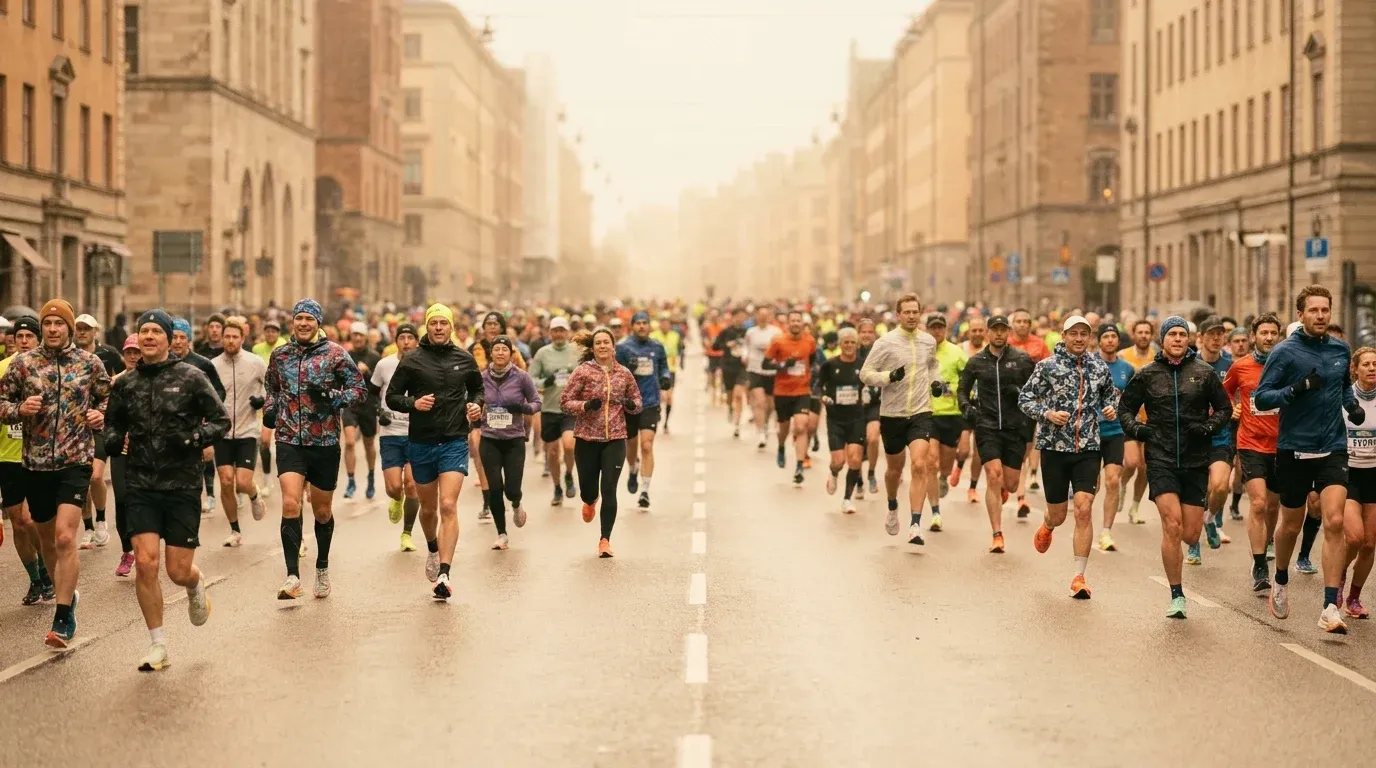
Something significant is happening in Philadelphia this November. Race organizers for the 2026 Philadelphia Marathon Weekend are projecting field sizes that would break every previous participation record across all distances, from the 8K to the full 26.2. If those projections hold, it won't just be a local milestone. It'll be one of the clearest signals yet that mass participation running has fully recovered from its pandemic-era slowdown and is now growing beyond its pre-2020 ceiling.
For anyone watching the sport closely, that matters. It means more runners on start lines, more communities investing in road events, and more first-timers making a commitment to the distance that changes how they think about their own fitness for years.
Record Fields Projected Across Every Distance
Organizers have confirmed that registration across all Philadelphia Marathon Weekend distances is tracking ahead of any previous year at the same point in the registration cycle. The full marathon, the half marathon, and the 8K all show stronger-than-usual demand. The waitlist for the full marathon opened earlier in 2026 than it ever has before.
Total participation across the weekend is expected to exceed 40,000 runners, a figure that would surpass the event's previous high-water mark. Volunteer sign-ups and spectator projections are following suit, with city officials anticipating higher foot traffic in Fairmount Park and along Kelly Drive than in any prior year.
What's driving it? A combination of pent-up demand, a generation of new runners who started during the pandemic and are now ready to race, and a broader cultural momentum around fitness that hasn't slowed down in 2026. The numbers aren't an accident. They reflect years of behavior change that locked-down running helped accelerate.
The Post-Pandemic Rebound Is Now Undeniable
Major marathons around the world spent 2020 and 2021 cancelled or virtual. By 2022 and 2023, many events returned but with capped fields, staggered wave starts, and registration systems that couldn't keep up with demand. Philadelphia was no exception. Fields were limited. Ballot systems replaced open registration. Runners who had trained through uncertainty found themselves without a race.
By 2025, the caps started coming off. Fields expanded. And 2026 is the year where the numbers are finally reflecting what the running community has known for a while: more people run now than before the pandemic, and they want to race.
Philadelphia isn't alone. Boston saw record-breaking qualifier submissions for its 2026 edition. London's ballot was oversubscribed within hours. Chicago and New York both reported their fastest-ever sellout timelines. The Philadelphia Marathon's projected record isn't a local quirk. It's part of a global pattern that shows road running's participation base has permanently expanded.
This growth is also reshaping the gear conversation. As more runners target fall goal races, the technology they're bringing to start lines has evolved considerably. Nike Vaporfly 5: Everything We Know So Far breaks down what could be one of the most anticipated shoes on feet at major fall races in 2026, and the super-shoe arms race just got more intense with new offerings from multiple major brands competing for race-day dominance.
Why Philadelphia Works as a Goal Race
Not every marathon draws the way Philadelphia does. The event has built its reputation on three things: a genuinely fast course, an accessible city, and a November date that sits perfectly in the fall racing calendar.
The course is legitimately flat. It runs through Fairmount Park, along the Schuylkill River, and through some of Philadelphia's most iconic neighborhoods. There are no brutal climbs, no exposed highway sections, and no notorious hills waiting in the final miles the way some other marquee marathons have. For runners chasing a Boston Qualifying time, that matters enormously.
The BQ crowd is a significant part of Philadelphia's field every year. With Boston qualification standards tightening in recent years, runners are increasingly strategic about which course they choose for their attempt. Philadelphia consistently delivers faster average finish times than hillier alternatives, which is why you'll find experienced runners flying in from across the country and internationally specifically for this race.
But it's also one of the best first-marathon experiences available. The crowd support is genuine. The course is well-marked. The logistics are manageable. Philadelphia isn't an overwhelming mega-marathon where you feel like a number. It's large enough to have energy and infrastructure, small enough to feel like the city is actually paying attention to you. That balance is hard to achieve at scale, and it's a big part of why first-timers keep choosing it.
Training and Preparation: What You Should Know Before November
If you're registered for Philadelphia 2026, your training is likely already well underway. But a few things are worth reinforcing as the event gets closer.
The fall timing means your long runs are happening through summer heat. That's a physiological challenge that's easy to underestimate. Heat slows you down more than elevation does on most training runs, which can skew your perception of your fitness heading into cooler race-day conditions. Trust the process, run your easy miles easy, and don't panic if your summer long run paces don't reflect your goal race pace.
Nutrition in the final weeks is as important as the miles. Gut issues are one of the most common reasons runners underperform on race day, and what you eat in the two weeks before the marathon matters more than most training plans acknowledge. If you've been dealing with any digestive sensitivity during long runs, it's worth reviewing your fueling strategy now rather than on race morning. gut health and performance research suggests that your microbiome has a measurable effect on endurance output, something worth taking seriously in your taper period.
Sleep is another lever that's fully in your control. Taper anxiety is real, and many runners sleep worse in the two to three weeks before a goal race. What you do in the evenings matters. Alcohol, even in small amounts, disrupts sleep architecture in ways that compound over time. understanding how alcohol affects your recovery sleep gives you a practical framework for making smarter calls during taper without feeling like you have to become a monk.
- Trust your taper. Reduced mileage in the final two to three weeks is not lost fitness. It's your body consolidating the work you've done.
- Practice your race-day nutrition now. Whatever gels, chews, or drinks you plan to use on race day, your gut needs to have practiced with them on long runs first.
- Dial in your shoe choice early. Don't wear new shoes to Philadelphia. If you're upgrading to a carbon-plated racer, you need at least four to six weeks of regular use before race day.
- Know the course mile by mile. Miles 20 through 26 include the most psychologically challenging sections. Study the map and have a mental plan for the back half.
What Philadelphia 2026 Signals for Running's Future
Record turnout at a single event is one data point. But when you stack it alongside similar numbers at Boston, London, Chicago, and New York in 2026, it starts to look like something more structural. Road running is not just recovering. It's growing into a larger version of what it was before.
That growth has implications beyond registration numbers. It's pushing race organizers to invest in better infrastructure, more robust timing technology, and improved athlete experiences. It's driving serious competition in the footwear market, where brands are racing to put the most advanced race-day technology under runners' feet. And it's expanding the community of people for whom a marathon finish is a personal identity milestone, not just a checkbox.
The fitness landscape in 2026 is crowded with options. Obstacle racing, functional fitness competitions, and hybrid events have all built dedicated followings. The fact that the road marathon is growing alongside those formats, rather than being displaced by them, says something real about what the distance means to people.
Philadelphia in November has always been a celebration of that meaning. In 2026, it's going to be the biggest celebration the city has ever hosted for the sport. If you're on the start line, you're part of something that's bigger than your personal race. That's not a bad thing to carry with you through the miles.