
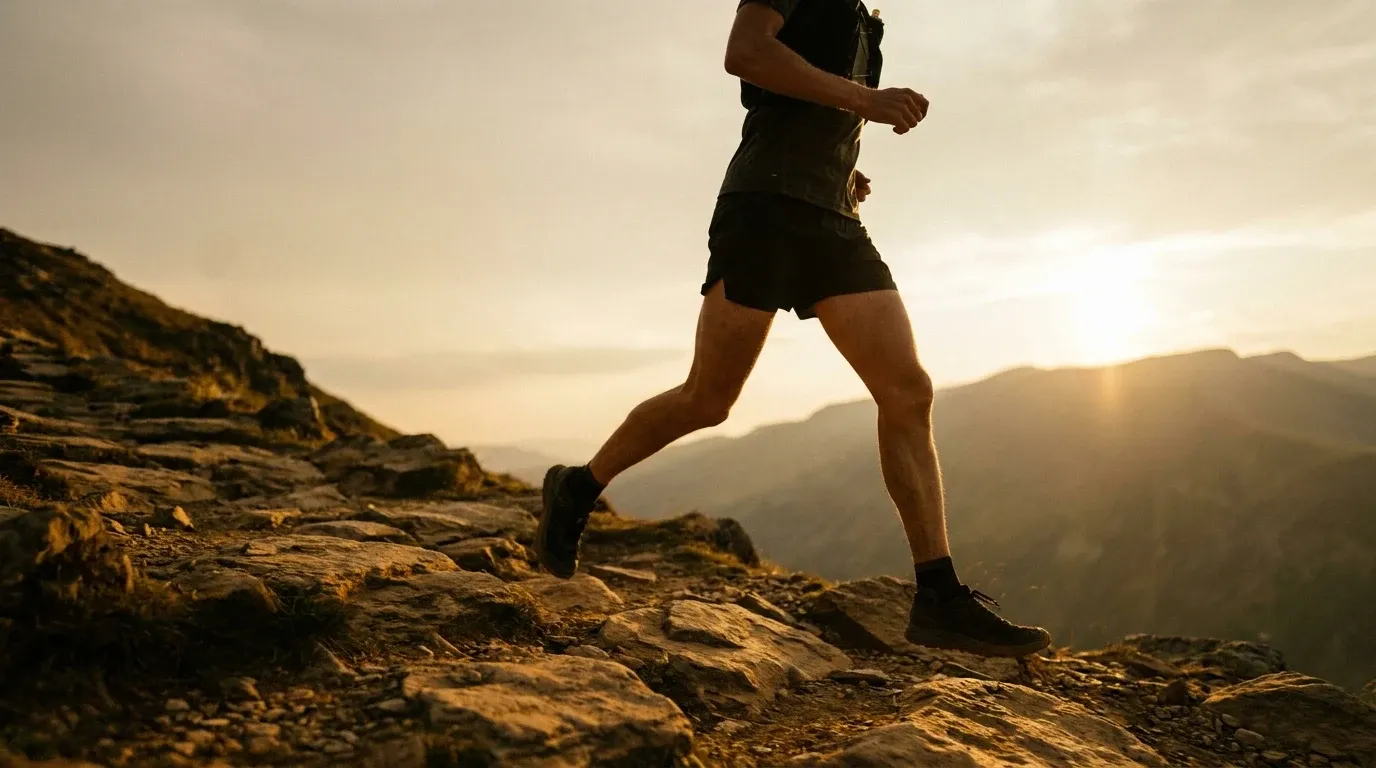
It sounds like a bar bet gone wrong. A runner, on foot, leaves a cyclist behind on a steep mountain climb. No drafting tricks, no mechanical failure, no flat tire. The cyclist just gets beaten. Fair and square.
If your first instinct is to call it a fluke, you're not alone. Cycling is supposed to be faster. Wheels beat legs. Gears multiply force. The machine wins. Except on certain terrain, under certain conditions, it doesn't. And the physics behind why that happens tells you a lot about how elite mountain athletes actually train.
The Gradient Threshold That Changes Everything
Cycling's mechanical advantage is real, but it's conditional. On flat roads and moderate climbs, a cyclist can generate and sustain far more speed than a runner at equivalent effort. The gear system converts pedal force into forward momentum with remarkable efficiency. But that efficiency is gradient-dependent.
Once a slope exceeds roughly 20 to 25%, something breaks down. At that angle, the rider's body weight shifts backward relative to the pedal stroke, making it nearly impossible to apply force through the full crank rotation. Cadence drops. Traction becomes inconsistent. On technical mountain trails, some cyclists are forced to dismount and push their bikes entirely.
Meanwhile, a trained trail runner doesn't lose efficiency at the same rate. Human bipedal locomotion on steep terrain actually adapts more fluidly than a drivetrain does. The runner shortens stride, lowers their center of gravity, and transitions between running and power hiking based on what the grade demands. That adaptability is the key.
Power-to-Weight Ratio on Vertical Terrain
In endurance sports, power-to-weight ratio matters enormously. On flat terrain, a heavier cyclist with a powerful engine can still dominate. But as gradient increases, weight becomes a tax. Every extra kilogram has to be lifted vertically, which is expensive in caloric and muscular terms.
Elite skyrunners tend to be exceptionally lean, often carrying body weights below 60 kilograms, with highly trained glutes, hip flexors, and single-leg strength. On a 30% gradient, their relative power output per kilogram can rival or exceed what a cyclist is generating on the same slope. The runner isn't faster in absolute terms on flat ground. They're faster per unit of elevation gained on extreme terrain.
This is also why weight management and strength training aren't separate conversations in mountain running. They're the same conversation. The shift toward strength training as a core component of endurance performance reflects exactly this understanding. Lifting isn't just for aesthetics. On a 25% grade, it's what gets you to the top first.
Why Elite Skyrunners Train Differently
Flat-ground speed is largely irrelevant in mountain racing. A 4:30 per mile pace on a track tells you almost nothing about how someone will perform on a 1,500-meter vertical kilometer. The training metrics that matter shift entirely.
The vertical kilometer, or VK, is one of the defining formats in skyrunning. Athletes cover 1,000 meters of vertical gain over a course typically under 5 kilometers in length. World-class competitors complete VKs in under 30 minutes. That's a sustained effort of roughly 33 meters of elevation gain per minute, on terrain that would send most runners into a walk.
To build that capacity, mountain specialists train for vertical gain as the primary variable, not pace or distance. A 2-hour session might cover only 10 kilometers horizontally but accumulate 1,800 meters of climbing. That's a training stimulus that simply doesn't exist on a treadmill at 1% incline.
It's a mindset shift that also shows up in hybrid endurance formats. Athletes competing in obstacle and fitness racing have increasingly borrowed from mountain running protocols to build vertical-specific conditioning. That crossover is evident when you look at the effort profiles from events like HYROX Washington DC 2026, where sustained muscular endurance under load mirrors the demands of sustained uphill movement.
Running Versus Power Hiking: Where the Line Actually Is
One of the biggest tactical decisions in mountain running is knowing when to stop running and start hiking. This isn't a concession to weakness. It's biomechanical strategy.
Research on uphill locomotion shows that there's a grade, usually somewhere between 15 and 25% depending on the individual, where transitioning from running to fast hiking is actually more economical. Running above that threshold burns more oxygen than it saves in time. Power hiking, with an aggressive arm drive and a forward lean, can match or beat the running pace while using significantly less energy.
Elite mountain runners master this transition. They know their personal threshold by feel and by data. They train both modes specifically, which means separate sessions focused on running form at high grades and separate sessions focused on hiking power and rhythm.
That nuance is worth understanding even if you're not racing. If you're training for any mountain event, building your power hike specifically, with weighted carries, stair protocols, and steep treadmill work, will improve your overall vertical performance more than simply logging more flat miles ever will.
The Role of Uphill-Specific Strength Work
The muscular demands of steep uphill movement are distinct from flat running. The glutes fire harder. The calves work isometrically to stabilize the ankle on unstable terrain. The hip flexors generate the high knee lift required to clear technical ground. And the entire posterior chain absorbs the loading that steepness creates.
Training that ignores these demands will produce a runner who's fit on flat ground and a liability on mountain terrain. Uphill-specific strength work closes that gap.
Practically, this means single-leg exercises like step-ups, Bulgarian split squats, and loaded carries. It means sled pushes on inclines and plyometric work that builds reactive strength in the lower leg. Athletes who understand this tend to perform at a different level on vertical terrain, which is partly why ultra-endurance performance has increasingly split into its own specialty.
The science of who performs best at extended efforts is also worth noting here. Research suggests women outperform men in ultra-endurance events beyond 195 miles, which connects to physiological traits like fat oxidation efficiency and pacing consistency that are highly relevant in long mountain events where vertical accumulation is enormous and sustained effort over many hours is the primary challenge.
What This Means for Your Training
You don't need to be racing against cyclists to take something from this. The story of a runner beating a cyclist uphill is really a story about specificity. Train for what you're actually doing.
If mountain running or vertical events are on your radar, here's what an intelligently structured approach looks like:
- Prioritize vertical gain as a training metric. Track meters climbed per week, not just kilometers run. Aim to build that number progressively over a training block.
- Train the run-to-hike transition deliberately. Find a steep local hill and practice the shift. Learn your threshold. Time both modes and compare effort levels.
- Build uphill-specific strength twice a week. Step-ups, single-leg presses, and loaded carries translate directly to mountain performance. These aren't supplemental. They're foundational.
- Include at least one vertical kilometer effort per training block. It doesn't need to be a race. Find a grade that forces sustained effort over 500 to 1,000 meters and go hard. Use it to measure progress.
- Keep body weight in check without under-fueling. Lean isn't the same as underfueled. Athletes who manage their power-to-weight ratio through quality nutrition outperform those who simply restrict calories. The framework of treating nutrition as a core performance variable matters here as much as in any other endurance sport.
The broader lesson from extreme-gradient performance is that fitness isn't universal. Speed on flat terrain doesn't guarantee performance on vertical terrain. The runner who beats the cyclist up a mountain didn't get lucky. They trained for a specific physiological and mechanical reality, and on that terrain, their preparation was simply better suited to the task.
That's not a quirk of mountain running. That's the whole point of training specificity. And it's a principle that applies whether you're chasing a VK record or just trying to stop walking the hills on your next trail race.
For runners who want to push what's possible over longer distances, the performance data being set right now is genuinely remarkable. Megan Eckert's 636-mile six-day record is a case study in what the human body can sustain when training, nutrition, and vertical-specific conditioning all align at an elite level.
The mountain doesn't care what your track times look like. It rewards the athlete who prepared for exactly what it demands.