
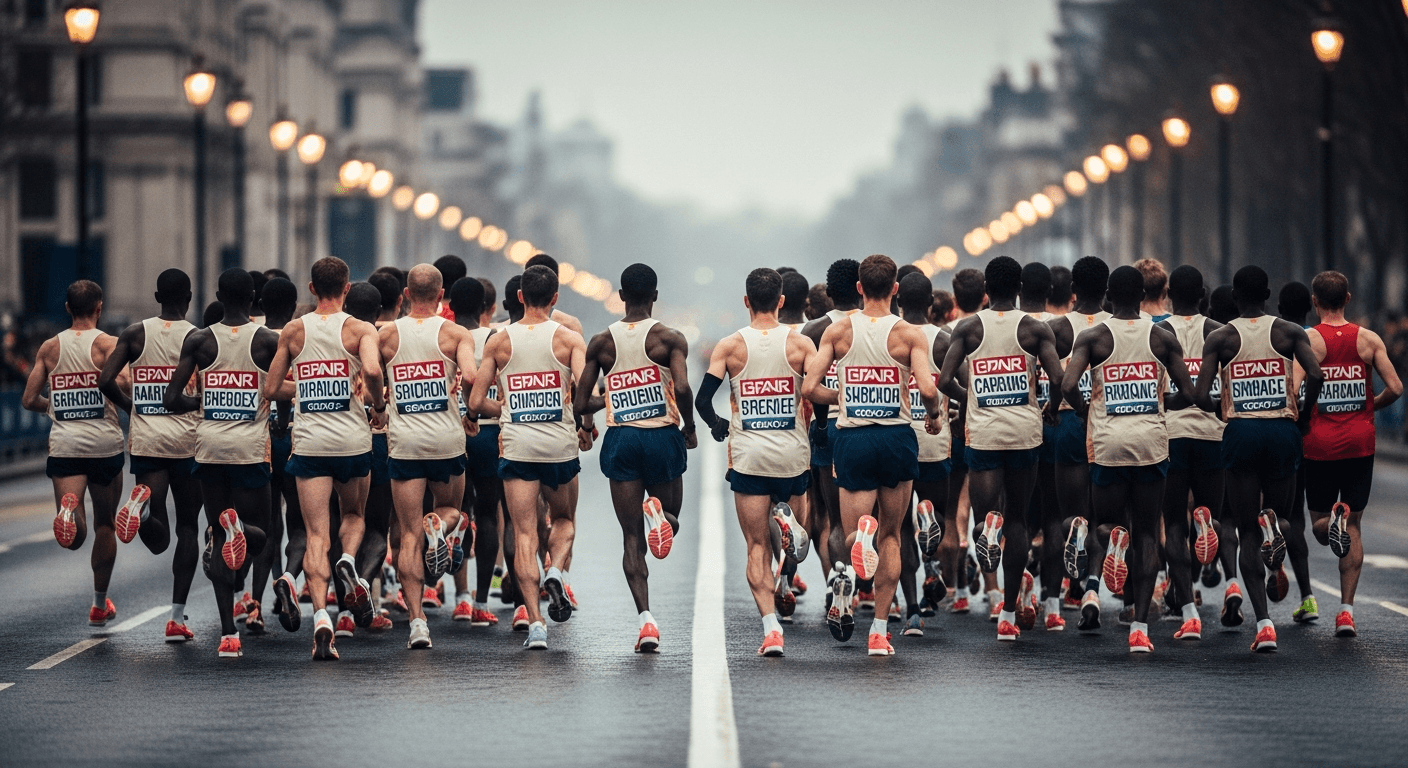
On a cool London morning in 2026, something happened that most exercise scientists had spent careers debating: two men finished a marathon under two hours in the same race. Sabastian Sawe crossed the line in 1:59:30. Yomif Kejelcha followed, also sub-2. History didn't just get made once. It got made twice before the finish-line tape had fully settled.
The headlines wrote themselves. But once the noise fades, the more useful question is this: what does any of it actually mean for you, running your weekend long runs at 9-minute miles, targeting a sub-4 or a sub-3:30, and trying to figure out what elite performance can realistically teach you?
Quite a lot, it turns out.
What Actually Happened in London
This wasn't a time trial with laser-paced rabbits and controlled conditions, the setup that Eliud Kipchoge used in his 1:59:40 exhibition run in Vienna back in 2019. London 2026 was a competitive race under World Athletics rules. Sawe's 1:59:30 is the legitimate world record. Kejelcha's finish made it the first time two men have broken the barrier in the same sanctioned marathon.
For a full breakdown of how Sawe executed the race technically, How Sawe Ran 1:59:30: The Pacing, Shoe Tech, and Race Strategy Behind the Record covers the split data and race mechanics in detail. What this article does is pull out the principles that transfer to your training.
The Pacing Blueprint: Negative Splitting at Scale
Sawe ran the second half of the race faster than the first. Not by much. But consistently. That's negative splitting, and it's the single most validated pacing strategy in distance running research. Studies across recreational and elite cohorts consistently show that runners who go out 1 to 3 percent slower in the first half finish faster overall than those who run even splits or positive splits.
The reason is physiological. Going out too hard forces your body to produce energy anaerobically earlier than necessary, accumulating lactate before your aerobic system has had time to stabilize. You're essentially borrowing time from your second half and paying it back with interest.
For a sub-4 marathoner, negative splitting looks like this in practice: if your goal is 3:58, you target the first half at around 2:02 and the second half at 1:56. That gap feels conservative at mile 6 when you're fresh. That's the point. Discipline in the first half is what creates capacity in the second.
Kejelcha's pacing under pressure confirmed the same pattern. He ran in Sawe's draft for a significant portion of the race, reducing his aerobic cost, and then used that conserved energy to close hard. The strategy wasn't just fast. It was intelligent.
Drafting: Free Speed You're Leaving on the Table
Wind resistance accounts for roughly 2 to 8 percent of a runner's total energy cost depending on conditions, body size, and pace. Elite runners have known this for decades. Recreational runners largely ignore it.
Kejelcha's positioning behind Sawe wasn't accidental. At marathon pace, sitting one to two meters directly behind another runner in comparable wind conditions can reduce aerobic demand enough to make a meaningful difference over 26.2 miles. Research suggests the energy savings at competitive marathon paces are roughly equivalent to a 1 to 2 percent improvement in running economy.
You can apply this in your next race. In a mass participation marathon with crowded early miles, positioning matters. Find runners running your goal pace and stay tucked behind a group rather than running solo off the front. This isn't drafting in the competitive sense. It's basic physics. The same logic applies to windy training days when you run out into a headwind and back with the wind at your back. Flip that. Run into the wind on the return leg so your harder efforts benefit from the tailwind.
Shoe Technology: Real Gains, But Not the Whole Story
Both Sawe and Kejelcha raced in carbon-plated super shoes, and the performance conversation around this technology has continued to evolve. The consensus from biomechanics research is that carbon-plated shoes with advanced foam midsoles improve running economy by 2 to 4 percent compared to traditional racing flats. That's substantial. For a 4-hour marathoner, a 4 percent improvement in economy could theoretically translate to roughly 9 minutes off finish time under ideal conditions.
For more on the specific shoe Sawe used and the competition it's reshaping, Sawe's 1:59:30: Why Adidas Hit the Jackpot covers the technology arms race in depth.
The takeaway for you: if you're targeting a time-based goal and you're not racing in a carbon-plated shoe, you're leaving measurable minutes on the course. Entry-level carbon-plated options now start around $150 to $180. The top-tier racing shoes that elites use run $250 to $280. That's not an insignificant spend, but in the context of months of training, it's one of the highest-return investments you can make on race day.
One caveat: don't train in them daily. Use them for key workouts and race day. The carbon plate accelerates midsole compression, and overusing them reduces the performance benefit while increasing injury risk in the calf and Achilles.
The Two Training Levers That Actually Move the Needle
Here's where exercise physiology gets direct. Physiologists who study distance running consistently point to two training variables as the biggest performance levers for runners at any level: negative split execution (which we've covered) and lactate threshold development.
Your lactate threshold is the pace at which lactate accumulates in your blood faster than your body can clear it. Below that threshold, you can run aerobically and sustain pace. Above it, the clock is ticking on your ability to hold form and speed. For most recreational runners, threshold pace sits around 25 to 30 seconds per mile faster than their marathon goal pace.
Raising your threshold means you can sustain faster paces aerobically for longer. The most effective way to do this is through threshold running: sustained efforts of 20 to 40 minutes at a comfortably hard effort, roughly a 7 out of 10, where you can speak in short phrases but not hold a conversation. Once per week is enough for most runners. Twice per week if you're in a dedicated build phase and your recovery is solid.
Recovery, in this context, includes more than sleep. Nutrition timing around hard training sessions affects how quickly your body adapts. Protein Timing in 2026: What Research Actually Says Now is worth reading if you're doing threshold work regularly and want to understand how to structure your intake around those sessions.
The Sub-3:30 Translation
If sub-3:30 is your target, you're running about 8 minutes per mile. Your threshold pace is probably somewhere around 7:25 to 7:40 per mile. Your long runs should be at 9:00 to 9:30. You're probably doing 40 to 55 miles per week at peak training.
The Sawe and Kejelcha template, stripped back to your level, looks like this:
- First half discipline: Start at 8:05 to 8:10 per mile. Resist the crowd energy in the early miles.
- Threshold work: One quality session per week at 7:30 to 7:40 for 25 to 35 minutes continuous, or broken into 10-minute reps with short recovery.
- Drafting awareness: Use pacing groups in training runs and position smartly in the race field for the first 10 miles.
- Shoe upgrade: Race in a carbon-plated shoe appropriate for your pace and gait. Get fitted properly.
- Aerobic volume base: Threshold training only works if your easy run volume is genuinely easy. Keep 80 percent of your weekly miles at a conversational pace.
What the Record Actually Proves
The sub-2 barrier mattered symbolically, but what it confirms physiologically is that the science was right all along. Pacing conservatism, aerobic threshold development, technology optimization, and race-day execution are the levers. They scale down. The strategies Sawe and Kejelcha used aren't elite secrets. They're applied versions of principles that recreational runners have access to and consistently underuse.
If you're coming off a race and your legs need attention before your next build, Marathon Recovery: A Week-by-Week Practical Guide gives you a structured framework to rebuild without compromising your next training block.
Two men ran under two hours in the same race. The barrier is gone. The methods that got them there are yours to use. The question now is how seriously you want to apply them.