
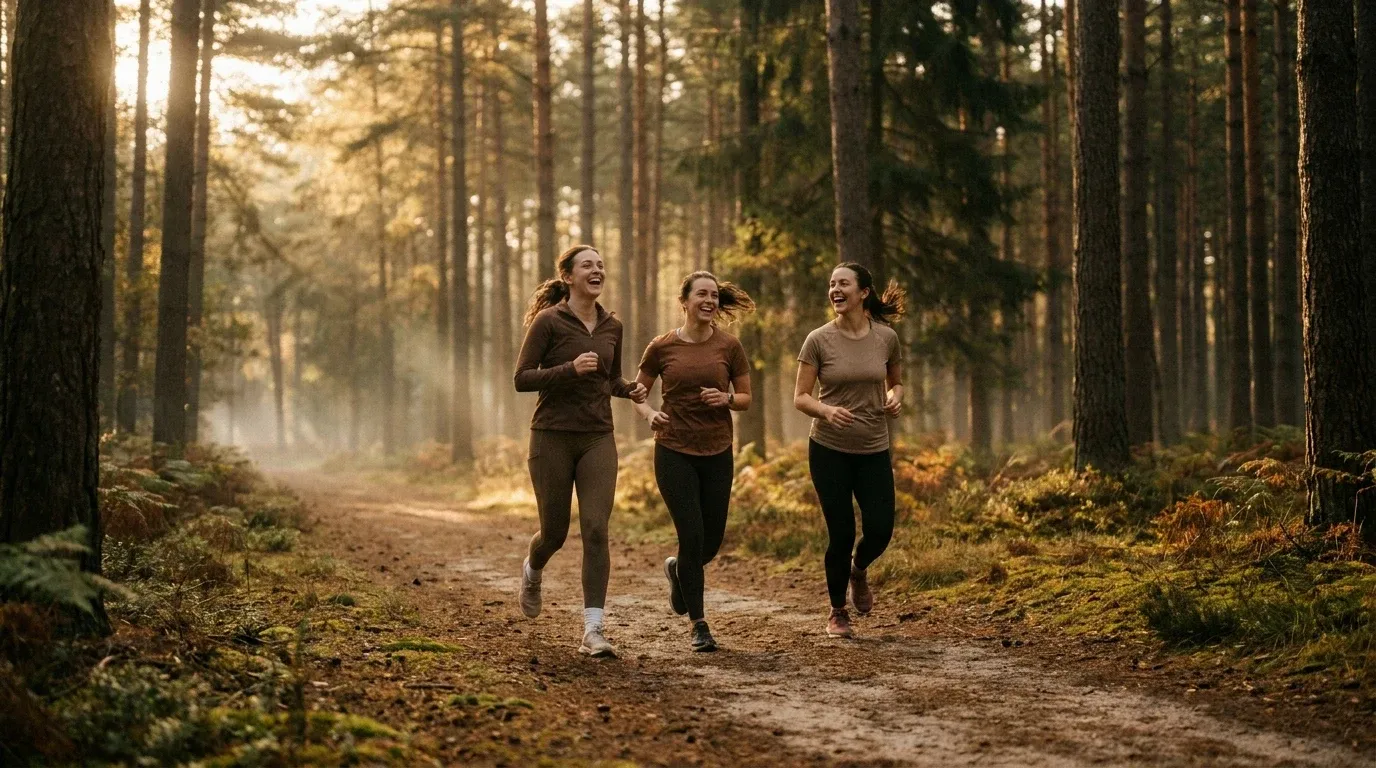
Ask a woman why she started trail running and you'll rarely hear "I wanted a faster 5K." More often, you'll hear something about needing to get outside, wanting to find people who actually showed up for each other, or just needing somewhere to put the noise in her head. That's not a niche story. It's becoming the defining narrative of one of running's fastest-growing demographics.
Women are reshaping trail running from the inside out, and the sport is only beginning to catch up.
The Numbers Behind the Shift
Trail running has moved well past cult status. The 2026 trail running boom report estimated 17 million trail runners in the United States alone, a figure that would have seemed wildly optimistic a decade ago. Women account for an increasing share of that growth, and the gap between male and female participation rates is narrowing faster in trail than in road running.
What's driving that? It's not prize money or podium pressure. Survey data from trail running organizations consistently shows that women entering the sport cite mental wellbeing, connection to nature, and community as their primary motivations. Performance metrics don't even crack the top three for most new participants.
This matters because it tells us something about what women are actually looking for when they lace up on a dirt path. They're not opting out of competition because they can't compete. They're opting into something different entirely.
Why the Trail Specifically
Road running has a pace problem. The culture around it, especially in apps, social media, and race corrals, defaults to speed as the primary measure of worth. You're fast or you're not. You PR'd or you didn't. Trail running disrupts that default in a meaningful way.
On trails, the terrain does the work of leveling the playing field. A technical descent or a steep climb demands presence, not performance. Elevation gain replaces pace as the common currency, and even experienced runners can be humbled by a muddy switchback. That shift in framing turns out to be genuinely freeing for a lot of women who've bounced off road running's more rigid metrics.
There's also accumulating evidence that outdoor physical activity carries specific mental health benefits beyond what you get indoors. Research has linked regular aerobic exercise in natural environments to lower cortisol, reduced anxiety, and improved mood regulation. For women managing the compounding pressures of work, caregiving, and everything in between, an hour on a trail isn't a workout. It's a reset.
That tracks with broader findings on exercise and mental health across the lifespan. Studies have found that physical activity habits developed early can have lasting effects on mental wellbeing into adulthood. As one piece of research noted, being fit as a kid cuts adult depression risk by up to 20%, suggesting that the psychological benefits of movement run deeper than most people assume. Women who find that connection through trail running tend to stick with it in a way that purely performance-driven runners often don't.
Community as the Core Product
If you've spent any time around women's trail running groups, you've noticed something that's harder to quantify than a finish time. People wait for each other at the top of climbs. No one gets dropped. Post-run conversation lasts longer than the run itself.
This isn't accidental. Many women-specific trail groups explicitly build their culture around a no-one-runs-alone policy. Groups like Trail Sisters, which operates across North America, have grown significantly by centering that ethos. Their runs aren't time trials. They're social infrastructure.
That community dimension is especially significant for women who feel intimidated by traditional running clubs or who've experienced the particular exhaustion of being the only woman in a group where the conversation is all about splits. Trail running, at least in its more community-oriented form, offers something closer to belonging than competition.
It's also worth noting that this community is increasingly diverse. Trail running has historically skewed white and affluent, and that's still true to a degree. But women-led trail organizations are doing more active outreach into communities that have historically had less access to trails, gear, and the cultural permission to take up space in the outdoors.
Brands and Race Organizers Are Starting to Listen
The commercial side of trail running has been slower to adapt, but it's moving. You can see it in product design, where women-specific trail shoes and gear have improved dramatically beyond simple colorway changes. You can see it in event programming, where women-focused trail races and "women's only" start waves are becoming more common across the US, UK, and Australia.
Prize parity is a live conversation. Some of the sport's most prominent ultra events now offer equal prize money across genders, and there's growing pressure on those that don't. The trail running community has also been paying attention to inclusion beyond gender. In a notable development, trail running is creating its first para-athlete prize purse, a sign that the sport is actively rethinking who it's built for.
Race calendars are expanding too. If you're in Australia, for example, events like the Sydney Marathon 2027, now open for ballot entries, reflect a broader regional appetite for inclusive, high-profile running events that attract participants at every level.
Brands targeting women trail runners are also getting smarter about messaging. The old approach, which leaned heavily on weight loss or "getting a beach body," has largely been abandoned by the more credible players in the space. What's replaced it is messaging around strength, duration, and experience. That's a meaningful shift, even if the industry still has room to grow.
What This Means for How We Talk to Women About Running
Here's the uncomfortable truth for a lot of running media, coaching businesses, and gear brands: the framework most of us use to discuss running is built around men's performance culture. Pace, race times, periodization, peak weeks. It's not that women don't care about any of that. Many do, deeply. But leading with performance metrics as the primary hook misses the actual motivations of a huge and growing segment of women runners.
If community is the product, then the content, events, and programs built for women need to reflect that. That means writing about the experience of a trail run, not just the training plan for it. It means building race events that feel welcoming on arrival, not just fast at the front. It means recognizing that a woman who runs 15 miles every weekend with her friends but never enters a race is not a "casual runner." She's a committed athlete with different priorities.
There's also a performance case to be made, one that doesn't require abandoning community values. Women who train consistently in supportive environments tend to train smarter and recover better. Understanding your body's actual needs, whether that's sleep, nutrition, or how recovery timelines work after hard efforts like a marathon, is part of what lets you stay in the sport for the long haul. And staying in the sport is the whole point.
It's also worth addressing the nutrition piece, because women trail runners are often under-fueled relative to their actual training loads. The research on this is consistent. Under-fueling doesn't just hurt performance. It affects bone density, hormonal health, and mood. If you're putting in serious trail miles, your nutrition strategy needs to match. That includes getting the basics right before worrying about anything more specialized. Some research even suggests targeted foods like blueberries may support performance in trail race contexts, which tells you that the details do matter once the foundation is in place.
A Sport Still Finding Its Shape
Trail running for women isn't a finished product. It's a movement that's still figuring out what it wants to be, and that's actually part of the appeal. There's less history to push back against, fewer rules about what "counts," and more room to define success on your own terms.
The women leading this shift aren't rejecting athletic ambition. They're expanding what ambition looks like. Sometimes it's a podium finish. Sometimes it's making it to the top of a ridge you've been scared of for two years, surrounded by people who waited for you at the bottom. Both of those things are worth celebrating. The sport is better when it has room for both.
If you're a woman who's been curious about trails but assumed it wasn't for you, it probably is. And the version of it that exists right now, communal, exploratory, and largely indifferent to your pace, might be exactly what you didn't know you were looking for.