
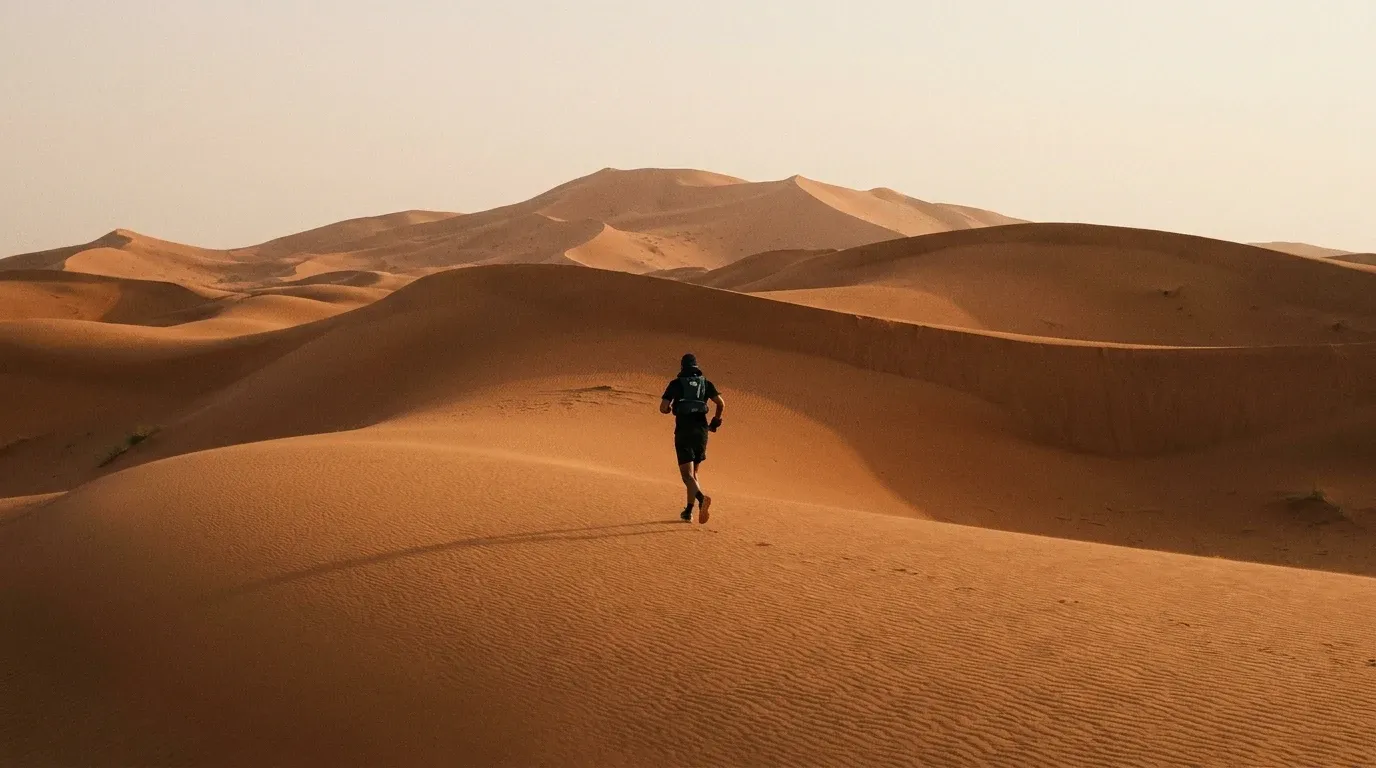
Not every trail race asks you to cross a desert. The XTERRA Alxa Trail Run does, and that's a large part of why it's drawing attention from runners well beyond China's borders. Set in the Alxa Desert of Inner Mongolia, one of Asia's most visually extreme landscapes, the event returns in 2026 with a reputation built on scenery, remoteness, and a course that genuinely tests your desert running ability.
If you've been watching the global trail calendar expand into new and unusual terrain, Alxa is a name worth knowing before registration windows open.
Where Exactly Is Alxa, and Why Does It Matter?
The Alxa League sits in the far west of Inner Mongolia, bordered by the Gobi Desert and shaped by wind-carved dunes, rocky plateaus, and vast open sky. It's not the kind of place you pass through by accident. Temperatures swing hard between day and night, the ground underfoot shifts from packed sand to loose gravel, and navigation across unmarked terrain requires focus that most road races simply don't demand.
That geographic severity is the point. XTERRA built its global brand on off-road sports in dramatic settings. Alxa fits that identity precisely. The course is designed to move runners through the desert's most photogenic and challenging sections, with enough elevation change and technical footing to separate casual participants from trained trail runners.
For international runners, the appeal is partly athletic and partly experiential. You're not just racing. You're spending days in a landscape that most people outside China have never seen in person.
The Race Format and What to Expect on Course
The 2026 edition offers multiple distance categories, typically ranging from shorter desert sprint formats up to a full ultra-distance option that covers 50 kilometers or more. Exact distances and course maps are released closer to registration opening, but the race structure has historically rewarded runners who train for heat management, sand running mechanics, and long days with limited shade.
Altitude plays a minor role compared to high-mountain races, but the combination of loose terrain and desert heat creates its own physiological load. Research on ultra-endurance events in arid environments consistently shows elevated sweat rates, faster glycogen depletion, and greater demands on electrolyte balance compared to temperate-climate races of equivalent distance.
Nutrition strategy matters here in ways it might not for a forest trail race. If you're building a plan, the framework used in multi-discipline endurance sports translates well. Thinking about food as a performance variable, not just a recovery tool, is the approach serious desert runners bring to events like Alxa. The principles behind treating nutrition as a fourth discipline in endurance sport apply directly to the kind of sustained effort Alxa demands.
Why Desert Trail Races Are Having a Moment
The growth of destination trail running has been steady and significant over the past decade. Events in Patagonia, Namibia, Jordan, and now increasingly across Central and East Asia have attracted runners who want their race to feel like an expedition, not just a competition. Alxa sits squarely in that category.
What's changed recently is who's showing up to these races. It's no longer a niche of ultra-endurance specialists. Cross-training culture has brought a broader athletic population to trail running, including athletes who come from strength-focused backgrounds and are looking for outdoor performance goals. The broader shift toward varied athletic pursuits, documented in the rise of hybrid fitness events, means that trail races in remote locations are pulling from a much wider field of potential participants than they did five years ago.
The global trail running market is projected to grow at a compound annual rate above 6% through the late 2020s, with Asia-Pacific destinations showing some of the fastest growth in international race registrations. Alxa benefits directly from that trend.
Logistics: Getting There and What It Costs
Let's be honest about what this race involves from a planning standpoint. Alxa is not easy to reach. The closest major airport is in Yinchuan or Hohhot, with connections from Beijing that add at least a full travel day to any international itinerary. If you're flying from North America or Europe, budget three to four days of total travel time around the event itself.
Entry fees for the 2026 edition haven't been officially confirmed at the time of writing, but based on previous years and comparable international desert races in Asia, expect registration costs in the range of $150 to $350 depending on distance category. That's before travel, accommodation, and equipment. All-in costs for an international runner typically land between $2,000 and $4,500 depending on point of origin and how far in advance flights are booked.
Accommodation near the race village is usually a combination of official race camps and limited local lodging. Most international runners book through race-affiliated packages when available, which simplifies logistics considerably.
Visa requirements for China apply. US, UK, Canadian, and Australian citizens should check current entry requirements well in advance, as processing times and documentation can vary.
Training Implications: Preparing for Sand and Heat
Desert racing demands specific preparation that standard trail training doesn't fully cover. Sand running mechanics differ from packed dirt or mountain trails. Your foot strike shifts, your calves absorb more load, and your pace-to-effort ratio changes significantly on soft ground. Runners who don't incorporate sand or beach running into their preparation often find the first 10 kilometers of a desert race far harder than expected.
Heat acclimatization is equally critical. If you're based in a cooler climate and targeting Alxa in autumn, the desert temperatures can still push into the mid-30s Celsius (mid-90s Fahrenheit) during midday stages. Structured heat exposure training, using saunas or warm indoor sessions, in the four to six weeks before the event has been shown to reduce physiological strain and improve performance in hot-condition races.
Strength work supports desert running more than many runners assume. The stabilization demands on loose terrain are significant, and runners who carry functional lower-body and core strength tend to hold form better in the late stages of a desert ultra. The growing recognition of strength work as a performance tool, not just an injury-prevention measure, is directly relevant here. The broader conversation about strength training moving into mainstream athletic training reflects a shift that desert ultra runners are already living.
Female runners, notably, may have physiological advantages in sustained desert efforts. Research on fat oxidation and pacing efficiency across long-distance running suggests that women often manage pace and fuel more effectively over very long efforts. Understanding why women are built for better marathon pacing can help all runners, regardless of gender, think more clearly about their own race strategy in a multi-hour desert event.
How Alxa Fits the Fall Trail Calendar
The XTERRA Alxa Trail Run takes place in autumn, which makes it a direct competitor for athletes considering late-season adventure races. That fall window is crowded. UTMB events, Western States lotteries, and dozens of regional ultras all compete for the same training blocks and travel budgets.
What Alxa offers that most of those races don't is genuine geographical novelty. You're unlikely to find another race that takes you through Inner Mongolian desert terrain with a globally organized event structure behind it. For runners who've done the European classics or the major North American ultras, Alxa represents something genuinely different on the bucket list.
It also sits at a point in the racing calendar where your summer fitness base is still largely intact, which means you don't need to rebuild from scratch. A well-structured training block from July through September gives you the specific preparation time you need without sacrificing your spring or summer racing entirely.
The expanding world of ultra-endurance competition has made clear that the athletes pushing boundaries in this space are driven by more than medals. Events like Alxa, alongside boundary-breaking performances such as Megan Eckert's 636-mile six-day run, reflect a culture that values experience, environment, and sheer effort as much as finish-line time.
Should You Register for XTERRA Alxa 2026?
If you're an experienced trail runner with at least one ultra-distance finish on your record, a tolerance for logistical complexity, and a genuine appetite for remote desert terrain, Alxa belongs on your shortlist. It's not a race for first-timers or runners who prefer well-marked, well-supported courses every few kilometers.
But if you've been looking for a race that earns its place in conversation alongside the world's most distinctive destinations, and you're willing to do the preparation that desert running actually requires, this is exactly the kind of event the trail community is increasingly organized around.
Registration details and official course announcements for the 2026 edition will be available through the XTERRA global events portal. Monitor those channels early. Desert race spots at this level of organization and location tend to fill before most runners have finished their winter training plans.