
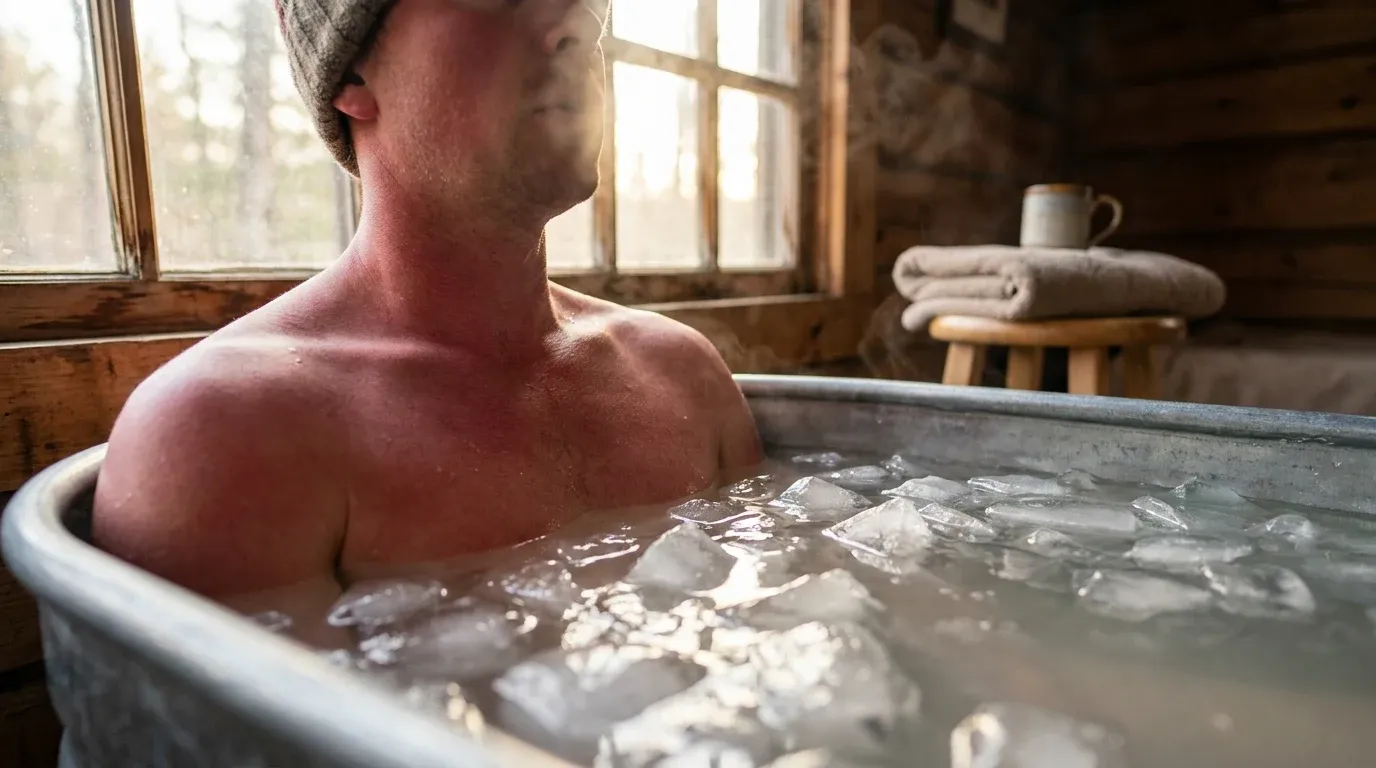
Cold water immersion is everywhere. On Instagram, in professional changing rooms, in backyard plunge pools. And the science around cold therapy in sport is more interesting — and more nuanced — than most content lets on.
The core question isn't «does it work?» The answer is yes, in specific contexts. The real question is «for who, when, and with what protocol?»
Key takeaways
- CWI reduces muscle soreness 31% more effectively than passive rest — strongest effect in the first 96 hours post-exercise
- Risk: CWI may blunt hypertrophy adaptations when used immediately after strength training
- Optimal protocol: 10-15°C water, 10-15 minutes, 30-60 min post-exercise (not immediately)
- Parasympathetic activation explains the mood and sleep benefits
- Best for: endurance athletes and high-frequency training — less appropriate as a default post-strength-session tool
What the science actually shows
Meta-analyses on CWI are consistent on one point: cold water immersion is more effective than passive rest for reducing delayed-onset muscle soreness (DOMS) after intense exercise. The effect is particularly strong in the 24-96 hours post-exercise — exactly the window when soreness most penalizes athletes training at high frequency.
Identified mechanisms: vascular constriction reducing localized inflammation, lowered muscle temperature slowing inflammatory processes, and parasympathetic nervous system activation promoting systemic recovery.
The problem with strength training
The important nuance — often left out of wellness content — is that systematically using cold immersion after strength sessions may reduce hypertrophy adaptations. The micro-tears and inflammation following an intense lifting session aren't just soreness. They're anabolic signals. Immediate post-session CWI can blunt those signals.
Multiple studies confirm this: athletes using cold baths systematically after lifting show slightly lower muscle gains than those who wait. Current consensus: if hypertrophy is the priority, avoid CWI in the hour following a strength session. If the priority is recovering to train again tomorrow, it's a relevant tool.
The optimal protocol
- Temperature: 10-15°C. Below 10°C, marginal additional benefits don't justify the risks. Above 15°C, the effect drops significantly.
- Duration: 10-15 minutes. The majority of benefits occur in the first 10 minutes.
- Timing: 30-60 min after exercise. Not immediately post-strength — but not 6 hours later either.
- Frequency: 2-4 times per week maximum. Full recovery also requires letting the body process normal inflammatory adaptations.
Who benefits most
Endurance athletes: Runners, cyclists, swimmers training multiple times per week whose priority is recovery between sessions. CWI fits here — it reduces soreness without slowing cardiorespiratory adaptations.
Combat and team sports: Athletes who need to perform the day after competition. Post-match CWI is an established practice in professional football, rugby, and combat sports.
HYROX and hybrid formats: HYROX athletes alternate between strength and intense cardiovascular effort. CWI can be useful 30-60 min after, especially during high-competition blocks.
Less appropriate for: People in intensive muscle-building phases, beginners to strength training (adaptive inflammation is useful), and people with cardiovascular conditions (thermal shock can be risky).
The stress and sleep effect
Beyond muscle recovery, CWI has documented effects on the autonomic nervous system. Cold immersion activates the parasympathetic nervous system — the «rest and digest» branch. This translates to reduced cortisol, improved heart rate variability (HRV), and often better sleep quality. These effects are less dependent on post-exercise timing — even an evening cold bath without prior exercise can have these benefits.
In summer, when heat disrupts sleep, an evening cold bath can help lower core body temperature and ease falling asleep. That's one of the best-validated uses for the general population.