
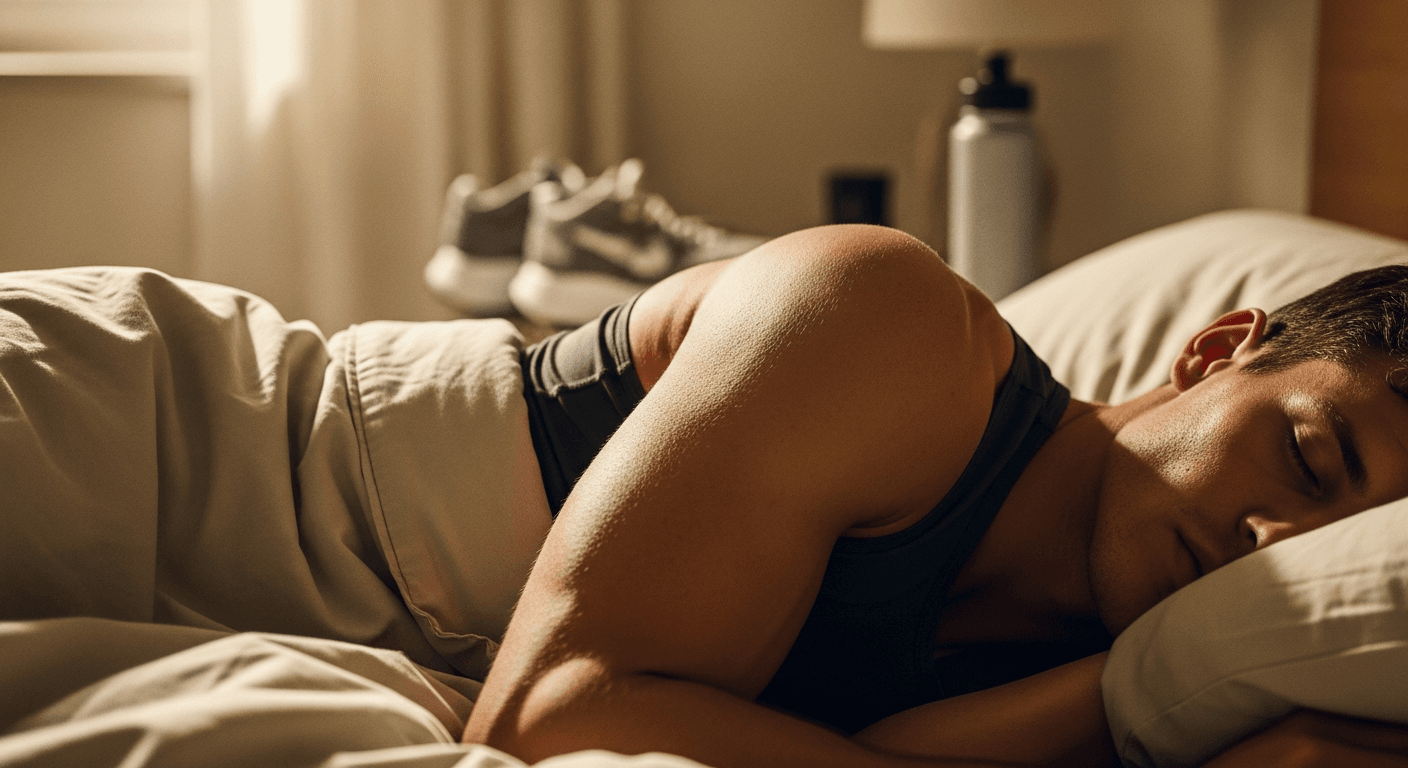
You already know sleep matters. But knowing something in the abstract and understanding the precise biological machinery behind it are very different things. New research out of UC Berkeley has mapped the brain circuitry that links deep sleep to growth hormone release, and the findings reframe sleep not as passive recovery, but as an active physiological process your body depends on to repair muscle, burn fat, and protect your brain.
This isn't another reminder to get eight hours. It's a mechanistic explanation for why shortchanging your sleep is functionally equivalent to skipping your workout and your recovery meal at the same time.
What UC Berkeley Found
Published in July 2026, the UC Berkeley study mapped a feedback loop between deep sleep, specifically slow-wave sleep (SWS), and the pulsatile release of human growth hormone (HGH). Researchers identified the brain circuitry responsible for this regulation, confirming that the relationship isn't one-directional. Growth hormone doesn't just get released during deep sleep. It actively reinforces the depth and quality of subsequent slow-wave sleep stages.
That reciprocal loop changes the entire conversation. It means deep sleep and growth hormone are co-dependent. Protect one, and you strengthen the other. Disrupt one, and both deteriorate together.
Growth hormone is the compound your body uses to rebuild muscle fibers stressed during training, mobilize fat stores for energy, and consolidate tissue repair across every major system. Most of that secretion, roughly 70 to 80 percent of daily HGH output in adults, happens during slow-wave sleep. The UC Berkeley findings now tell us how the brain orchestrates that release, and what happens to the circuit when sleep quality falls short.
When the Circuit Breaks Down
Insufficient deep sleep doesn't just leave you groggy. It breaks the feedback loop at a structural level. When slow-wave sleep is fragmented or shortened, HGH secretion drops. Without adequate growth hormone, muscle protein synthesis slows, fat oxidation becomes less efficient, and the brain's glymphatic clearance system, which flushes metabolic waste during sleep, loses much of its operating window.
The physical consequences are measurable. Studies consistently show that sleep-deprived individuals retain more body fat, particularly visceral fat, and show blunted muscle recovery following resistance training. A single night of poor sleep can reduce muscle protein synthesis rates by up to 18 percent. Across weeks and months, that compounds into training adaptations that stall, regardless of how well you're eating or how hard you're working in the gym.
Cognitive function takes a parallel hit. The same slow-wave stages that drive HGH release are critical for memory consolidation, emotional regulation, and executive function. If you've ever noticed that your decision-making and focus feel sharp after a strong training block and then flat when sleep slips, the deep sleep circuit is a large part of why. Research linking poor sleep to working memory deficits is growing, and the mechanisms are increasingly clear. For a broader look at how lifestyle factors compound cognitive load, endless scrolling hurts your memory, and exercise fights back covers the overlapping behavioral factors in detail.
The Long-Term Stakes: Alzheimer's, Parkinson's, and Beyond
The UC Berkeley research carries implications that extend well beyond athletic performance. The same deep sleep circuitry that drives HGH release is directly tied to the brain's ability to clear amyloid-beta and tau proteins, both implicated in Alzheimer's disease. The glymphatic system operates primarily during slow-wave sleep, and its efficiency depends on the same circuit the researchers mapped.
This positions sleep quality not just as a recovery variable, but as a long-term neuroprotective investment. Chronic disruption of slow-wave sleep appears to accelerate the accumulation of neurotoxic waste products, raising risk profiles for neurodegenerative conditions over decades. Parkinson's research has similarly identified disrupted REM and slow-wave sleep as early markers that precede motor symptoms by years.
The practical implication is significant: optimizing your sleep architecture now isn't just about performing better next week. It's about protecting cognitive function into your 50s, 60s, and beyond. That's a different kind of return on investment than most people assign to their bedtime routine.
Why Your Sleep Data Might Be Misleading You
Consumer sleep trackers have made it easier than ever to monitor sleep stages, and for many people, that data provides a useful baseline. But there are real limits to what wearables can measure. Slow-wave sleep in particular is difficult to detect accurately from wrist-based sensors, which rely on movement and heart rate variability as proxies rather than direct brainwave measurement.
If your tracker consistently shows low deep sleep percentages, that's worth taking seriously. But if it shows normal figures while you still wake up feeling unrestored, the device may not be capturing what's actually happening in your slow-wave stages. Understanding what your device is and isn't measuring is essential context. What your sleep tracker can actually tell you about apnea breaks down the signal limitations and what to do when the data doesn't match how you feel.
There's also the question of whether you're getting assessed correctly in the first place. Sleep disorders that fragment slow-wave sleep, including obstructive sleep apnea, often go undetected or are underestimated. One night of sleep testing isn't enough to accurately classify apnea, a finding that matters if you're relying on a single home study to rule out structural sleep disruption.
How to Protect Your Deep Sleep Stages
The research identifies the mechanism. The application is yours to implement. Here's what the evidence consistently supports for increasing slow-wave sleep duration and quality.
- Anchor your bedtime. Circadian rhythm consistency is one of the strongest predictors of slow-wave sleep depth. Your brain begins preparing for deep sleep stages hours before you lie down. Irregular sleep and wake times disrupt that preparation and shift your sleep architecture toward lighter stages. Aim for a consistent bedtime within a 30-minute window, seven days a week, not just weekdays.
- Cool your room down. Core body temperature needs to drop by approximately 1 to 2 degrees Fahrenheit to initiate and maintain slow-wave sleep. A room temperature between 65 and 68 degrees Fahrenheit (18 to 20 Celsius) supports that transition. A warmer environment increases nighttime awakenings and compresses the time spent in deep sleep stages.
- Cut alcohol before bed. Alcohol is one of the most reliably documented suppressors of slow-wave sleep. Even moderate intake within three hours of sleep onset fragments slow-wave architecture significantly, often replacing it with lighter stage-2 sleep. The sedation alcohol produces is not the same as restorative sleep, and it directly impairs the HGH feedback loop the UC Berkeley team mapped.
- Time your training strategically. Resistance training increases slow-wave sleep drive, partly through the adenosine buildup and tissue repair signals it generates. However, high-intensity training within two hours of bedtime can delay sleep onset by elevating core temperature and cortisol. Morning or early afternoon sessions tend to produce the cleanest sleep architecture benefits.
- Limit late-night light exposure. Blue light from screens suppresses melatonin, but the bigger mechanism is its direct effect on circadian phase. Shifting your circadian clock later compresses early-night slow-wave sleep, which is when the largest HGH pulses occur. A 30 to 60 minute screen-free wind-down window makes a measurable difference for most people.
For a broader framework of recovery habits that support this kind of sleep quality, these five simple recovery habits that actually work stack well alongside the sleep-specific strategies above.
Sleep Is a Training Variable, Not a Lifestyle Add-On
The UC Berkeley findings give fitness-focused individuals something concrete: a confirmed biological circuit that connects sleep quality to the outcomes they're actually training for. Muscle repair, fat metabolism, and cognitive performance don't happen in the gym. They happen at night, during the slow-wave stages your brain is actively regulating through a growth hormone feedback loop that research is only now beginning to fully describe.
Treating sleep as a training tool means applying the same intentionality to your sleep environment and routine that you apply to your program design and nutrition. If you're tracking your macros and monitoring your progressive overload but sleeping six fragmented hours in a warm room after a glass of wine, you're leaving the most anabolic window of every 24-hour cycle largely unoptimized.
The science doesn't ask you to be perfect. It asks you to be consistent. A regular bedtime, a cooler room, and fewer late-night habits that suppress slow-wave sleep are not complicated interventions. They're just underused ones.