
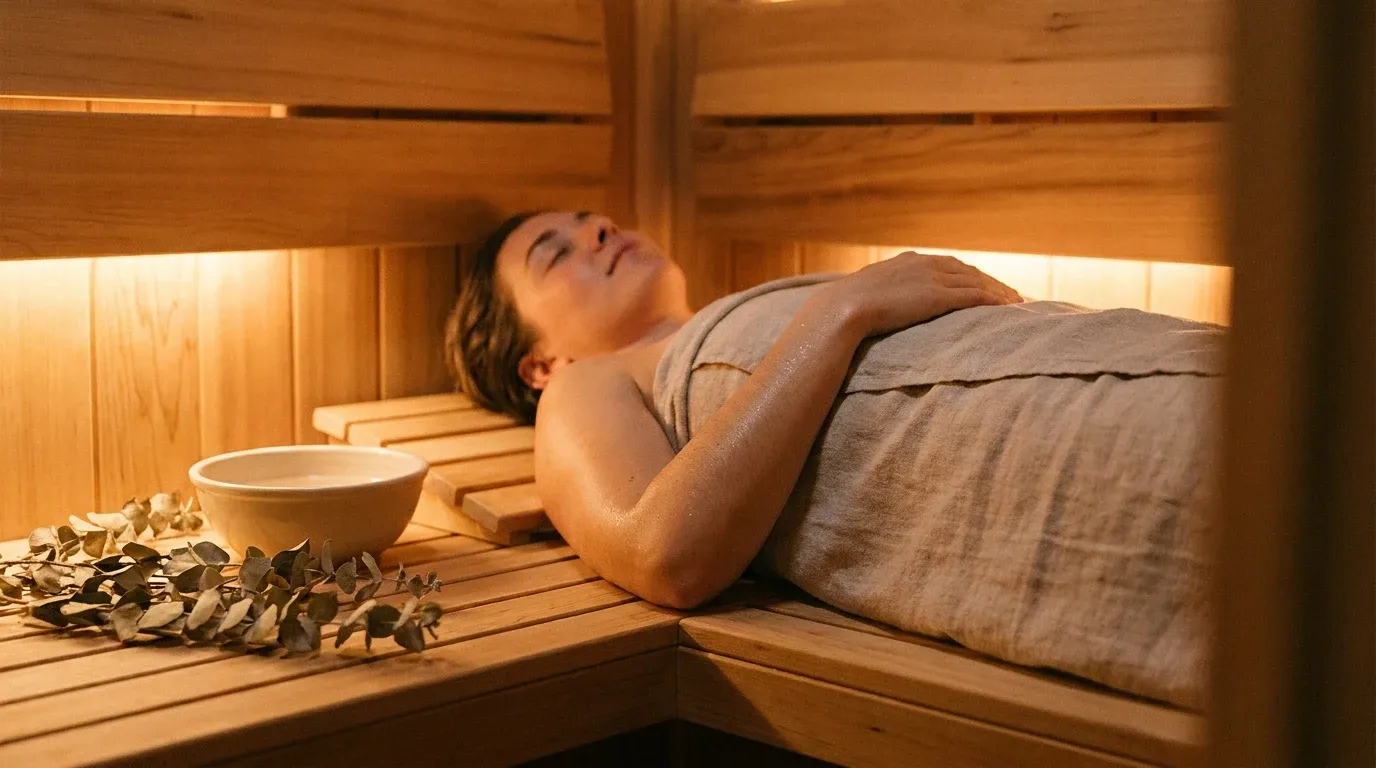
Recovery tools have multiplied fast. Cold plunges, compression gear, massage guns. and now infrared saunas are showing up in gyms, wellness studios, and home setups across the US, UK, Canada, and Australia. The pitch sounds compelling: sit in a warm cabin for 30 minutes, let the light do the work, recover faster. But the evidence backing that pitch has been thin. Until recently, most infrared sauna research leaned on single-session studies or lumped infrared and traditional saunas together. A 3-week controlled trial has now changed the texture of that conversation.
What the Trial Actually Measured
The study ran participants through a structured 3-week protocol using infrared sauna sessions three times per week following standardized training loads. Unlike one-off studies that capture a snapshot after a single session, this design tracked cumulative changes. Researchers measured creatine kinase levels (a blood marker of muscle damage), self-reported muscle soreness, grip strength recovery, and inflammatory cytokines at baseline, week one, and week three.
The findings were specific enough to be useful. By the end of week one, participants using infrared sauna post-workout showed measurably lower creatine kinase levels 24 hours after exercise compared to the control group. By week three, the gap widened. Soreness scores dropped by roughly 30% in the infrared group relative to controls, and grip strength returned to baseline faster after each session. These aren't dramatic numbers, but they're consistent, and consistency across three weeks matters more than a single impressive data point.
Inflammation markers told a more nuanced story. Pro-inflammatory cytokines were modestly reduced in the infrared group, but the reduction was not uniform across all markers measured. That aligns with what scientists working on a 30-year inflammation mystery recently clarified: the inflammatory response after exercise is not a single process you can simply dial down. Some inflammatory activity is essential for adaptation. The trial's results reflect that complexity.
Why Infrared Is Not Just a Warmer Room
The distinction between infrared and traditional sauna is worth understanding before you assume results transfer between them. Traditional saunas heat the air around you, reaching temperatures of 150°F to 195°F (65°C to 90°C). Your body responds primarily through convective heat transfer at the skin surface. Infrared saunas operate at lower air temperatures, typically 120°F to 140°F (49°C to 60°C), but use near-, mid-, or far-infrared wavelengths that penetrate tissue more directly.
Far-infrared wavelengths, which most consumer cabins use, penetrate roughly 1.5 to 2 inches below the skin surface. That means the heat reaches muscle tissue, not just the dermis. The physiological response differs accordingly: core temperature rises more gradually, cardiovascular strain is generally lower, and the session feels more tolerable for people who find traditional saunas overwhelming. For recovery purposes, the tissue-depth difference is the mechanism that matters.
This distinction also explains why the trial's design was careful to specify infrared-only exposure. Pooling infrared and traditional sauna data, as older meta-analyses sometimes did, obscures whether benefits come from heat stress in general or from something specific to infrared wavelength penetration.
Who Benefits Most, and When
The trial's participant pool skewed toward recreational athletes training four to five days per week. That's not elite sport, but it's not casual movement either. If you're training at that frequency, your recovery window between sessions is short, and marginal improvements in how quickly muscles clear damage markers can translate to better quality in your next workout.
The data suggests the benefit compounds over weeks rather than arriving immediately. After a single session, the infrared group's markers improved only slightly compared to controls. The clearest signal emerged between week two and week three. That means committing to infrared sauna as a one-off, post-race treat is probably not the best use of the tool. The protocol that worked was three sessions per week, each lasting 30 to 40 minutes, initiated within 60 minutes of finishing training.
Timing matters for other recovery inputs too. If you're supplementing with caffeine around your sessions, it's worth knowing that caffeine's interaction with heat stress is not well studied. The evidence on caffeine and athletic performance offers a useful frame for thinking about timing your intake around any thermally demanding session.
Older athletes may find infrared sauna particularly relevant. Recovery slows with age, partly because muscle protein synthesis rates change and partly because inflammation clearance takes longer. Research on HIIT after 65 has shown that the type of training stimulus matters significantly for older adults, and the same logic likely applies to recovery modalities. A lower-heat, tissue-penetrating session may be better tolerated and more consistently accessible than cold immersion for people over 50.
Sleep, Stress, and the Wider Recovery Picture
The trial focused narrowly on muscular recovery markers. But infrared sauna's effect on sleep quality is a related benefit that the data touched on peripherally. Participants in the infrared group self-reported improved sleep onset, though the study wasn't powered to analyze sleep as a primary outcome.
That matters because sleep is where most of the recovery work actually happens. Deep sleep stages play a central role in cellular repair and memory consolidation, and any recovery tool that nudges sleep quality upward compounds its benefits overnight. The body temperature drop that follows an infrared session is thought to support sleep onset through a similar mechanism to warm baths taken 1 to 2 hours before bed.
Stress load also interacts with how well infrared sauna works. If your cortisol is chronically elevated from poor sleep or high life stress, the thermal stimulus may be less effective at driving the parasympathetic shift that makes the session useful. Recovery isn't just about what happens to your muscles. It's a systemic state.
The Cost and Commitment Calculation
Here's where honest assessment gets important. Infrared sauna access costs money, and the study's protocol required frequency. Studio sessions in the US typically run $25 to $50 per session, depending on the market and membership structure. Three sessions per week at that rate lands you at $300 to $600 per month. Home units range widely, from under $1,000 for basic single-person cabins to $4,000 to $8,000 for quality two-person units from reputable manufacturers.
If you're already paying for gym access, nutrition tracking, and other recovery tools, infrared sauna is an addition, not a replacement. The trial doesn't suggest it eliminates the need for sleep, protein intake, or rest days. What it suggests is that adding consistent infrared sessions to an existing routine can improve how efficiently your body clears the biochemical debris from hard training.
Whether that efficiency gain justifies the cost depends entirely on your training goals, your budget, and how much room you have in your schedule for 30-to-40-minute passive sessions. For competitive athletes, the math may favor it. For people training primarily for health and longevity, the case is more context-dependent.
Practical Takeaways From the Trial
- Three sessions per week produced the clearest results. Single or occasional sessions showed minimal measurable benefit over controls. Consistency drove the outcome.
- Session timing mattered. Post-workout use within 60 minutes was the protocol. Pre-workout infrared sauna was not tested and could theoretically interfere with the inflammatory signaling needed for adaptation.
- Temperature and duration were specific. Sessions ran at 130°F to 140°F (54°C to 60°C) for 30 to 40 minutes. Higher isn't better. Tolerability and adherence matter more than intensity.
- Hydration is non-negotiable. Participants consumed 500ml of water before and after each session. Sweat loss in infrared sessions is real, even if the heat feels milder than a traditional sauna.
- Results accumulated over weeks, not days. Don't evaluate this tool after two sessions. The meaningful signal appeared at week two and strengthened by week three.
The 3-week trial doesn't settle every question about infrared sauna. Longer studies, larger sample sizes, and head-to-head comparisons with other modalities are still needed. But it moves the evidence from anecdote toward structured data, and it gives you a usable protocol rather than a vague recommendation to "try it and see." If you're training hard and recovering on a tight timeline, that specificity is worth something.