
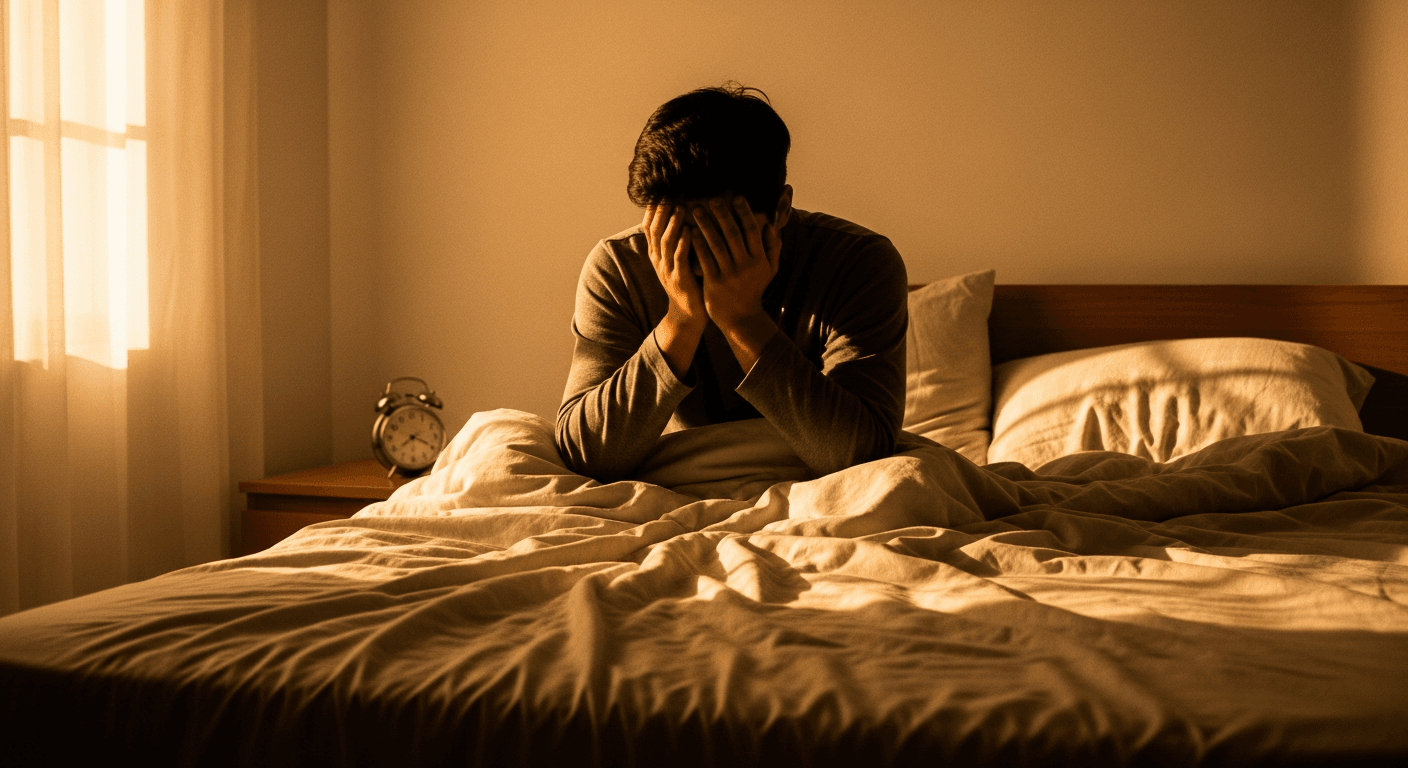
You recovered from COVID. You tested negative, returned to work, and moved on. But months later, you're still exhausted, you're waking at 3 a.m., and no amount of rest seems to touch it. For tens of millions of people, this isn't lingering laziness. It's long COVID disrupting sleep at a neurological level, and most of them have no idea that's what's happening.
As of 2026, an estimated 65 million people globally are living with long COVID. Sleep disruption is one of its most prevalent and least discussed consequences. New research is starting to clarify exactly what's going wrong, and what you can actually do about it.
What the Research Shows About Sleep and Long COVID
A growing body of evidence now links long COVID directly to measurable sleep impairment across multiple dimensions. Studies comparing long COVID patients to matched non-COVID controls consistently show three things: shorter total sleep duration, lower subjective sleep quality scores, and significantly higher rates of sleep disturbance, including fragmented sleep, delayed sleep onset, and frequent nighttime awakenings.
One multi-country analysis found that long COVID participants reported sleeping an average of 45 to 60 minutes less per night than healthy controls, even when accounting for age, sex, and pre-existing conditions. That's not a rounding error. That's a meaningful, cumulative sleep deficit playing out night after night.
Scores on validated tools like the Pittsburgh Sleep Quality Index are consistently worse in long COVID cohorts. Critically, these differences persist well beyond the acute infection phase, often 12 to 18 months post-infection, even in people who consider themselves "recovered." If you want to understand why this matters for your brain, how sleep actually repairs your brain during non-REM cycles explains the downstream cognitive costs of this kind of chronic disruption.
The Mechanisms: Neuroinflammation and a Dysregulated Nervous System
The "why" behind long COVID sleep disruption is still being mapped, but two mechanisms keep appearing in the literature: neuroinflammation and autonomic nervous system dysregulation.
SARS-CoV-2 can cross the blood-brain barrier and trigger prolonged inflammatory responses in neural tissue. Neuroinflammation interferes with the brain regions and neurotransmitter systems that regulate sleep, including the hypothalamus, the brainstem nuclei governing REM sleep, and the adenosine pathways that build sleep pressure across the day. When those systems are inflamed or disrupted, normal sleep architecture breaks down.
Autonomic dysregulation is the other major driver. Long COVID frequently pushes the autonomic nervous system into a state of chronic sympathetic dominance, essentially keeping the body stuck in a low-grade fight-or-flight state. That's physiologically incompatible with deep, restorative sleep. Heart rate variability data from long COVID patients confirms this pattern, showing reduced parasympathetic activity at night, precisely when the body needs to downshift into recovery mode.
This is why techniques that directly engage the parasympathetic nervous system are getting research attention as potential interventions. The connection between breathing, vagal tone, and sleep quality is real, and heart coherence breathing may offer a measurable protective pathway for people dealing with exactly this kind of nervous system dysregulation.
The Recognition Gap: Why People Don't Connect the Dots
Here's the problem that makes long COVID sleep disruption especially hard to address. Most people don't connect it to their COVID history.
When you're tired and sleeping badly 14 months after a COVID infection that felt relatively mild, you don't think "post-viral syndrome." You think stress, aging, screen time, or poor habits. You download a sleep app, you try melatonin, and you blame yourself when nothing works. The actual cause stays invisible.
Research supports this recognition gap. In survey-based studies, a significant proportion of long COVID patients attributed their fatigue and sleep problems to lifestyle factors before receiving any kind of post-COVID assessment. The delay between symptom onset and appropriate support is frequently measured in months, sometimes over a year.
This matters because misattribution leads to mismanagement. If you're treating long COVID fatigue like ordinary burnout, you might push harder, increase training load, cut back on rest days, and make things significantly worse. Post-exertional malaise, one of the hallmark features of long COVID, means that pushing through fatigue can trigger multi-day symptom crashes. This is the opposite of the conventional "train harder to sleep better" logic that works in healthy populations.
What Long COVID Does to Sleep Quality, Specifically
It's worth being precise here, because "bad sleep" covers a lot of ground.
In long COVID, the most commonly reported disturbances include:
- Sleep onset insomnia: Difficulty falling asleep despite significant fatigue, likely tied to elevated sympathetic arousal at bedtime.
- Sleep maintenance insomnia: Waking during the night and struggling to return to sleep, often between 2 and 4 a.m.
- Non-restorative sleep: Waking after a full night and still feeling exhausted, a hallmark of disrupted deep sleep and REM architecture.
- Hypersomnia: A smaller subset experiences excessive daytime sleepiness alongside nighttime disruption, pointing to circadian dysregulation rather than simple insomnia.
- Vivid or distressing dreams: Reported at higher rates in long COVID cohorts, likely connected to REM sleep dysregulation and elevated stress hormones.
The non-restorative sleep pattern is particularly significant. You can hit eight hours and still feel like you've barely slept. That's not psychological. That's neurobiological, and it won't respond to standard sleep hygiene advice alone.
What Actually Helps: Evidence-Backed Strategies
The research on interventions is still developing, but several approaches show genuine promise for managing long COVID sleep disruption.
Strict sleep scheduling. Maintaining a consistent wake time every day, even on weekends, is one of the strongest circadian stabilizers available. For long COVID patients with circadian dysregulation, this consistency serves as an anchor that helps recalibrate the internal clock over weeks. If you've been using weekend lie-ins to compensate, the research on weekend sleep recovery is more nuanced than you'd expect and worth understanding before you make that a habit.
Nervous system downregulation before bed. Given the autonomic dysregulation driving much of this disruption, pre-sleep routines that engage the parasympathetic nervous system are not optional extras. They're mechanistically relevant. Extended exhale breathing (inhale for four counts, exhale for six to eight), body scan practices, and restorative yoga all show measurable effects on heart rate variability and pre-sleep arousal in research settings.
Stimulant management. Caffeine's half-life is approximately five to seven hours in most adults, but in people with post-viral fatigue syndromes, anecdotal and emerging clinical data suggest that sensitivity may be elevated. Moving the caffeine cutoff earlier, to noon or before, is a low-cost, high-relevance change for this population.
Temperature regulation. Core body temperature drop is a key trigger for sleep onset. Long COVID patients with dysautonomia often have dysregulated thermoregulation, so actively supporting that temperature drop, through cool bedroom environments, warm baths two hours before bed, or lightweight bedding, can meaningfully improve sleep onset time.
Pacing, not pushing. This is counterintuitive for a fitness audience, but for long COVID patients, exercise as a sleep intervention requires a fundamentally different approach. The standard evidence that moderate cardio improves sleep quality applies to healthy populations. For post-exertional malaise sufferers, gentle movement within individual energy envelopes is the appropriate framework. The current conversation around recovery as a legitimate fitness priority, not just a passive gap between workouts, is directly relevant here. Recovery has become fitness's new status symbol for evidence-based reasons, and long COVID makes that case more compellingly than almost any other health context.
Why This Matters for the Wellness Conversation in 2026
Long COVID is not a niche clinical issue. Sixty-five million affected people globally makes it one of the most significant chronic health burdens of the decade. Sleep is one of its most pervasive and impactful symptoms. And yet it's consistently underrepresented in mainstream wellness content, which still tends to treat sleep problems as a lifestyle optimization challenge rather than a potential post-viral consequence.
If you've had COVID and you're not sleeping well, the research now gives you a legitimate framework for understanding why. It's not your mattress. It's not your phone. It's not willpower. It may be neuroinflammation, autonomic dysregulation, and a nervous system that hasn't fully recalibrated after a significant viral event.
That's worth taking seriously. And it's worth knowing that targeted, evidence-informed strategies exist, even if the field is still building the complete picture. For a broader look at which sleep interventions hold up under scientific scrutiny and which ones are mostly trending noise, the evidence on sleepmaxxing separates what actually works from what's just hype.
The first step is making the connection. You recovered from COVID. Your sleep may still be recovering too.