
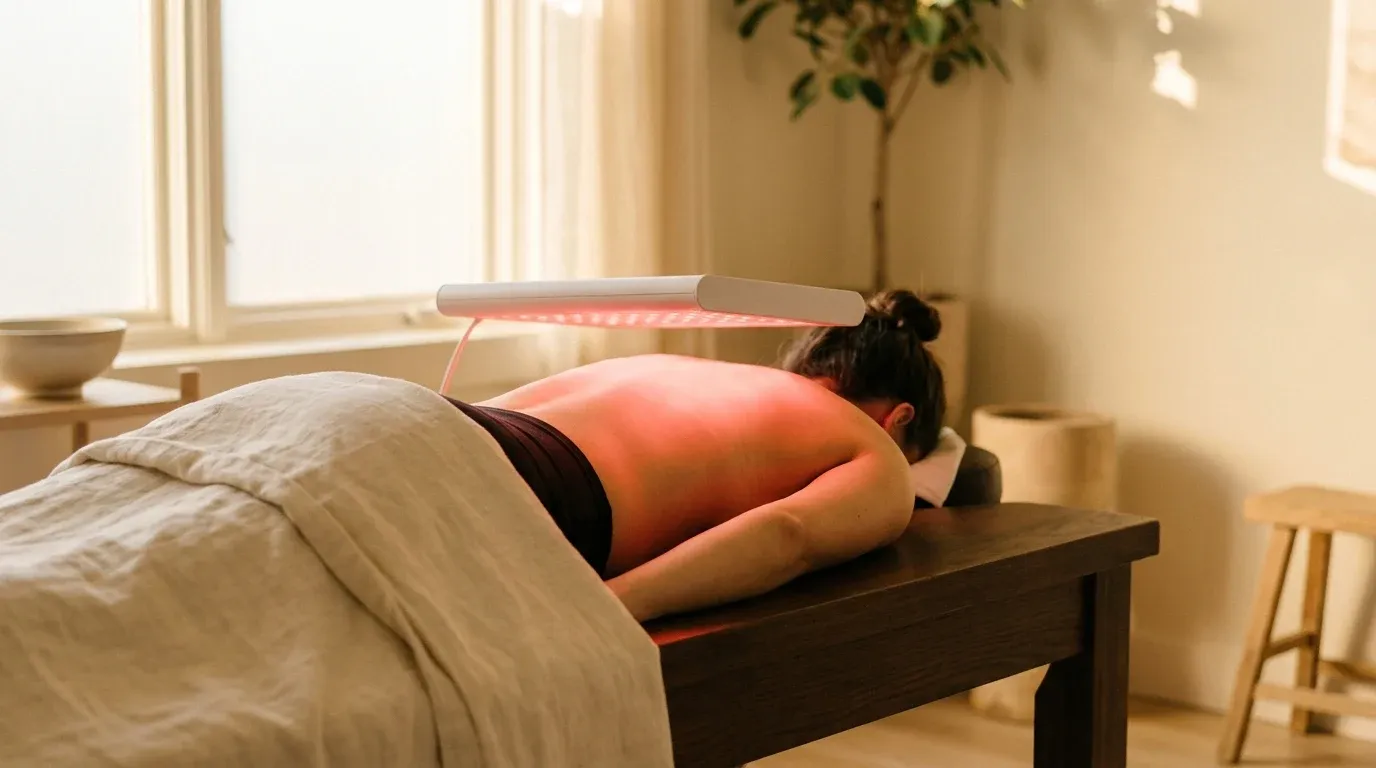
Red light therapy is showing up in more recovery rooms, physical therapy clinics, and home setups than ever before. The devices look simple. The claims sound compelling. But the gap between what this technology can actually do and what most people expect it to do is still significant.
Here's what the science says, what remains unresolved, and how to think about incorporating this modality into a recovery program without wasting your time or money.
What Red Light Therapy Actually Does to Your Cells
Red light therapy. or photobiomodulation (PBM). uses specific wavelengths of light, typically between 630 and 700 nanometers for red light and 800 to 1100 nanometers for near-infrared (NIR) light, to penetrate skin and interact with tissue at a cellular level.
The primary target is mitochondria. the organelles responsible for producing adenosine triphosphate (ATP), the energy currency your cells run on. When red or near-infrared light hits the mitochondrial enzyme cytochrome c oxidase, it appears to stimulate the electron transport chain, increasing ATP synthesis and improving cellular energy availability.
This matters for recovery because exercise creates a significant metabolic demand. Muscle fibers sustain microdamage, reactive oxygen species (ROS) accumulate, and inflammation follows. By supporting mitochondrial function, photobiomodulation may help cells repair more efficiently and reduce the burden of exercise-induced oxidative stress.
Research published across multiple peer-reviewed journals supports this mechanism in principle. Studies using post-exercise protocols have shown reductions in markers like creatine kinase and lactate. as well as improvements in delayed onset muscle soreness (DOMS). The effect sizes are generally moderate, not dramatic, and results vary based on how the therapy was applied.
Why Timing and Dosing Are More Complicated Than They Look
One of the most common mistakes people make with red light therapy is treating it like a passive wellness habit. a few minutes under a panel, any time of day, without much thought. That's not how the research frames it.
The evidence points to a biphasic dose-response, meaning more light is not always better. Too low a dose produces minimal effect. Too high a dose can actually inhibit the cellular processes you're trying to stimulate. This is one reason protocol precision matters more than just buying a device and switching it on.
Key dosing variables include:
- Wavelength: Red light (630-700 nm) penetrates superficial tissue effectively. Near-infrared (800-1100 nm) reaches deeper structures like muscle belly and joint tissue. Many recovery-focused protocols use a combination of both.
- Power density (irradiance): Measured in milliwatts per square centimeter (mW/cm²). Most therapeutic protocols target between 20 and 100 mW/cm², though this varies by application.
- Energy dose (fluence): Measured in joules per square centimeter (J/cm²). A common therapeutic range for musculoskeletal recovery sits between 4 and 60 J/cm², depending on tissue depth and treatment goal.
- Session duration: Typically 5 to 20 minutes per treatment area. Longer sessions don't automatically translate to better outcomes and can cross into the inhibitory zone of the dose-response curve.
- Timing relative to exercise: Pre-exercise application has shown some benefit for performance priming. Post-exercise application targets recovery directly. The optimal window isn't yet universally agreed upon, but most current evidence favors applying therapy within 30 to 60 minutes post-training.
No universal consensus exists on ideal protocols. Research groups use different parameters, different devices, and different populations, which makes direct comparisons difficult. What works in an elite athletic setting with clinical-grade equipment may not translate directly to a home panel purchased online.
Red Light Therapy in Personalized Recovery Programs
As of late 2026, leading industry suppliers report that red and near-infrared light therapy is being actively integrated into personalized physical therapy and performance programs. This isn't happening in isolation. It's part of a broader shift toward individualized, data-informed recovery. alongside tools like heart rate variability tracking, sleep monitoring, and structured nutrition timing.
In clinical and performance settings, practitioners are pairing photobiomodulation with other recovery strategies, adjusting protocols based on training load, injury status, and individual response. That kind of nuanced application is what separates results from noise.
This is also where working with a qualified coach or physical therapist adds real value. If you're early in building a structured training routine, understanding what mistakes a good coach prevents in your first month of training gives important context for why recovery modalities like this need to sit inside a broader, well-managed program. not outside it.
The At-Home Device Reality
Consumer red light therapy panels have become widely available. Entry-level panels start around $150 to $300, mid-range full-body panels sit between $500 and $1,200, and professional-grade panels used in clinical settings can exceed $3,000 to $5,000. The price range reflects meaningful differences in output, wavelength accuracy, and build quality.
The core issue is that not all devices deliver what they claim. Some panels list their power specifications using LED input wattage rather than actual irradiance at the skin surface. which is the number that actually determines therapeutic effect. A device that looks powerful on the spec sheet may deliver a fraction of the effective dose at a realistic treatment distance.
Third-party tested devices from established manufacturers are a safer starting point. Look for devices that publish irradiance measurements (mW/cm²) at specific distances (typically 6 inches and 12 inches), use true 660 nm and 850 nm wavelengths, and have some level of independent verification. Consumer guidance in the supplement and wellness device space is evolving. and if you want broader context on how product regulation is shifting, the 2026 guide to supplement rules for athletes is a useful reference for understanding how regulatory frameworks affect what you actually get from wellness products.
Even with a quality device, applying it without a coherent protocol produces inconsistent results. Too close to the panel, too far, wrong treatment duration, or wrong body area for your training focus. all of these undermine outcomes that are already modest by nature.
What Red Light Therapy Won't Do
This is worth stating clearly. Red light therapy is not a replacement for sleep, nutrition, or structured training. It's a recovery support tool, not a shortcut. Expecting it to compensate for poor hydration, inadequate protein intake, or chronic sleep disruption is unrealistic. For example, research consistently shows that cellular repair processes depend heavily on post-exercise hydration. A point worth revisiting if you're already investing in recovery tools: skipping water after a workout undercuts even your protein shake, let alone more advanced interventions.
Similarly, red light therapy doesn't build muscle on its own. It may support the conditions for recovery that allow training adaptations to occur more effectively. That's a meaningful but specific role. For context, research into whether compounds like creatine can drive muscle adaptation independently. as explored in whether creatine can build muscle without lifting. highlights how even well-studied interventions have limits when they're not paired with the right stimulus.
The modality also won't compensate for overtraining. If you're accumulating more training stress than your recovery capacity can handle, no light panel will close that gap.
Practical Guidance If You Want to Try It
If you've decided to experiment with red light therapy, here's a grounded starting framework:
- Choose a verified device. Prioritize manufacturers who publish irradiance data at treatment distances. Avoid devices that only list wattage without specifying output at the skin surface.
- Start with a conservative protocol. Begin with 10-minute sessions at a standard distance (typically 6 to 12 inches), targeting major muscle groups trained that day. Two to three sessions per week is a reasonable starting frequency.
- Apply post-exercise when possible. Current evidence leans toward post-training application for recovery purposes, ideally within an hour of finishing your session.
- Track your response. Note soreness levels, sleep quality, and training performance over four to six weeks. Individual response to photobiomodulation varies, and personal data matters more than general averages.
- Don't isolate it. Red light therapy works best as one layer in a complete recovery approach. sleep, nutrition, hydration, and load management remain foundational.
- Consult a professional if you have specific injuries. For targeted rehabilitation goals, a physical therapist who uses PBM clinically can provide protocol guidance far more precise than any consumer manual.
The science behind red light therapy is real, but it's also still developing. The honest position is that it offers a legitimate, low-risk recovery support option when applied correctly. with quality equipment and a clear protocol. The hype around it often outpaces the evidence, but the evidence itself is meaningful enough to take seriously.
If you're building a complete recovery and performance program, this tool belongs in the conversation. Just keep it in proportion to everything else that's already proven to work.