
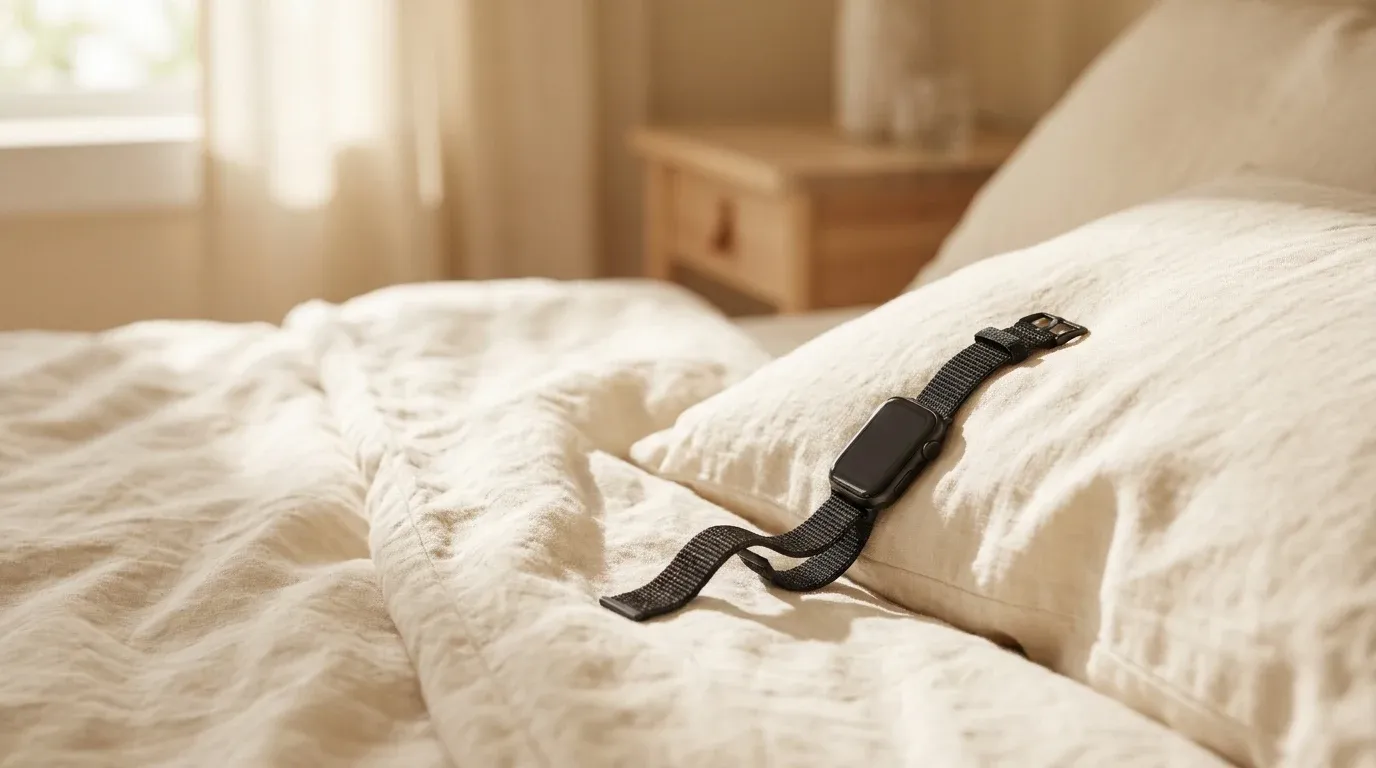
Your wrist tracker might be the most revealing health device you own. It's logging your heart rate, your breathing rhythm, and the architecture of your sleep in granular detail. And a major new study suggests that what it's measuring really does matter. Higher amounts of REM and deep sleep are linked to meaningfully lower risk across dozens of serious diseases. That's a compelling reason to pay attention.
But here's the tension: the same clinical landscape that validates sleep tracking is producing a growing number of patients whose obsession with their sleep scores is actively destroying their sleep. The tool designed to help you rest better is keeping some people awake at night. Understanding both sides of this story is the only way to use your tracker intelligently.
What the Data on 95,000 Sleepers Actually Shows
A large-scale analysis drawing on wrist-tracker data from approximately 95,000 individuals found that higher levels of REM sleep and slow-wave (deep) sleep were associated with reduced risk across 83 distinct health conditions. The list includes some of the most consequential diseases in modern medicine: dementia, hypertension, Parkinson's disease, type 2 diabetes, and several cardiovascular conditions.
The scale of that number is worth sitting with. Eighty-three conditions. That's not a marginal finding. It positions sleep architecture, not just sleep duration, as one of the most significant modifiable factors in long-term health. You can read a detailed breakdown of the findings at More REM Sleep Is Linked to 83 Fewer Diseases.
REM sleep, which tends to peak in the final hours of the night, is associated with emotional memory processing, neural repair, and hormonal regulation. Deep sleep, which dominates the early part of the night, is when the brain clears metabolic waste through the glymphatic system. Both stages appear to do protective work that lighter sleep simply cannot replicate.
What makes this research unusual is the sample size. Most sleep studies rely on polysomnography in a lab setting, with dozens or hundreds of participants. A dataset of 95,000 wrist-tracker users creates a different kind of visibility, one that reveals population-level patterns even if individual-night precision remains imperfect.
The Problem That the Trackers Created
Orthosomnia. The word is new enough that many clinicians haven't encountered it yet, but it's now appearing in peer-reviewed literature as a recognized clinical pattern. It describes a state in which a person becomes so focused on achieving optimal sleep scores that the anxiety itself disrupts natural sleep architecture.
The irony is almost painful. A device worn to improve sleep quality becomes a source of cognitive hyperarousal, the exact physiological state most incompatible with falling and staying asleep. Patients presenting with orthosomnia often report lying awake calculating how many REM cycles they need, checking the time anxiously, or feeling genuine distress after seeing a low score in the morning.
That morning score-check is particularly problematic. Sleep researchers have noted that starting the day by grading your previous night creates a psychological framing that affects mood, performance expectations, and even subsequent sleep behavior. If your score is low, you carry that information into your day and into your next attempt at sleep.
The profile of someone vulnerable to orthosomnia overlaps significantly with high achievers who apply the same optimization mindset to sleep that they use in training or work. If you're already tracking your VO2 max, your macros, and your step count, it's entirely natural to extend that framework to sleep. The problem is that sleep doesn't respond to effort the way exercise does. Trying harder to sleep makes sleep worse.
Why Tracker Data Is Genuinely Imperfect
Consumer wrist trackers are not clinical-grade instruments. They infer sleep stages primarily from movement data and heart rate variability, neither of which maps cleanly onto the electroencephalography used in sleep labs. Studies comparing wrist devices to polysomnography consistently find that trackers overestimate total sleep time and have variable accuracy in distinguishing light, deep, and REM stages.
This doesn't mean the data is useless. It means it's directional rather than definitive. A tracker that shows you averaging four hours of sleep per night when you thought you were getting seven is telling you something real. A tracker that shows your deep sleep dropped from 18% to 14% on a given night may simply be reflecting normal variation, sensor error, or a change in sleeping position.
The practical implication is that individual nights are noisy. Trends over weeks or months carry actual signal. Treating a single night's score as diagnostic information is like judging your cardiovascular fitness from one workout. The data needs context that a single session cannot provide.
How Researchers Recommend Using Your Tracker
Sleep scientists who have studied orthosomnia are not advising people to throw their devices in a drawer. The behavioral recommendations are more nuanced and more usable than that.
- Shift to weekly reviews. Instead of checking your sleep score every morning, designate one day a week to review your data. This reduces the emotional charge of individual nights while preserving the trend-level insight that actually has value.
- Disable score notifications. Most major platforms allow you to turn off the push notifications that deliver your sleep score the moment you wake up. This single change can meaningfully reduce the reflexive first-thing-in-the-morning score check.
- Anchor the data to behaviors, not outcomes. Use the tracker to monitor upstream choices: consistent bedtime, screen exposure, alcohol consumption, exercise timing. These are variables you control. Your sleep score is an output, not an input.
- Notice your emotional response. If you feel genuine anxiety when your score is low, or if you find yourself making decisions during the day based on your sleep score, that's clinical information. It suggests the tracker is causing more harm than benefit for you personally.
- Consider a data break. Removing the tracker for two to four weeks and paying attention to how your sleep and your mood shift is a legitimate experiment. Some people sleep measurably better without the device.
These recommendations reflect a broader principle in evidence-based wellness: tools serve you, not the other way around. If a piece of technology is governing your behavior in ways that increase stress, it's worth reassessing the relationship. This applies whether you're evaluating a sleep tracker, a calorie counter, or any other biometric device.
Protecting Your Sleep Architecture Without the Score Spiral
The research on REM and deep sleep gives you something genuinely useful: a framework for understanding which behaviors support the sleep stages that protect long-term health. You don't need a perfect nightly score to apply those insights. You need consistent habits.
Alcohol is one of the most reliable suppressors of REM sleep, even in moderate amounts. A drink within three hours of bedtime can significantly reduce the proportion of REM you accumulate in the first half of the night. Temperature matters too. Core body temperature drops naturally as part of sleep onset, and a cooler bedroom, typically between 65 and 68 degrees Fahrenheit, supports that process.
Timing of exercise affects sleep architecture in ways that are still being studied. Evening yoga, for example, has produced mixed results, while morning practice shows more consistent benefits for sleep quality. The research on this is covered in depth in Morning vs. Evening Yoga: New Study Settles the Sleep Debate. If you're deciding when to build movement into your day, sleep architecture is a legitimate factor to weigh.
Stress management directly affects the autonomic nervous system state required for deep sleep. Techniques that activate the parasympathetic system in the evening, including structured breathwork, have demonstrated measurable effects on sleep quality. Research on coherent breathing and its 31% reduction in stress markers points toward practical options that don't require a device at all.
And if hypertension is part of your health picture, the disease risk data from the tracker study links directly to interventions beyond sleep. Isometric training performed twice a week has demonstrated meaningful blood pressure reductions, and combining that with consistent sleep habits creates a compounding effect on cardiovascular risk.
The Honest Balance
The 95,000-person dataset is real science, and it should motivate you to take sleep seriously. REM and deep sleep are not passive recovery periods. They're active biological processes with measurable consequences for the diseases most likely to affect your health over a lifetime.
Your tracker can support that goal if you use it the right way. Trends, not nights. Behaviors, not scores. Curiosity, not performance anxiety.
If your relationship with your sleep data has crossed into something that feels like pressure or dread, that's not a minor issue. Orthosomnia is a clinical concern precisely because the anxiety it generates is neurologically incompatible with the sleep stages it's supposedly trying to improve. The irony is structurally identical to overtraining. Doing more of a thing in the wrong way produces the opposite of the intended result.
Treat your tracker the way good coaches treat performance data: as one input among several, reviewed with perspective, and never allowed to become the point in itself. For a broader look at how recovery science is evolving, what science says actually works in 2026 offers a useful frame for putting all of this in context.
The goal isn't a better sleep score. The goal is actually sleeping better. Those two things are not always the same.