
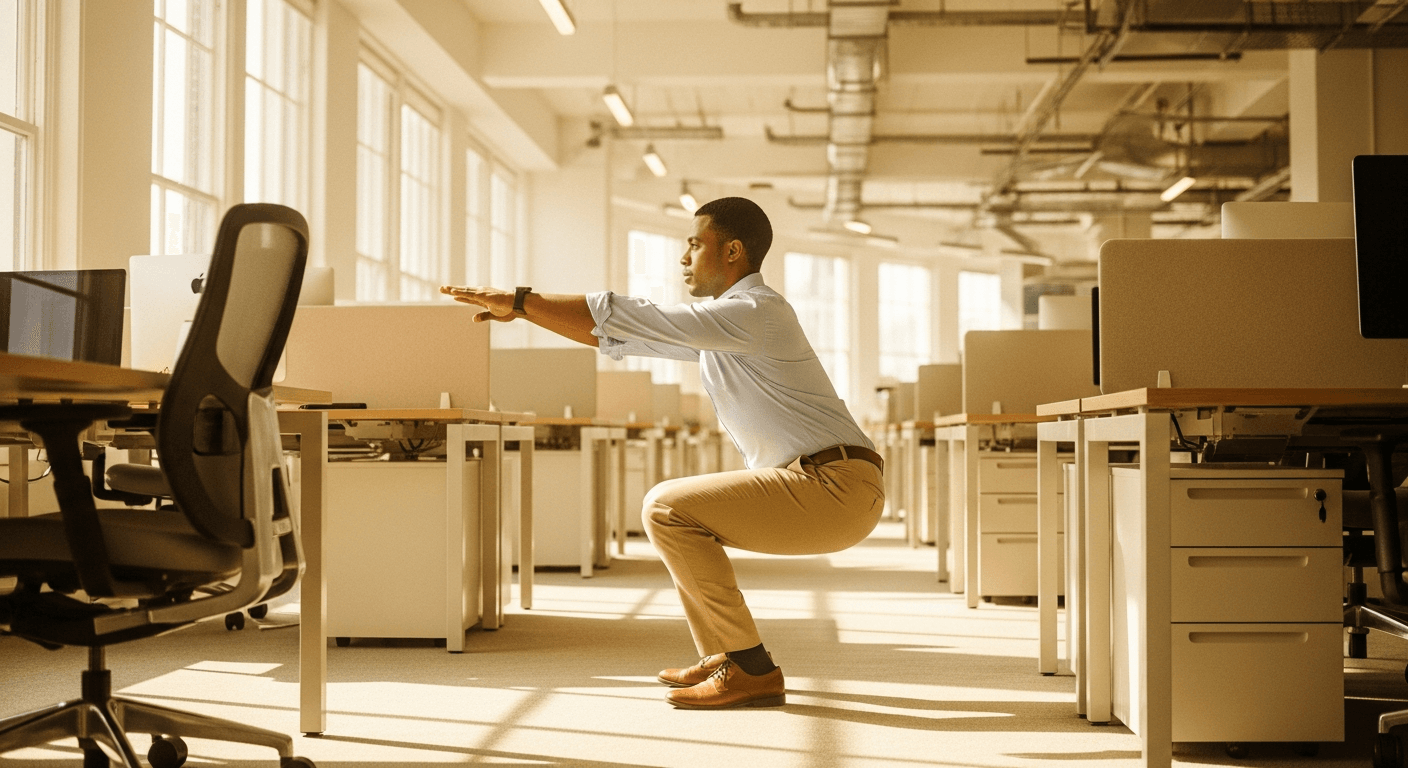
You've probably heard that sitting is the new smoking. But the real problem isn't sitting itself. It's sitting without interruption. New expert analysis published July 7, 2026 confirms that even a 30-second movement break, done consistently throughout the day, can begin reversing the metabolic and musculoskeletal damage that accumulates when you stay still for hours at a stretch.
And here's where it gets more interesting: not all movement breaks are created equal. Strength-based micro-bouts, think bodyweight squats, wall sits, or standing calf raises, appear to outperform casual walking breaks for desk workers, particularly when it comes to preserving muscle mass and improving glucose regulation over time.
What 30 Seconds Actually Does to Your Body
The physiological case for short movement bouts is stronger than most people expect. When you sit for extended periods, your postural muscles disengage, blood pools in the lower extremities, insulin sensitivity begins to drop, and intervertebral disc pressure increases. These changes don't require hours of immobility to begin. Research has shown measurable shifts in blood glucose and circulation within 20 to 30 minutes of uninterrupted sitting.
What the July 7, 2026 expert analysis adds to this picture is a clearer threshold for reversal. A 30-second bout of moderate-intensity movement is enough to re-engage major muscle groups, stimulate circulation, and begin resetting glucose uptake pathways. You don't need a gym. You don't need a yoga mat. You need a small patch of floor and the intention to use it.
This matters because it removes the most common objection: "I don't have time." At 30 seconds per break, even six exercise snacks across a workday costs you three minutes total. The barrier isn't time. It's habit architecture.
Why Strength Beats Steps for Sedentary Workers
Walking breaks have long been the default recommendation for desk-bound employees. A 5-Min Walk Every Hour Is All It Takes, Says New Study captured exactly this logic, and the evidence behind it is real. But the newer analysis suggests that for workers who are already significantly sedentary, strength-based movement may offer a more efficient return on that three-minute investment.
Here's why. Walking primarily activates slow-twitch, oxidative muscle fibers. It's good for cardiovascular maintenance and mood regulation, but it doesn't meaningfully challenge the fast-twitch fibers that atrophy most rapidly during sedentary aging. Bodyweight squats, wall sits, incline push-ups, and similar exercises recruit a broader spectrum of muscle tissue, creating a stimulus for preservation that walking simply doesn't match.
For workers in their 40s and above, this distinction matters considerably. Sarcopenia, the age-related loss of muscle mass, accelerates during periods of prolonged inactivity. Embedding resistance-style movement into the workday creates a low-level but consistent counterstimulus. As covered in The One Workout That Burns Fat Without Losing Muscle, resistance training remains the most evidence-backed strategy for preserving lean mass during sedentary phases of life.
None of this means walking breaks are worthless. They're not. The most effective desk wellness strategy likely combines both: strength-based snacks for metabolic and musculoskeletal benefit, with short walks layered in for circulation, eye rest, and cognitive reset.
Frequency Over Duration: A Principle That Changes the Equation
One of the most consequential ideas embedded in the July 2026 analysis is the reinforcement of what exercise scientists call the "frequency over duration" principle. The body doesn't require long, continuous exercise bouts to achieve meaningful health outcomes. Short, repeated stimuli, distributed across the day, can aggregate into genuinely significant physiological benefit.
This has been documented across multiple domains. Blood pressure responses, glucose regulation, mood, and even some markers of inflammation all respond positively to frequent low-dose movement, sometimes more favorably than to a single longer session preceded and followed by hours of immobility.
For organizations, this reframes the entire conversation. Wellness is not a time-cost problem. It's a scheduling design problem. Employees don't need to carve out 45 minutes for a lunchtime gym session. They need environmental cues and permission structures that make 30-second breaks a normalized part of the workday rhythm.
It's also worth noting that the cumulative health burden facing desk workers extends well beyond physical inactivity. Digital Eye Strain Is Now the Fastest-Growing Ergonomics Risk at Work, and the same prolonged desk sessions that drive metabolic dysfunction are also driving visual fatigue. Movement breaks that include stepping away from a screen address both problems simultaneously.
What This Means for HR and Operations Leaders
If you're responsible for employee wellness programs or operational planning, the exercise snack research carries some direct implications that are worth acting on now.
Meeting cadence redesign. The standard 60-minute meeting format is physiologically poorly designed. Consider building in two to three minutes of structured movement at the 30-minute mark, or shifting default meeting lengths to 25 and 50 minutes, freeing up transition time that employees can use for movement without feeling they're stealing it from work.
Break policy formalization. Many organizations have informal break cultures that effectively discourage stepping away from screens. Formalizing a short-break policy, whether that's two 30-second movement prompts per hour or a structured mid-morning and mid-afternoon pause, gives employees psychological permission and organizational cover to actually use it.
Workspace layout adjustments. Low-cost environmental nudges have an outsized impact on behavior. Positioning a wall near standing desks for wall sits, adding floor markers for squat positioning, or placing resistance bands in common areas turns passive spaces into movement-ready zones. None of this requires capital expenditure beyond a few hundred dollars per floor.
Digital nudge systems. Existing productivity and communication platforms increasingly support wellness integrations. Movement reminder apps, calendar block features, and even simple recurring alarms cost next to nothing to implement and consistently show high uptake when introduced with management endorsement.
The business case isn't abstract. 89% of Employees Perform Better When Their Health Is Prioritized, According to Wellhub's 2026 Numbers. Organizations that treat desk wellness as a scheduling design challenge rather than an individual responsibility problem tend to see measurably better outcomes, both in health metrics and in performance data.
The Five Exercise Snacks Worth Building Into Your Day
If you want a practical starting point, here are five strength-based micro-bouts that work in most office environments, require no equipment, and can each be completed in 30 to 60 seconds.
- Bodyweight squats. Stand with feet shoulder-width apart, lower until your thighs are parallel to the floor, return to standing. Ten to fifteen reps takes under 45 seconds and activates the glutes, quads, and hamstrings that disengage entirely during sitting.
- Wall sit. Find any flat wall, slide down until your knees are at 90 degrees, hold for 30 seconds. Isometric holds build muscular endurance without requiring movement space and are genuinely difficult to excuse away.
- Calf raises. Stand at your desk, rise onto your toes, lower slowly. Fifteen to twenty reps in 30 seconds. Specifically helpful for counteracting the circulatory stagnation in the lower legs that prolonged sitting creates.
- Desk push-ups. Place hands on the edge of your desk at shoulder width, step back until your body is at an angle, complete ten to fifteen incline push-ups. Upper body engagement that addresses the rounded-shoulder posture almost all desk workers develop over time.
- Hip flexor stretch hold. Step one foot forward into a shallow lunge, lower the back knee toward the floor, hold for 20 to 30 seconds per side. The hip flexors are the muscles most directly shortened by sitting, and even brief stretching provides measurable relief in lumbar tension.
None of these require you to change clothes, break a visible sweat, or leave your immediate work area. That's the point. The lower the friction, the higher the consistency. And consistency, not intensity, is what the frequency-over-duration principle depends on.
The Bigger Picture for Desk-Worker Health
Exercise snacks are one piece of a larger desk-worker wellness picture that organizations are increasingly taking seriously. The physical costs of sedentary work, metabolic disruption, postural degradation, and cardiovascular risk, don't operate in isolation. They interact with sleep quality, cognitive load, and emotional stress in ways that compound over time.
Workers who are physically uncomfortable are also more likely to report attention fatigue and emotional exhaustion. Addressing movement isn't separate from addressing mental performance. It's the same intervention seen from different angles. And given that 87% of People Fall Short on Both Sleep and Exercise, the population most likely to benefit from exercise snacks is also the population least likely to be meeting broader wellness targets through other means.
The 30-second exercise snack won't replace a structured fitness routine. It's not designed to. What it does is keep the physiological baseline from eroding through the eight to ten hours a day that most desk workers spend seated, and it does that at essentially zero cost and minimal disruption to the workday.
That's not a minor benefit. For the majority of full-time office workers who aren't hitting exercise guidelines in their personal lives, what happens during working hours may be the most accessible lever they have. The scheduling is already there. The question is whether you choose to use it.