
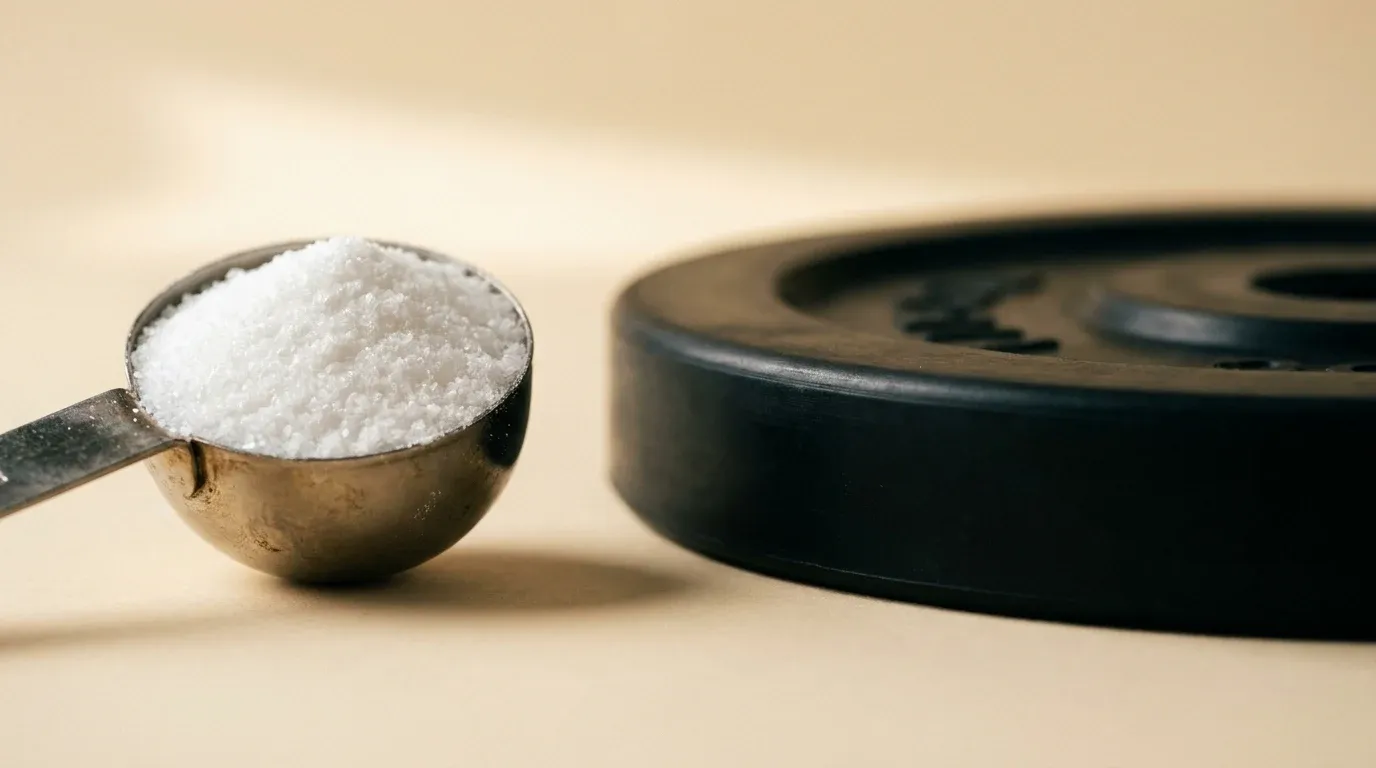
A new study has the supplement world paying attention. Sedentary adults aged 45 to 65 took 10 grams of creatine daily for 12 weeks. No exercise program. No structured training. At the end of the trial, they had gained approximately 1.1 kilograms of lean mass and showed measurable improvements in bench press strength.
That's a striking result. But before you cancel your gym membership, it's worth understanding exactly what those numbers mean and what they don't.
What the Study Found
The participants were deliberately sedentary throughout the 12 weeks. No resistance training, no cardio protocol. They simply supplemented with 10 grams of creatine per day, which is double the 5-gram maintenance dose most protocols recommend after an initial loading phase.
The outcomes measured included lean body mass via DEXA scan and upper body strength assessed by bench press performance. Both improved. Lean mass went up by roughly 1.1 kilograms. Bench press numbers moved in the right direction, even without a single set of lifting in a gym.
For a population that often struggles to maintain muscle as they age, those numbers are genuinely notable. But the mechanism behind the lean mass gain changes how you should interpret it.
Lean Mass Is Not the Same as Muscle Hypertrophy
This is the part that gets glossed over in most supplement headlines. Creatine works in part by drawing water into muscle cells. When your muscles hold more water, they are heavier. They may even appear slightly fuller. On a DEXA scan, that extra cellular water registers as lean mass because it's not fat.
What it is not, necessarily, is new contractile muscle tissue. True hypertrophy, the kind that makes you stronger over the long term and that slows age-related muscle loss, requires mechanical tension. That means training. Without a progressive resistance stimulus, you're not triggering the signaling cascades that build new myofibrils.
So the 1.1 kilograms gained in this study almost certainly contains a meaningful water component. The researchers used lean mass as their primary outcome, not muscle protein synthesis or fiber cross-sectional area. Those are different things, and the distinction matters if you're trying to understand what creatine can actually do for you.
That said, dismissing the result entirely would also be a mistake.
Why the Findings Still Matter, Especially After 45
Even accounting for water-driven lean mass gains, the bench press improvement is harder to explain away. Water retention doesn't directly make you stronger. What creatine does do is increase the availability of phosphocreatine in muscle cells, which fuels short-duration, high-intensity efforts. That's a real physiological mechanism, and it may explain why strength numbers improved even without structured training.
For adults in the 45 to 65 age range, this is meaningful. Sarcopenia, the gradual loss of muscle mass and strength that accelerates after 40, is one of the biggest drivers of functional decline in older adults. Any intervention that helps preserve or modestly increase lean tissue and functional strength in a sedentary population is worth taking seriously.
Research consistently shows that even minimal resistance stimulus can be protective. One strength session a week is enough to fight muscle loss, according to recent findings, which suggests that combining even light training with a creatine protocol could produce results meaningfully beyond what either approach achieves alone.
For individuals who are injury-limited, post-surgical, or managing conditions that make regular exercise difficult, creatine supplementation may offer a partial buffer during periods of forced inactivity. It won't replace training. But it may slow the losses that happen when training isn't possible.
The Dose Question: Why 10 Grams Is Worth Flagging
Standard creatine supplementation protocols typically involve a loading phase of around 20 grams per day for five to seven days, followed by a maintenance dose of 3 to 5 grams per day. Some research suggests 5 grams is sufficient to saturate muscle stores in most adults once loading is complete.
This study used 10 grams per day with no loading phase, which sits well above the typical maintenance recommendation. That's not inherently dangerous. Creatine monohydrate has a strong safety profile across decades of research. But it does raise a practical question: were the results partially driven by the higher dose itself?
It's possible that 10 grams produced a degree of ongoing muscle saturation that a standard 5-gram maintenance dose might not sustain in all individuals, particularly older adults who may absorb or utilize creatine less efficiently. Age-related changes in muscle creatine uptake are an active area of research, and some evidence does suggest older adults benefit from slightly higher doses to achieve the same intracellular concentrations as younger people.
If you're currently taking 5 grams and wondering whether to increase, the honest answer is: the evidence here is suggestive, not conclusive. What's clear is that 10 grams daily for 12 weeks produced measurable outcomes in a group that wasn't exercising. That's useful information.
Creatine also works best when paired with adequate protein intake. Getting enough leucine in particular, a key trigger for muscle protein synthesis, supports the anabolic environment that creatine helps sustain. The best leucine-rich foods for muscle and energy include eggs, chicken, beef, and certain dairy sources, all of which are easy to incorporate regardless of training status.
What This Means If You're Already Training
If you lift regularly, this study is less about what you should do differently and more about what the research confirms: creatine supports lean mass and strength even under suboptimal conditions. If it can move the needle in sedentary middle-aged adults, it's almost certainly helping you more when combined with consistent training and progressive overload.
The water retention component that shows up as lean mass on a DEXA scan isn't a scam. Cellular hydration plays a real role in muscle function and protein synthesis. A well-hydrated muscle cell is a more anabolically active muscle cell. The gains you see from creatine while training include both intracellular water and genuine new tissue, and the two are not mutually exclusive.
For lifters looking to optimize beyond creatine, the cognitive and neurological benefits of strength training are also worth keeping in mind. Lifting weights has been shown to make the brain two years younger, which adds another layer of long-term value to staying consistent in the gym beyond body composition alone.
What This Means If You're Not Training
If you're sedentary by circumstance rather than choice, whether due to injury, illness, a demanding schedule, or simply not having built the habit yet, this study gives you something concrete to work with. Creatine supplementation during that period may help preserve more lean mass than you'd otherwise retain.
It's not a replacement strategy. The benefits of resistance training extend far beyond muscle mass, including bone density, metabolic health, hormonal balance, and cognitive function. But if you're in a gap period, creatine may reduce the cost of that gap.
For older individuals managing muscle loss as a medical concern, including those on medications or treatments that accelerate tissue breakdown, combining nutritional strategies is particularly important. If you're on GLP-1 medications and concerned about muscle loss, dietary protein strategies become especially relevant alongside any supplementation protocol.
The Bottom Line
The study is real, the results are meaningful, and the caveats are necessary. Sedentary adults in their mid-life years can gain lean mass and strength improvements from 10 grams of creatine daily over 12 weeks. Some of that lean mass is intracellular water. Some of it may reflect genuine anabolic support. The strength improvements are harder to explain away and suggest a real physiological effect.
The 10-gram dose is higher than standard recommendations and worth noting if you're adjusting your own protocol. Creatine remains one of the most researched and well-tolerated supplements available, and this study adds to the case that its benefits extend well beyond elite athletes and gym regulars.
What it doesn't do is make exercise optional. It makes the absence of exercise slightly less costly. That's a meaningful distinction, and it's exactly the kind of nuance that tends to get lost when a headline reads "you don't need to go to the gym."
You still do. But if you can't right now, 10 grams of creatine might help you hold the line.