
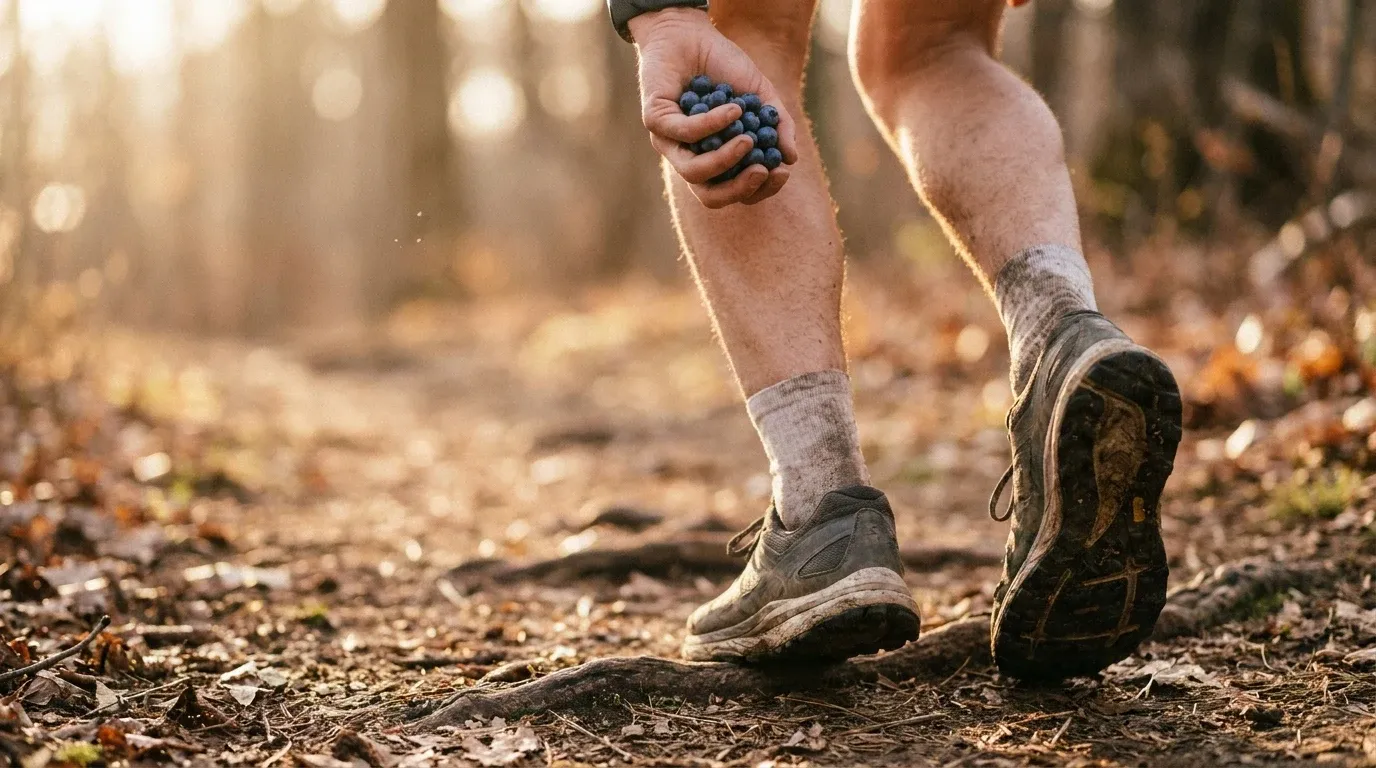
Sports nutrition has a long history of overpromising on antioxidants. Eat more berries, the advice goes, and your muscles will recover faster. It sounds reasonable, but the evidence has rarely been specific enough to act on. That's starting to change.
New research from the University of the Fraser Valley, published September 17, 2026 in the International Journal of Sport Nutrition and Exercise Metabolism, moves the blueberry conversation out of general wellness territory and into something trail runners can actually use. The study focused specifically on highbush blueberry supplementation and its effects on muscle damage, inflammation, and oxidative stress following downhill running. The findings are more targeted, and more actionable, than anything that's come before on this topic.
Why Downhill Running Is a Different Problem
Before getting into what blueberries do, it helps to understand why downhill running creates a unique recovery challenge in the first place.
When you run downhill, your muscles are constantly braking. Your quads and glutes are lengthening under load to slow your descent, a movement pattern known as eccentric contraction. Eccentric work is fundamentally harder on muscle tissue than the concentric contractions involved in pushing off flat ground. The mechanical stress is higher, the cellular disruption is greater, and the resulting inflammation tends to linger longer.
This is why you can finish a steep descent feeling fine and wake up two days later barely able to walk down stairs. The damage isn't always immediate. If you've ever underestimated a technical downhill section mid-race and paid for it in the back half, you already know this pattern firsthand. Understanding the mechanics of how your lower body absorbs impact. and where the real stress accumulates. is part of what makes smart glute training and biomechanics work so relevant for trail runners, not just gym athletes.
Standard antioxidant supplementation has shown mixed results in endurance contexts partly because most studies don't differentiate between running types. Flat road running and technical downhill trail running place very different demands on your musculature. The UFV researchers designed their study specifically around the eccentric-heavy demands of downhill running, which is what makes the results stand out.
What the Research Actually Found
The UFV study measured three primary markers after participants completed downhill running protocols: creatine kinase (a marker of muscle damage), inflammatory cytokines, and oxidative stress indicators. Participants who supplemented with highbush blueberries showed meaningful reductions across all three compared to controls.
Crucially, the research also tracked performance outcomes in simulated race conditions. Blueberry supplementation was associated with measurable time savings, suggesting that reduced muscle damage and inflammation weren't just numbers on a lab report but translated into the ability to sustain pace and effort when it mattered.
The effect size varied depending on individual training status and baseline diet quality, which is worth flagging. Highly trained athletes with already-optimized diets showed smaller gains than recreational runners whose nutritional foundations had more room to improve. This isn't a weakness in the research. It's a realistic picture of how dietary interventions tend to work.
The mechanism driving these effects comes down to anthocyanins, the polyphenols responsible for the deep blue-purple pigment in highbush blueberries. Anthocyanins act on multiple inflammatory pathways simultaneously and have been shown to modulate NF-kB signaling, one of the key drivers of exercise-induced inflammation. They also support mitochondrial function, which matters for sustained aerobic output over long efforts.
Highbush vs. Wild: Does the Type of Blueberry Matter?
One detail worth pulling out of the research is the specific variety used: highbush blueberries, not wild or lowbush varieties. This distinction matters because anthocyanin content and polyphenol profiles differ meaningfully between cultivars.
Highbush blueberries are the large, cultivated variety you find at most grocery stores across North America, the UK, and Australia. Wild or lowbush blueberries, common in parts of Canada and the northeastern US, actually tend to have higher anthocyanin density per gram but are harder to source consistently and aren't what most commercial supplements use.
The UFV study used a standardized highbush supplement rather than whole fruit, which allowed for consistent dosing across participants. Whole fruit introduces variables in anthocyanin content that make dose-response relationships hard to pin down. For practical purposes, if you're using whole blueberries rather than a supplement, you'll need to consume more volume to hit comparable polyphenol loads.
Practical Dosing: What You Need to Know
The study provides more specific dose guidance than most previous berry research, which has historically been vague. Here's what the evidence now supports:
- Supplementation window: The most significant effects were seen when supplementation began five to seven days before a key training block or race and continued through the recovery period afterward. Single-dose or same-day use showed minimal benefit.
- Dose range: The study used standardized extract doses delivering roughly 300 to 600mg of anthocyanins daily. Whole-food equivalents vary, but reaching the lower end of that range would require approximately 150 to 200 grams of fresh highbush blueberries per day.
- Timing relative to training: Pre-training consumption (one to two hours before downhill efforts) appeared to offer some protective effect, but consistent daily supplementation across the loading window mattered more than acute timing.
- Individual response: Runners with lower baseline antioxidant intake showed stronger effects, suggesting dietary context shapes how much the supplement moves the needle.
If you're preparing for a race with significant elevation loss, building a supplementation protocol into your taper is a practical application of these findings. The evidence doesn't support treating blueberries as a daily magic bullet, but using them strategically around high-damage training periods and races is now backed by solid mechanistic reasoning.
Where This Fits in the Broader Nutrition Picture
Blueberry supplementation isn't operating in isolation. Recovery nutrition works as a system, and the UFV findings are most useful when they're layered onto an already functional foundation.
Protein timing, carbohydrate availability, and hydration all continue to matter more than any single micronutrient or polyphenol. The performance gains from blueberry supplementation in this study were real but incremental. That's not a dismissal. In trail running, where the difference between a strong finish and a blown second half often comes down to how well you managed accumulated fatigue, incremental gains are worth taking seriously.
It's also worth noting that the conversation around ergogenic supplements has been evolving rapidly. Compounds that were once considered purely gym-focused are now being examined for their endurance applications. The depth of research growing around certain widely-used supplements is a useful reminder that nutrition science doesn't stay still. For a look at how one popular supplement is being reconsidered across multiple performance contexts, the work around creatine and its expanding range of studied benefits offers a useful parallel.
Trail running also has its own nutritional complexity relative to road running, particularly when events stretch beyond four hours. Understanding how training intensity and volume interact during ultra-distance preparation helps frame where targeted supplementation fits relative to the bigger picture of training load management.
Should You Actually Try It?
If you're a trail runner who regularly deals with technical descents, whether in training or racing, the UFV research gives you a genuinely evidence-based reason to consider blueberry supplementation beyond the generic "antioxidants are good for you" advice.
The key caveats are real and worth keeping in mind. Supplements are not regulated to the same standard as pharmaceuticals in most markets. If you're competing under anti-doping rules, confirm that any supplement you use has third-party certification. Products with NSF Certified for Sport or Informed Sport certification are your safest options.
Cost is also a factor. Quality standardized blueberry extracts at effective doses typically run $25 to $45 per month in the US market, which is reasonable against the cost of race entry fees and training gear. Whole-food approaches using fresh or frozen blueberries are viable but require more volume to achieve comparable anthocyanin loads.
The trail running community has always had a certain skepticism toward supplement culture, and that skepticism is generally healthy. What makes trail running's culture distinct from other endurance sports is partly that emphasis on simplicity and self-sufficiency. But "natural" and "evidence-based" aren't in conflict here. Blueberries are food. The research is solid. The application is specific enough to be actionable.
Use the evidence, run the protocol, and pay attention to how your recovery responds. That's all the complexity it needs.