
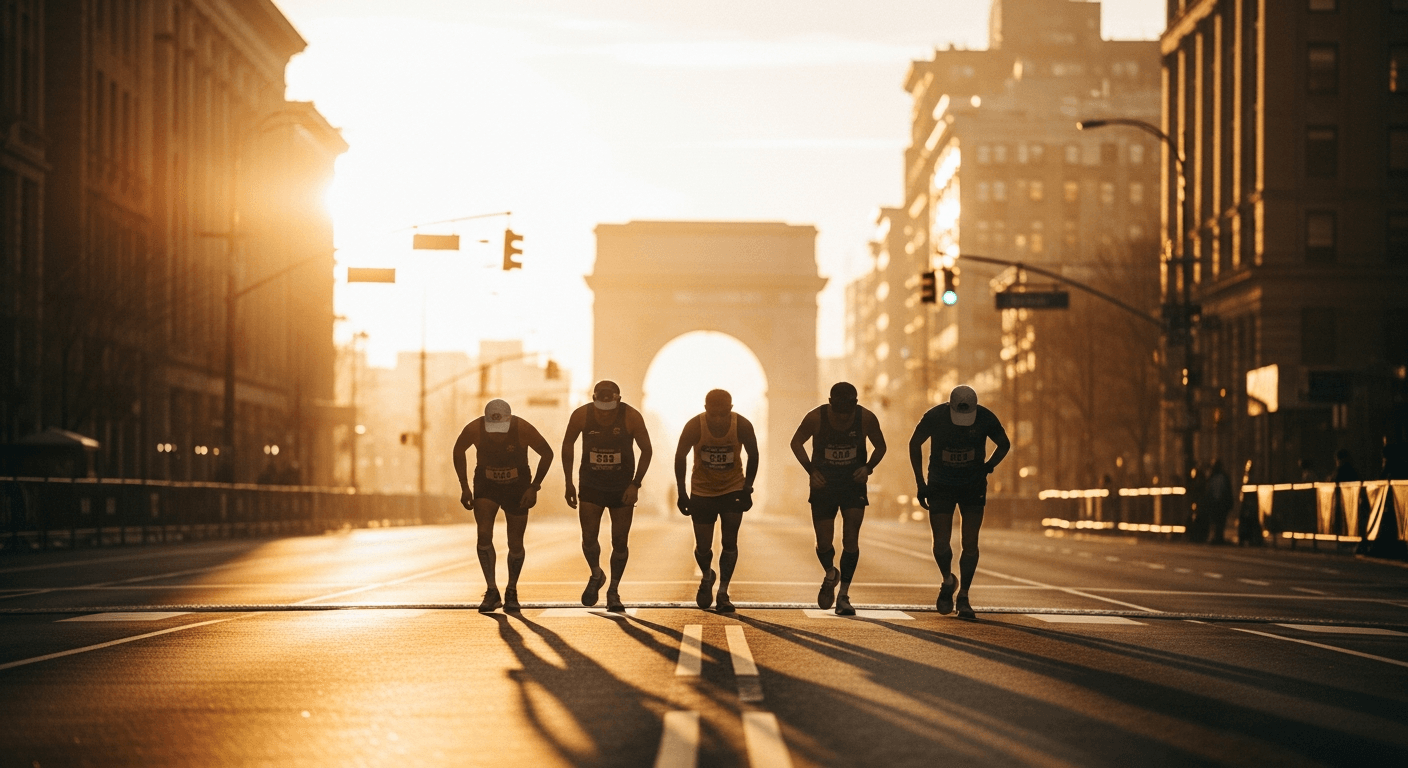
On April 21, 2026, while tens of thousands of runners toed the line in Hopkinton, seven members of the Trail Animals Running Club were already miles into their day. They had started at the finish line on Boylston Street and were running the Boston Marathon course backwards, heading out of the city toward the suburbs. By the time the official gun went off, they would turn around and run it all over again, this time with the crowd.
The result: 52.4 miles completed in a single day, along one of the most iconic road racing routes in the world. No official recognition, no race bib for the first half, no support crew. Just seven runners, a shared goal, and a lot of early-morning miles through the Massachusetts hills.
What Is the Boston Double?
The Boston Double, also known as the Boston Yo Yo, is exactly what it sounds like. You run the 26.2-mile marathon course in reverse, starting at the finish line on Boylston Street and ending in Hopkinton. Then you register for the official race, line up with everyone else, and run the whole thing again in the correct direction.
The challenge is entirely self-organized. The Boston Athletic Association, which operates the official marathon, has no involvement in the Double. There's no registration, no timing mat, no medal for the reverse leg. Participants coordinate among themselves, handle their own logistics, and show up to the start village after covering a full marathon before the race even begins.
That first leg typically starts in the early hours of the morning, long before the roads are closed and the crowds arrive. Runners navigate the course in the dark or at dawn, passing through neighborhoods that won't wake up to race day noise for several hours. It's a strange, quiet version of a course that will later be one of the loudest on earth.
Why the Trail Animals Running Club Does This
The Trail Animals Running Club is a Massachusetts-based group with a long history of pushing endurance events into unconventional territory. The club has built its identity around the idea that running doesn't have to be about pace charts and podium finishes. For many of its members, the point is the experience itself, and the people you share it with.
The seven runners who completed the 2026 Boston Double described the day primarily as a community celebration rather than a personal performance. The reverse leg gives you a different relationship with the course. You see the hills from the other side. You pass the landmarks in a different order. You arrive at the start village having already done the work that everyone else is about to begin.
That contrast, finishing a marathon just as thousands of others are starting theirs, is part of what makes the Double so distinctive. It's not a race against anyone. It's a statement about what you find meaningful in running.
The Physical Reality of 52.4 Miles
Running a double marathon is a serious physiological undertaking. The Boston course is already more demanding than most because of the net elevation profile. The famous Newton Hills, including Heartbreak Hill, appear between miles 16 and 21 in the official race. In the reverse direction, those same hills show up early, when your legs are still relatively fresh but your body hasn't yet fully warmed into the effort.
By the time you reach the official start and join the race, you've already been on your feet for several hours. Your glycogen stores are significantly depleted. Your legs are carrying accumulated fatigue. The second marathon, the one with the official bib, becomes an exercise in managing what's left rather than expressing what you have.
Nutrition and pacing strategy are everything. Runners completing the Double typically eat aggressively during the reverse leg, knowing that the stomach becomes less cooperative as the hours accumulate. Hydration planning matters more than in a standard race. The goal for many isn't a fast finishing time. It's finishing.
For context, elite ultramarathon events like the Marathon des Sables cover far greater distances over multiple days, but the Boston Double compresses the challenge into a single continuous effort on a course most runners already find demanding on its own.
The Self-Supported Nature of the Challenge
One of the defining features of the Boston Double is that it operates entirely outside the official infrastructure. During the reverse leg, you're responsible for your own water, food, and navigation. The aid stations on the course are set up for the official race and aren't operational when Double runners pass through going the other direction.
This is both a logistical challenge and part of the point. Relying on yourself, or on a small group moving together, is a different experience from racing with full support. It asks you to be more self-aware and more intentional about what you carry and when you consume it.
Some participants stash supplies along the route in advance. Others carry everything they need. The reverse leg is slow by design. It's not meant to be run fast. It's meant to be completed with enough left in reserve to actually finish the official race.
A Community Celebration, Not a Competition
Boston Marathon day in Massachusetts is something larger than a road race. It's a public holiday in the state, Patriots' Day, and the communities along the route have been hosting spectators for over a century. The towns of Hopkinton, Ashland, Natick, Wellesley, Newton, and Brookline all become part of the event in ways that feel genuinely rooted in local identity.
For the Trail Animals runners, the Double is a way of immersing yourself in that culture more completely than a standard race entry allows. You're on the course longer. You see more of the day. You interact with the communities along the route at different moments and in different directions.
The official race itself brings its own energy. The 2026 edition delivered remarkable performances across the board, and if you followed Boston 2026's top results including Sharon Lokedi's repeat win and Marcel Hug's record-extending ninth title, you already know the day produced headlines at the front of the pack. For the Double runners, the front of the pack is almost irrelevant. They're there for something else entirely.
That separation of purpose, competing at the elite level versus participating for meaning, is one of the things that makes the broader running world so interesting right now. The sport holds space for both.
Who Is the Boston Double For?
The honest answer is that it's for a very specific kind of runner. You need a legitimate qualifier for the official race, which at Boston means meeting age-graded time standards that are among the strictest in road racing. You also need a serious ultramarathon base or at minimum a history of running well beyond the marathon distance.
Completing the reverse leg on tired legs, then running an official qualifier-level race, is not something you stumble into. The Trail Animals members who did this in 2026 brought years of high-volume training to the attempt. That's not a barrier meant to discourage interest. It's a description of what the challenge actually requires.
If you're earlier in your running journey, it's worth understanding what sustained endurance training looks like before setting your sights on something like this. Building your aerobic base progressively, learning how your body responds to back-to-back long efforts, and developing a nutrition strategy that holds up over many hours are all prerequisites. The men's race highlights from Boston 2026 offer a reminder of just how demanding the standard course is when run at full effort.
Running as Something More Than Sport
What the Trail Animals Running Club is doing with the Boston Double is something that the broader endurance world keeps returning to. As official races grow larger and more logistically complex, informal challenges like this one create space for a different kind of participation.
You don't need a governing body's approval to do something difficult. You don't need a finisher's medal to make an experience meaningful. Seven people deciding to run 52.4 miles together, through a city waking up to marathon day, is its own complete thing.
The running world is producing remarkable stories right now across every format, from humanoid robots pushing the boundaries of what's possible in a half-marathon in Beijing to course records falling at major city races worldwide. Against that backdrop, the Boston Double is a reminder that some of the most compelling stories in running involve ordinary people doing extraordinary things with no audience required.
Seven runners. 52.4 miles. One long day in Massachusetts. That's the Boston Double.