
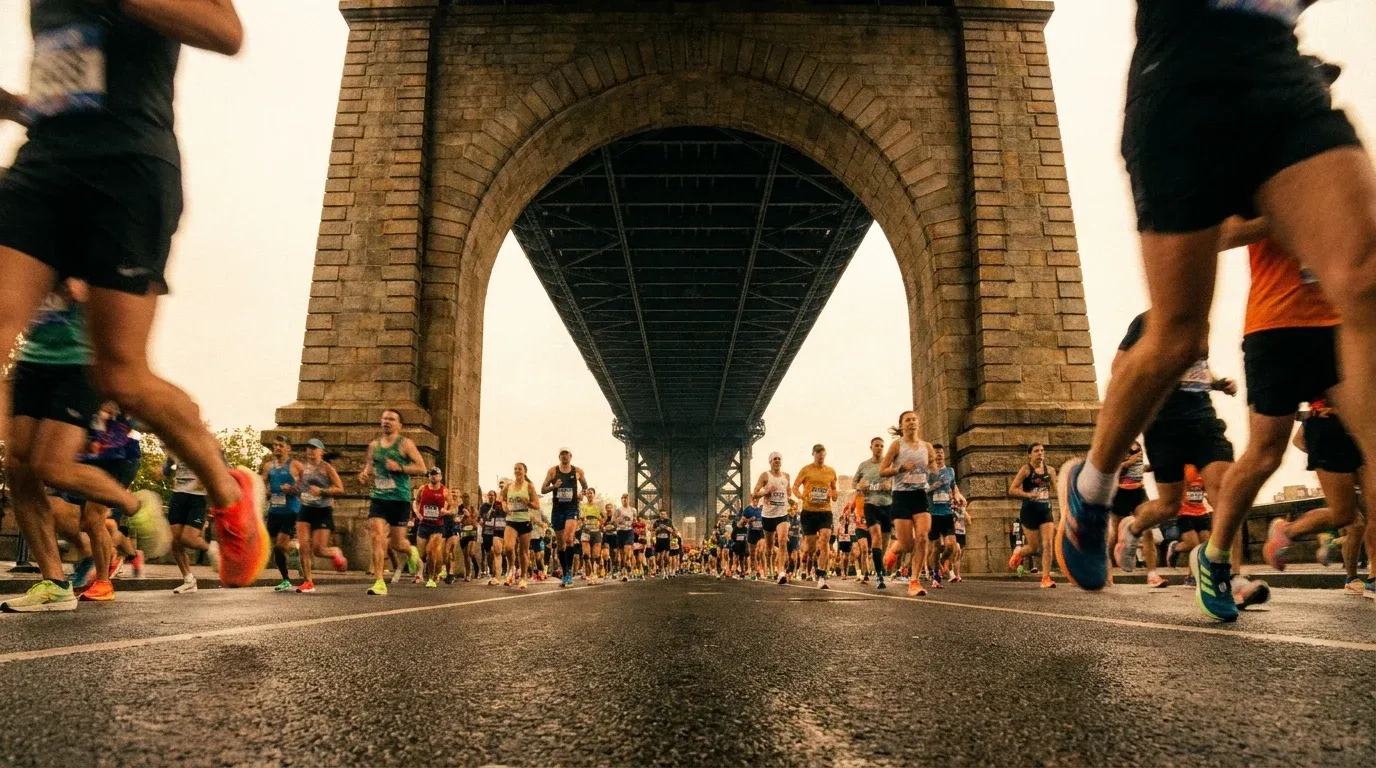
Numbers don't always tell the full story. But sometimes, they come close. When the final runner crossed the finish line in Central Park at the 2026 TCS New York City Marathon, the official tally read 61,146 finishers. A new world record. The third consecutive year the race had broken its own mark. And the punctuation on what may be the most significant edition in the event's history.
This wasn't just a bigger race. It was a genuinely different one.
Three Years in a Row: What the Numbers Actually Mean
The 2024 edition set a world record. The 2025 edition broke it. Now 2026 has done it again. That kind of sustained growth isn't accidental, and it doesn't happen in a vacuum. It reflects a sport that continues to expand its global reach, a city that has refined its capacity to host mass participation events, and an organizing body in New York Road Runners (NYRR) that has quietly become one of the most effective race management operations in the world.
To put 61,146 finishers in context: that's roughly the population of a small city crossing one finish line in a single day. It's more than double the field size of many other World Marathon Majors. And it's a figure that raises immediate, legitimate questions about what comes next.
For now, though, the record stands. And the running community is still processing what it means.
Fifty Years Across Five Boroughs
The 2026 edition carried extra weight before a single runner crossed the Verrazzano-Narrows Bridge. This year marked the 50th anniversary of the five-borough course format, first introduced in 1976 when the race expanded from a loop around Central Park to its now-iconic route through Staten Island, Brooklyn, Queens, the Bronx, and Manhattan.
That transformation turned a local event into a civic institution. It threaded a race through neighborhoods that rarely share space, through communities that cheer in dozens of languages, through a city that is, in many ways, a world unto itself. Fifty years later, that original vision looks less like a logistical gamble and more like one of the best decisions in the history of endurance sports.
Race organizers marked the anniversary with archival activations along the course, historical mile markers, and tributes to the athletes and volunteers who built the race's identity across five decades. It wasn't nostalgia for its own sake. It was context. And it made the record-breaking attendance feel earned rather than arbitrary.
The Winners: A Debut for the History Books and a Champion's Return
On the men's side, Swedish runner Andreas Almgren did something that almost never happens at this level. He won a World Marathon Major on his debut at the distance. If you want to understand just how rare that is, the variables involved, the experience gap, the pacing risk, the pressure of a global stage, this breakdown of what it takes to win a World Major on your marathon debut puts it in sharp relief.
Almgren ran a controlled, tactical race through the five boroughs and held his form through the final push into Central Park. His time was competitive at the elite level and his composure throughout suggested a runner who had prepared with unusual precision. Expect to hear his name again.
On the women's side, Kenya's Sheila Chepkirui claimed her second NYC Marathon title, confirming what her first win had already suggested: she runs this course better than almost anyone alive. Chepkirui's ability to manage the technical demands of the five-borough route, the bridges, the crowds, the relentless pace changes, makes her a different kind of champion from those who excel on flat, fast courses. New York suits her, and she suits New York.
153 Countries: The Most Global Race on Earth
The NYC Marathon has long marketed itself as the world's most international race. In 2026, that claim has harder data behind it. Runners from 153 countries crossed the finish line, a figure that covers nearly every nation with an active athletics federation.
That breadth of representation matters for reasons beyond optics. It reflects the globalization of recreational running as a sport, the rise of bucket-list marathon culture across Asia, the Middle East, and Latin America, and the specific gravitational pull that New York exerts as a destination race. For many international runners, finishing NYC isn't just a personal achievement. It's a travel event, a cultural experience, and in some countries, a genuine status marker within their local running communities.
The race's charity fundraising operation reflects this global reach too. The 2026 edition raised record sums through its charity entry program, with a full breakdown of how the race broke both its finisher record and its charity fundraising goal simultaneously showing just how intertwined participation and philanthropy have become at this scale.
The Harder Questions: Ballots, Crowding, and the Future of Mass Participation
Here's where the conversation gets more complicated. The NYC Marathon's growth is impressive. It's also generating friction within the running community that's worth taking seriously.
Entry through the standard lottery now operates with acceptance rates that make it one of the hardest sporting events in the world to access. Hundreds of thousands of runners apply each year. Most are rejected. Many turn to charity entries, which require fundraising minimums that can reach $3,000 or more. Time-qualifying entries exist but demand standards that exclude the majority of recreational runners. And international runners often pay significant race week costs on top of travel, with hotels and registration fees in New York routinely pushing total trip budgets well above $2,500.
Meanwhile, on the course itself, 61,000-plus runners create conditions that are, by any honest measure, extremely crowded through the first several miles. The Verrazzano-Narrows Bridge start is managed in waves, but the density in Brooklyn during the opening miles can make it difficult for mid-pack runners to find a sustainable rhythm. That's not a complaint. It's a structural reality of a field this size on a course that, however iconic, was not designed for 60,000 runners.
Some runners have started to ask whether the experience of running NYC has changed in ways that matter. Whether a finish line record is worth celebrating if the journey to it has become more logistically taxing and less personally meaningful. These aren't fringe concerns. They reflect a broader tension in the World Marathon Majors ecosystem between growth, access, and quality of experience.
It's a tension that shows up in other marquee events too. The challenges around Hong Kong's first Northern Metropolis Marathon showed how quickly large-scale ambition can run ahead of execution. And the Nice-Cannes Marathon's record 25,000-runner edition in 2026 demonstrated that regional races are increasingly competing for the same energy and appetite that once flowed exclusively toward the Majors.
What You're Actually Signing Up For
If you're thinking about applying for the 2027 NYC Marathon, here's what you should know going in. The race is genuinely extraordinary. The crowd support across five boroughs is unlike anything in endurance sports. The final stretch through Central Park, regardless of how tired you are, delivers. The medal means something.
But you're also committing to a training cycle that demands real structure. Marathon preparation at this level, even for recreational runners, involves months of consistent mileage, strength work, and recovery management. The question of how hard you should actually be training isn't rhetorical. Training too aggressively in the buildup to a race this size is one of the most common ways runners arrive at the start line already compromised.
Nutrition strategy matters too, particularly around race week fueling and caffeine timing. The science around caffeine dosing for endurance performance is worth reviewing before you decide what to take on race morning. Getting that wrong on a 26.2-mile course through five boroughs is a costly mistake.
A Record That Earns Its Moment
61,146 finishers. 153 countries. 50 years across five boroughs. A debut men's champion. A women's champion defending her crown on the hardest major course in the world.
The 2026 NYC Marathon was historic not because a number got bigger, but because nearly everything aligned at once. The growth felt purposeful. The anniversary felt resonant. The winners felt worthy of the stage. And the city, as it tends to do, showed up.
The questions that follow, about access, about crowding, about what a world major owes its field, are real and deserve honest answers. But they don't diminish what happened on those five boroughs on that Sunday in November. They make it more interesting. Because a race this size, with this much at stake for this many people, should generate exactly this kind of conversation.
That's not a problem. That's what it looks like when running matters.