

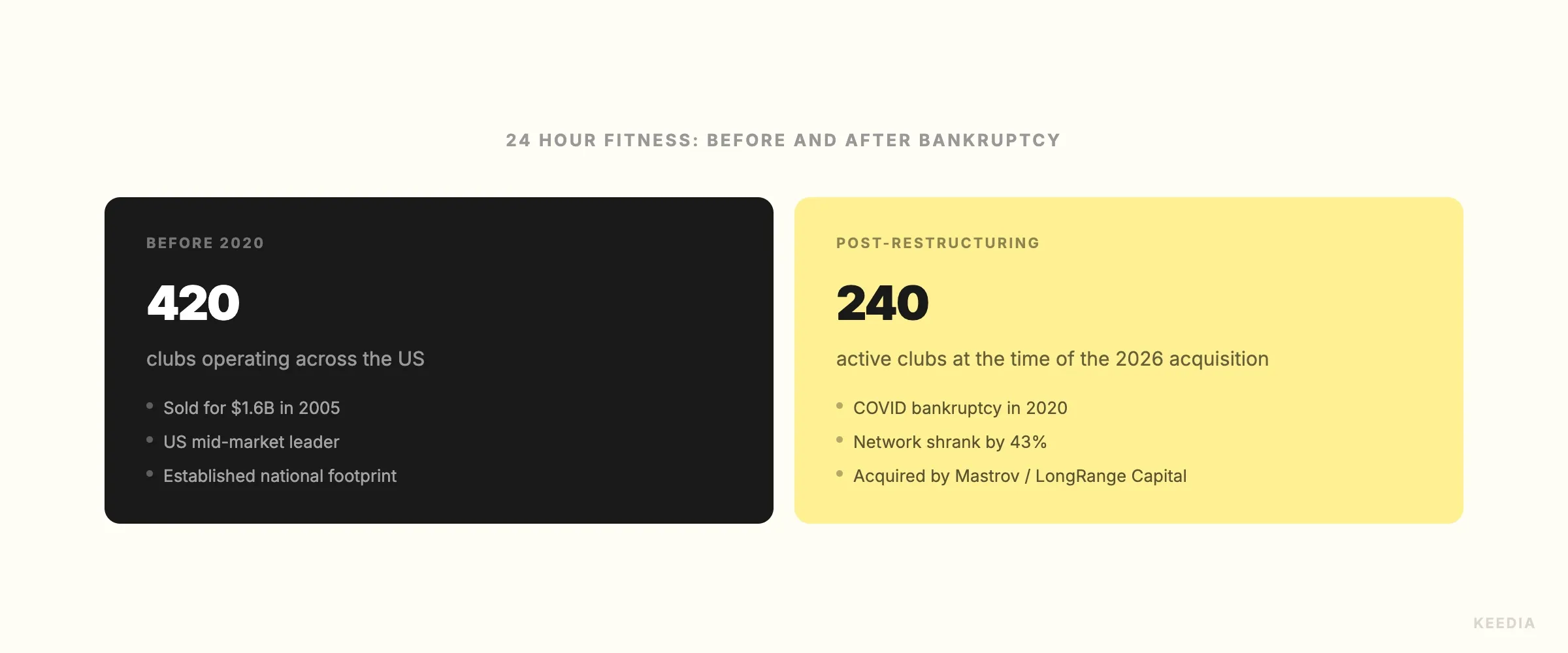
Mark Mastrov built 24 Hour Fitness from a single club into a 420-location national chain. He sold it in 2005 for $1.6 billion. Two decades later, he's buying it back. The chain he created went bankrupt in 2020, shrank by nearly half, and spent years in the hands of distressed-debt investors. Now Mastrov returns as executive chair with a turnaround mandate and a franchise playbook already proven at Crunch Fitness.
This isn't just an M&A story. It's a case study in brand positioning, market bifurcation, and what actually works when a mid-market gym operator loses its footing.
The Deal: What Happened and Who's Involved
In January 2026, Mastrov and LongRange Capital completed the acquisition of 24 Hour Fitness. Mastrov steps back in as executive chair, roughly 20 years after exiting the business he founded. The chain's previous owners. Monarch Alternative Capital, Sculptor Capital, and Keyframe Capital Partners. had held the company through its post-bankruptcy recovery period after taking control when the chain filed for Chapter 11 in June 2020.
The bankruptcy was direct COVID fallout. 24 Hour Fitness closed all locations during lockdowns, then permanently shuttered roughly 130 clubs as it restructured. It emerged from bankruptcy with around 240 locations and a leaner balance sheet, but without a clear growth strategy or refreshed brand identity. That's the situation Mastrov is inheriting.
From 1 Club to 420: What Mastrov Built the First Time
Mastrov opened his first gym in the San Francisco Bay Area in 1983. By the time he sold to Forstmann Little in 2005, 24 Hour Fitness was one of the largest gym chains in the United States. The growth was built on a simple value proposition: full-service clubs with extended hours at a price point accessible to working adults. It occupied the middle of the market, below luxury and above budget, and that worked well through the 1990s and early 2000s.
After the sale, Mastrov didn't step away from the industry. In 2009, he acquired Crunch Fitness, which at the time had a handful of locations concentrated in New York. Over the following 15 years, he expanded it to more than 550 locations nationwide, selling the chain in 2025. The mechanism wasn't a corporate-owned rollout. It was a franchise model, systematically distributing growth risk while accelerating geographic reach.
That distinction matters enormously for what comes next at 24 Hour Fitness.
The Crunch Playbook: Franchise Expansion Over Corporate Control
Crunch's expansion under Mastrov is worth studying carefully if you're trying to understand his intentions for 24 Hour Fitness. The chain grew not by building and operating hundreds of corporate-owned locations, which requires enormous capital and creates fixed-cost exposure, but by franchising to regional operators who know their local markets.
Franchise models shift the capital expenditure to franchisees, keep the brand's corporate structure lean, and allow faster market penetration. The tradeoff is quality control and brand consistency, which is why the franchisor's playbook, training infrastructure, and brand standards have to be airtight. Crunch managed this with a positioning that was clear: high-energy, unapologetically non-intimidating, and priced accessibly. Members knew exactly what they were walking into.
If Mastrov applies a similar framework to 24 Hour Fitness, expect a franchise conversion strategy for new locations, tighter brand repositioning, and possibly a tiered club format that can serve different density markets. He has also previously developed NFL-branded gym concepts, which could resurface as a partnership or licensing play to differentiate 24 Hour clubs from generic mid-market competitors.

Why the Mid-Market Model Is Structurally Under Pressure
Here's the harder problem Mastrov is walking into. The segment 24 Hour Fitness occupies, full-service gyms priced somewhere between $30 and $60 per month, is the most competitively stressed tier in the US fitness market right now.
From below, budget chains have taken enormous market share. Planet Fitness now operates over 2,400 locations with membership fees starting at $10 per month. EōS Fitness competes at $10 to $25 per month with larger, newer facilities. These chains don't pretend to offer everything. They undercut on price and win on accessibility and volume.
From above, premium boutique studios have captured the high-intent, high-spending consumer. Barry's, CorePower Yoga, and Orangetheory all charge $100 to $300 per month or more. They sell specificity: a defined workout type, a community, an identity. Members don't just buy fitness. They buy belonging to something with a clear point of view.
The mid-market gym sits in between and increasingly struggles to offer a compelling answer to either group. It's not cheap enough to win on price, and it's not specialized enough to justify premium pricing. Gym retention metrics from 2026 confirm that mid-market clubs consistently show higher churn than both budget and boutique operators, which makes member acquisition costs unsustainable over time.
This bifurcation isn't new, but it has accelerated. The pandemic reshuffled consumer habits, and the members who came back to gyms post-2020 largely sorted themselves into one of two camps: price-driven or experience-driven. The middle kept shrinking.
What a Turnaround Actually Requires
Buying a distressed mid-market gym chain and returning it to growth requires more than operational efficiency. It requires a clear answer to a question your members are implicitly asking: why here instead of the $10 gym down the street or the boutique studio that charges $150 a month and knows your name?
Mastrov's stated goal is to accelerate growth and reinvent the brand. Those two objectives can pull in opposite directions if you're not careful. Accelerating growth through franchising means getting a lot of operators aligned on a brand standard that doesn't yet fully exist. Reinventing the brand takes time, research, and iterative testing across markets that look nothing like each other.
The Crunch model worked in part because the brand identity was tight and the consumer was well-defined. 24 Hour Fitness is starting from a more diffuse brand memory. For consumers who remember it, the association is reliable and affordable but not exciting. That's not a terrible starting point, but it needs sharpening.
One area where mid-market clubs can genuinely compete is programming depth. Budget gyms offer equipment access and nothing else. Boutique studios offer one format, done very well. A full-service mid-market club can theoretically offer strength training infrastructure, group fitness, recovery zones, and coaching support under one roof at a reasonable monthly price. The challenge is executing all of those well enough to justify the price premium over budget alternatives. This connects directly to what operators offer members in terms of training education and results. The Les Mills and Life Fitness connected equipment partnership points to where group fitness programming inside larger clubs is heading, and mid-market operators who ignore connected and on-demand class integration are ceding ground they can't afford to lose.
Member retention is the other lever. Acquiring members is expensive. Keeping them past the critical 90-day window is where profitability lives or dies. Understanding what triggers churn in the first 90 days is as relevant for a gym chain's membership team as it is for an individual coach. Mastrov will need a retention infrastructure that goes beyond app check-ins and email campaigns.
What Gym Operators Can Learn From This
If you operate a gym or fitness franchise at any scale, the 24 Hour Fitness trajectory carries real lessons. The chain's decline wasn't primarily a COVID story. COVID was the accelerant. The structural vulnerability was already there: a brand without a clear tier identity in a market that was increasingly sorting itself into distinct tiers.
Chains that knew exactly who they were serving held up better through the disruption. Budget operators competed on price and won. Boutique studios competed on experience and community and retained high-value members who could afford to keep paying. 24 Hour Fitness competed on familiarity and convenience. Those are weaker anchors when alternatives multiply.
The franchise model Mastrov used at Crunch also offers a lesson for independent operators thinking about growth. Franchising isn't only for massive chains. The Workout Anytime franchise model demonstrates how a focused concept can scale into smaller markets that corporate chains overlook, a strategy that rewards brand clarity and operational simplicity over footprint size.
For any gym operator watching this acquisition, the practical question is the same one Mastrov is now answering at scale: what is your gym for, who is it for, and is that answer clear enough that a prospective member can feel it within five minutes of walking in?
The Road Ahead for 24 Hour Fitness
Mastrov has done this before, at smaller scale with Crunch and at larger scale with 24 Hour Fitness itself in its original growth phase. He understands the operational mechanics of multi-location gym management and the franchise economics that drive scalable expansion. That's not nothing. Many turnaround attempts fail because the incoming leadership understands finance but not fitness operations.
The harder variable is timing. The mid-market segment isn't waiting for 24 Hour Fitness to find its footing. Planet Fitness is still opening locations. Boutique studios are expanding beyond urban cores into suburban markets that 24 Hour Fitness has historically owned. The window to define a differentiated position is open, but it won't stay open indefinitely.
Watch for franchise announcements, brand refresh initiatives, and any NFL or sports partnership plays in the next 12 to 18 months. Those signals will tell you whether this is a genuine reinvention or a financial restructuring dressed up as one. Mastrov has earned enough credibility to deserve the benefit of the doubt. The market, as usual, won't wait long to render its own verdict.