
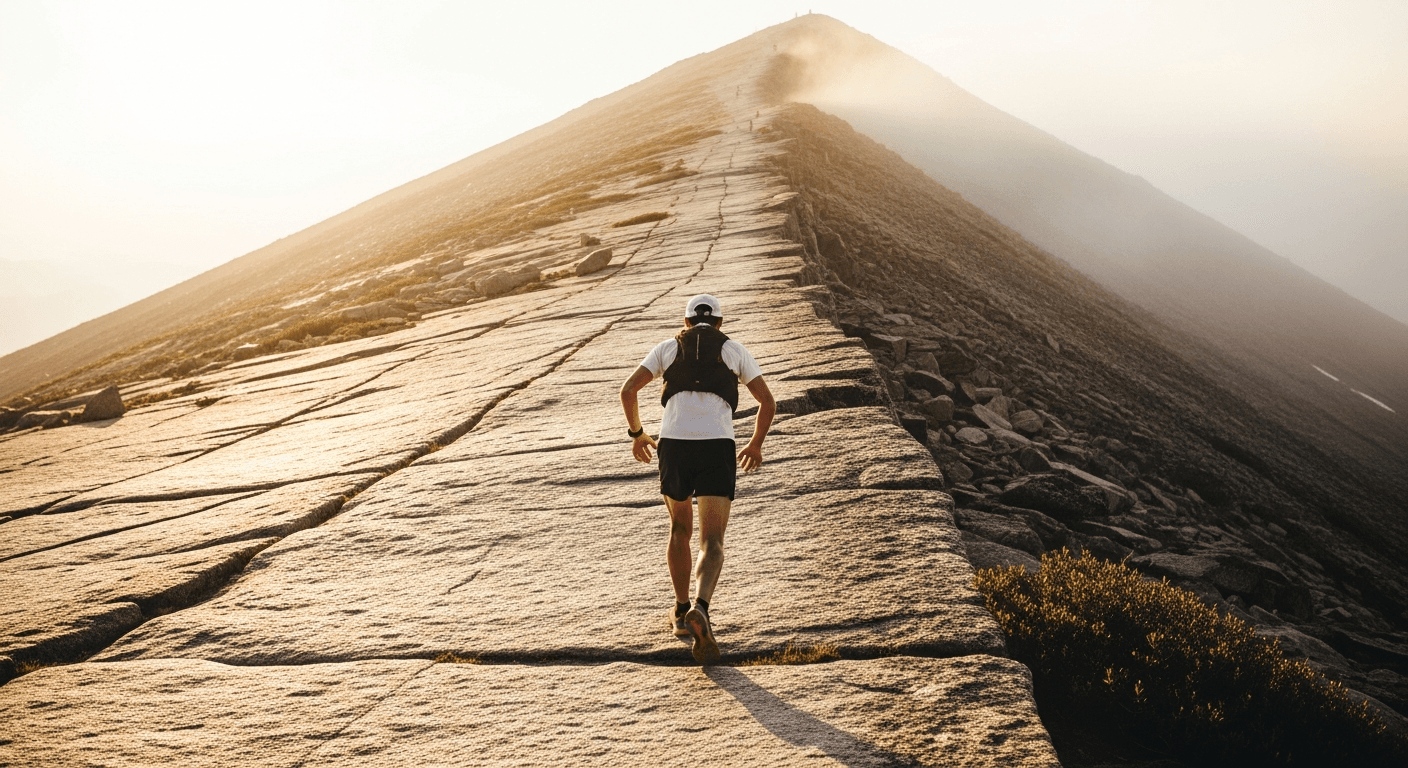
Meikael Beaudoin-Rousseau crossed the finish line at the summit of Mount Washington in 59 minutes and 52 seconds on June 21, 2025, becoming the first runner to break the one-hour mark at this race since 2017. The performance came at the 65th Delta Dental Mount Washington Road Race, and it sent a clear message through the trail running community: a new uphill specialist has arrived.
Sub-60 at Mount Washington isn't just a round number. It's the kind of benchmark that separates elite mountain runners from everyone else. The fact that no one had done it in eight years tells you everything about how hard that barrier is to crack.
What Makes Mount Washington So Brutal
The numbers alone are enough to make most runners uncomfortable. The course covers 7.6 miles and climbs 4,727 feet from the base to the summit, giving it an average gradient of roughly 12 percent. But averages don't tell the full story. Sections of the Auto Road push into 18 to 22 percent grades, the kind of incline where your running form breaks down and your lungs start negotiating with your legs.
Mount Washington holds a well-earned reputation as the home of the world's worst weather. The summit sits at 6,288 feet and sits at the intersection of three major storm tracks, which means conditions can change from manageable to genuinely dangerous within minutes. Wind gusts above 100 mph have been recorded during race week. On a calm day, it's still cold enough at the top to require a jacket at the finish line.
Race organizers monitor conditions closely and have cancelled or significantly altered the event in the past. When athletes line up at the base, they're committing to a climb where the finish line might be shrouded in cloud, battered by wind, or both. That unpredictability is baked into the challenge. You can train for the gradient, but you can't fully train for what the mountain decides to throw at you on race day.
If you've been following the surge in extreme weather running events and want to understand how heat, cold, and altitude affect your output, the science behind heat and running performance offers a useful starting point for understanding how your body adapts to environmental stress.
The 59:52 Breakdown
Beaudoin-Rousseau, a Canadian trail runner who competes regularly on the North American ultra and mountain circuit, executed what anyone familiar with the course would describe as a nearly perfect race. Breaking sub-60 requires you to average just under 7 minutes and 54 seconds per mile up a mountain. That's not a pace that allows for tactical errors.
He went through the early miles conservatively enough to preserve something for the upper sections, where the road kicks up sharply and oxygen becomes a negotiable commodity. By the steepest sections of the course, where most runners are hiking or close to it, he kept running. That's the defining difference between a sub-60 effort and a very good finish. The ability to maintain forward momentum when everything in your body is telling you to walk is what separates performances in this range from the rest of the field.
His finishing time of 59:52 puts him in rare company. The course record, set by Jonathan Wyatt in 2002, stands at 56:41. Only a handful of runners in the race's 65-year history have gone under one hour. Beaudoin-Rousseau now belongs to that group.
What This Means for His Career
This result doesn't come out of nowhere. Beaudoin-Rousseau has been building steadily on the North American mountain and trail scene, accumulating results that suggested this kind of performance was within reach. But there's a difference between being a strong mountain runner and being the kind of athlete who breaks barriers that have stood for eight years.
This performance cements him as one of the top uphill specialists on the continent. Mountain running occupies a specific niche within trail running. It rewards a physiology built for sustained power output at low cadence, a high lactate threshold, and an unusual tolerance for prolonged discomfort. Athletes who excel here often don't translate directly to flat ultras, and vice versa. Beaudoin-Rousseau's result signals that his particular combination of aerobic engine and technical running ability is well-suited to the most demanding vertical races on the calendar.
For context on the broader landscape of elite performances this season, the 2026 Western States 100 results showed just how deep the talent pool in North American trail running has become across multiple disciplines.
The Training Demands Behind a Sub-60 Effort
You don't break one hour at Mount Washington by accident. The training required for this kind of performance is specialized, high-volume, and unforgiving. Athletes targeting this race typically spend months building vertical gain into their weekly schedule, running repeats on the steepest hills available and incorporating treadmill sessions at maximum incline when outdoor terrain is limited.
The muscular demands of sustained uphill running are distinct from flat road or even standard trail training. Your glutes, hip flexors, and calves absorb force differently on steep grades. The cardiovascular ceiling gets tested in ways that flat running can't replicate. Altitude exposure, whether through training camps or simulated protocols, adds another layer of preparation for races that finish close to or above 6,000 feet.
Recovery nutrition plays a critical role when training loads are this high. Athletes doing this kind of volume need consistent protein intake, not just around workouts but distributed across the full day to support muscle repair. The research on protein distribution for active adults is increasingly clear on this point. Protein timing and distribution for active adults breaks down what the current science shows about how to structure your intake for maximum muscle synthesis under heavy training loads.
And the quality of the protein you're consuming matters just as much as the quantity. Not all sources are created equal, and understanding the difference can shift how you approach fueling during heavy training blocks. How the DIAAS score changes the way you count your protein grams is worth understanding if you're serious about recovery.
The Race Itself: 65 Years of History
The Mount Washington Road Race has been run since 1936, with the modern competitive version taking shape in 1960. It's one of the oldest mountain races in North America and draws a mix of elite mountain runners, competitive age groupers, and athletes who simply want to say they made it to the top. The field is capped and entry is competitive. Qualifying standards apply to the faster runners, and a lottery system manages the broader field.
What makes the race culturally significant in trail running goes beyond the numbers. It's a point-to-point course with no descending. Every step from start to finish is upward. That simplicity creates a purity of effort that appeals to athletes who want a clear, unambiguous test. You can't make up time on the downhill. You can't rely on technical skills or descending ability. It's entirely about how much power you can sustain over vertical terrain.
The race also sits within the broader context of sky running and mountain running as disciplines that are growing globally. Events like this one attract attention from European mountain runners, USATF mountain running team selectors, and coaches building programs around altitude and vertical specialists. A sub-60 at Mount Washington travels well as a credential in that world.
What You Can Take From This
Most people reading this aren't going to line up at the bottom of Mount Washington's Auto Road. But the lessons embedded in Beaudoin-Rousseau's performance are applicable at every level of running.
Specificity matters. Training that matches the demands of your target race produces better results than general fitness work. Patience builds the kind of aerobic base that allows you to sustain hard efforts for nearly an hour on a 12 percent average grade. And mental frameworks around discomfort, specifically the ability to keep moving when the effort feels impossible, determine outcomes as much as fitness does.
The other takeaway is that records in mountain running tend to stand for a long time because so few athletes are willing to dedicate themselves to a discipline that's as hard to train for as it is to race. When someone like Beaudoin-Rousseau finally breaks through, it usually reflects years of deliberate, unglamorous work. That's worth paying attention to, regardless of what you're training for.
At 59:52, he didn't just break a benchmark. He reset what's considered possible at one of North America's most respected and feared mountain races, and he did it on a course that has been humbling elite runners for more than six decades.